
OpenOCD
On-chip JTAG debug and programming tool
OpenOCD provides JTAG-based programming, flashing, and source-level debugging for embedded targets, exposed through telnet, Tcl, and GDB server interfaces.

Multi-node embedded system simulation and virtual development
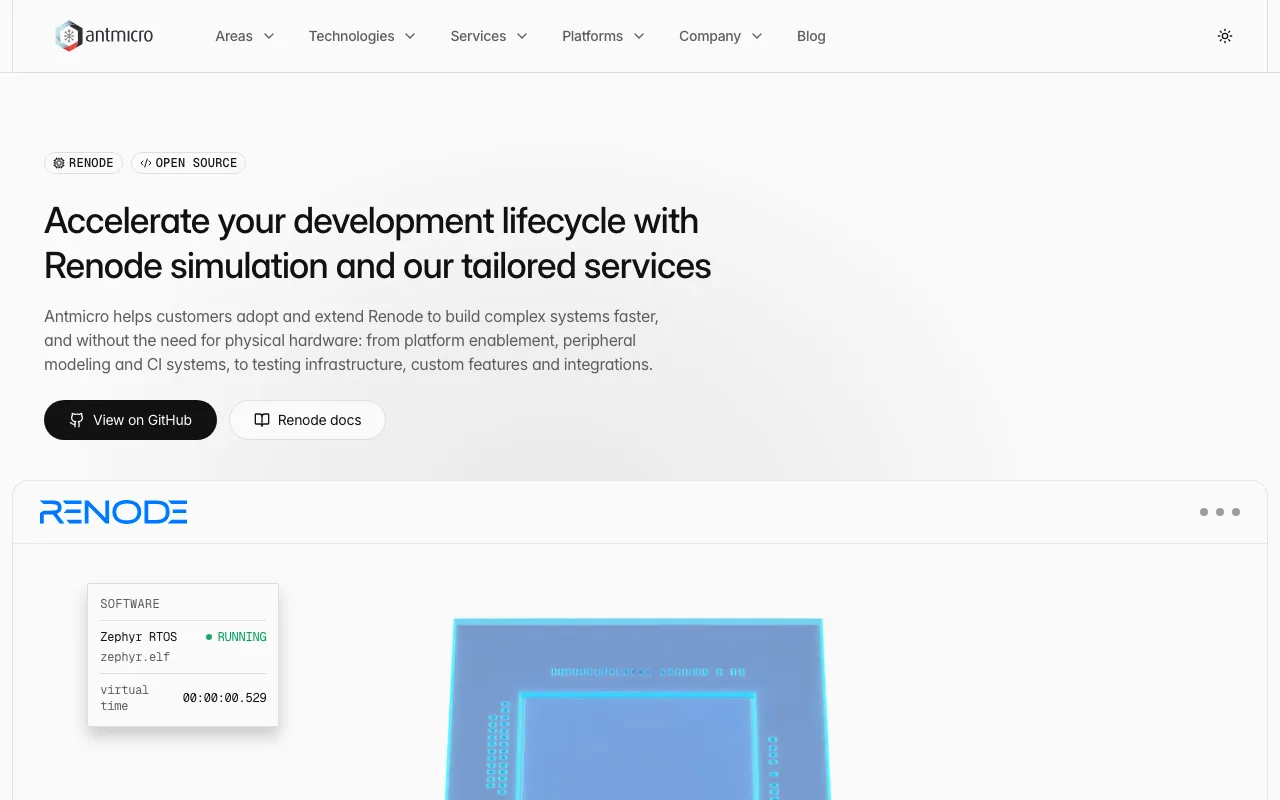
Renode simulates embedded boards, SoCs, and networks so unmodified firmware runs without hardware. Antmicro built it for IoT development, testing, and debugging.
Renode is Antmicro’s open source framework for simulating complex embedded systems. It targets multi-node wired and wireless networks and lets teams develop, test, debug, and simulate unmodified software for IoT devices in a virtual environment rather than on physical boards.
Supported CPU families include ARM Cortex-A, R, and M, x86 and x86-64, RISC-V, SPARC, POWER, Xtensa, and MSP430X. Beyond cores, it models whole SoCs with peripherals and links between nodes so production-like software stacks can run and interact.
Install via nightly or stable packages for Linux, macOS, and Windows, including portable archives, distro packages, Homebrew taps, and Docker images on Docker Hub. Running renode starts a monitor UI; optional startup scripts and Robot Framework integration support automated test cases. Python helpers such as renode-run and pyrenode3 wrap common launch and control flows.
Use cases described publicly span pre-silicon firmware work, CI-driven board validation, mesh radio simulation, and integrations with vendor platforms. Commercial support and custom platform work are offered by Antmicro, the framework maintainer.
On-chip JTAG debug and programming tool
OpenOCD provides JTAG-based programming, flashing, and source-level debugging for embedded targets, exposed through telnet, Tcl, and GDB server interfaces.

WiFi CSI spatial sensing without cameras
RuView turns WiFi channel state into presence, motion, breathing, heart rate, and activity signals using low-cost ESP32 nodes. Processing can stay on edge hardware with optional visualization and smart-home bridges.

Cross-browser web automation and testing framework
Playwright drives Chromium, Firefox, and WebKit through one API for tests, scripts, and agent-driven browser control.

JavaScript library for automating Chrome and Firefox
Puppeteer exposes a high-level JavaScript API to drive Chrome or Firefox through the DevTools Protocol or WebDriver BiDi. It defaults to headless browser control for scripts and tests.

Local-first open home automation platform
Home Assistant connects smart home devices and services for local control and privacy. It suits Raspberry Pi or a server at home, with companion apps for phones and watches.

Isolated workshop for UI components and pages
Storybook runs a local dev workshop where teams build, test, and document components in isolation. It integrates with major frontend frameworks and addons for docs, accessibility, visual review, and agent tooling.