
MarkItDown
Python utility converting office and media files to Markdown
MarkItDown converts many file types into Markdown for LLM and text analysis pipelines. It aims to preserve headings, lists, tables, and links rather than perfect human layout.

Pure Python toolkit for RDF graphs and SPARQL
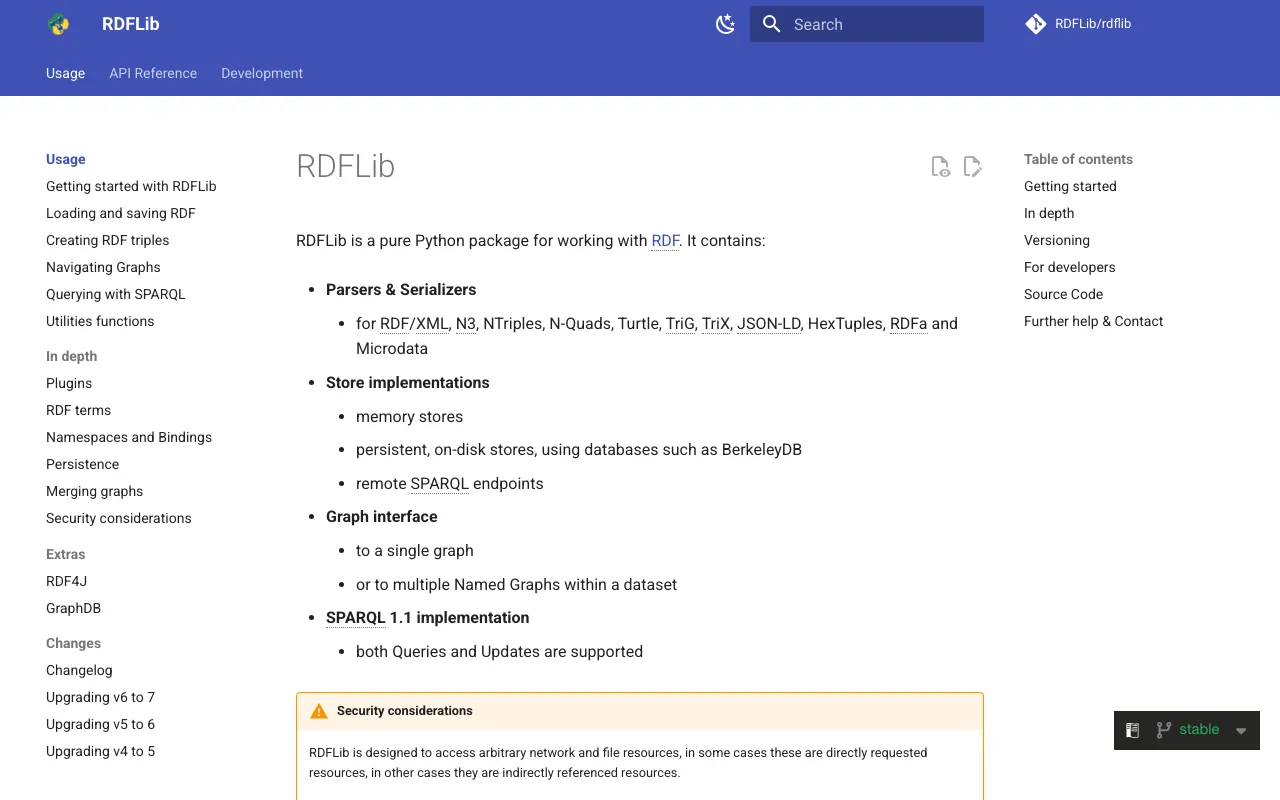
RDFLib is a Python package for parsing, storing, and querying RDF. It includes serializers, in-memory and persistent stores, and SPARQL 1.1 support.
RDFLib helps Python developers work with Resource Description Framework data for semantic web and linked-data projects. The central Graph type holds subject–predicate–object triples and can be populated by parsers or programmatic triple insertion using namespace-aware URIs and typed literals.
Built-in parsers and serializers cover RDF/XML, Turtle, N-Triples, N-Quads, N3, TriG, TriX, JSON-LD, HexTuples, RDFa, and Microdata. Namespace helpers shorten common vocabularies, and binding prefixes affects serialized output across major syntaxes.
Storage backends include in-memory graphs, Berkeley DB persistence, and remote SPARQL endpoints, with additional stores available through plugins. A SPARQL 1.1 engine supports query and update operations plus extension hooks for custom functions.
Installable from PyPI via pip, with optional extras for BerkeleyDB, NetworkX, HTML, lxml, or orjson integrations. Documentation warns that processing untrusted RDF may trigger file or network access, so callers should apply appropriate restrictions. Related packages in the RDFLib organization extend specific integrations such as GraphDB or RDF4J clients.
Python utility converting office and media files to Markdown
MarkItDown converts many file types into Markdown for LLM and text analysis pipelines. It aims to preserve headings, lists, tables, and links rather than perfect human layout.

Open-source data integration platform for analysts, quants and AI agents
Open Data Platform (ODP) by OpenBB connects proprietary, licensed and public data sources once, then exposes them to Python, OpenBB Workspace, Excel, MCP servers for AI agents, and REST APIs.

Document parsing toolkit for generative AI pipelines
Docling ingests PDFs, office files, media, email, and many other formats into a unified document model. It targets downstream RAG and agent workflows with local execution options.

Python data structures for labeled analysis
pandas is a Python package for working with labeled, tabular, and time-series data. It provides Series and DataFrame objects with alignment, grouping, and rich import and export options.
Open RSS feed network with community-maintained routes
RSSHub aggregates content from many online sources into RSS feeds and is maintained as an open source project with a large network of deployed instances.
Portable command-line JSON processor
jq slices, filters, maps, and transforms JSON from the shell. It is a standalone C binary with no runtime dependencies, plus an online playground and optional Docker image.