Astro
JavaScript web framework for content-driven sites
Astro builds content sites, web apps, and server APIs with server-first rendering, optional UI islands, and integrations for major frameworks.

Resumable web framework for minimal JavaScript page loads
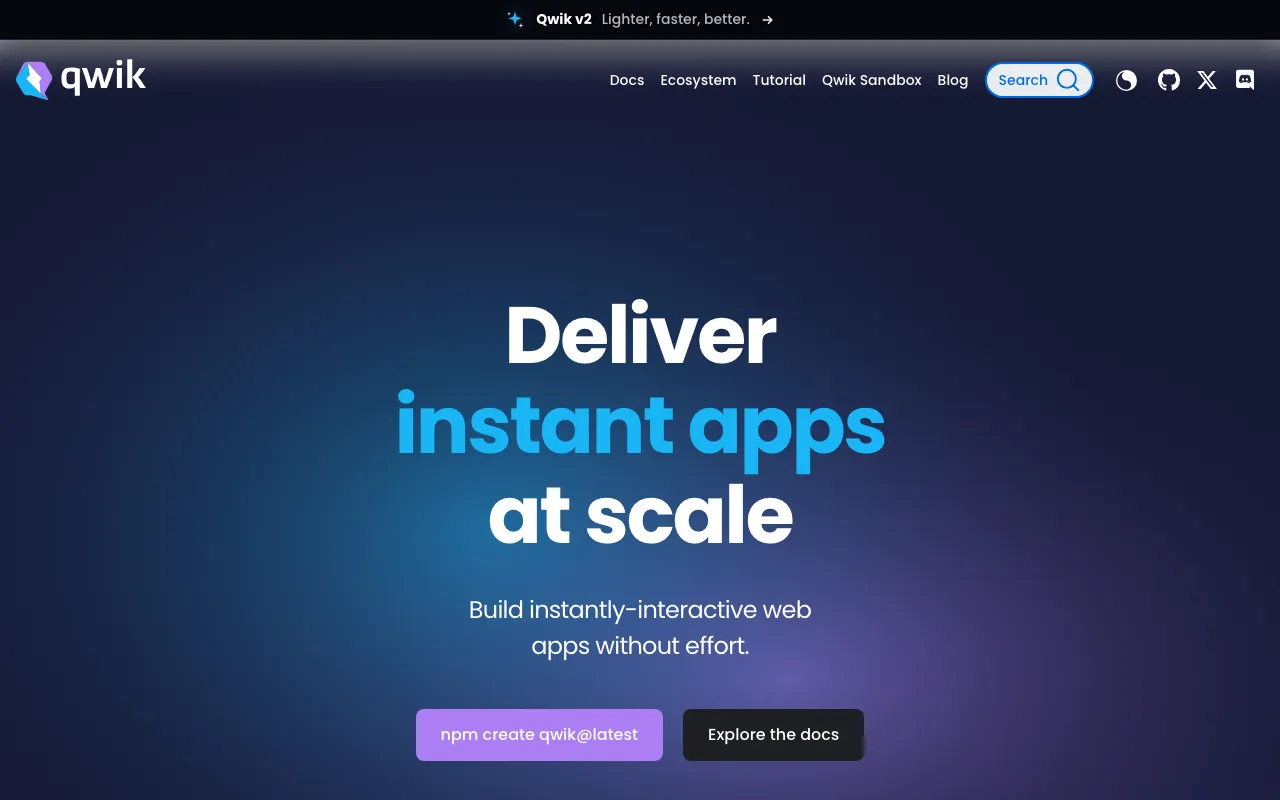
Qwik is a JavaScript framework for building web applications that defer interactivity until needed. It uses resumability and lazy loading so pages can become interactive with little upfront client-side code.
Qwik targets web applications where fast first paint and low initial JavaScript matter. Instead of hydrating the whole client tree up front, it resumes execution from server output and loads only the code paths a user actually touches.
Applications are built with JSX, functional components, and familiar reactive patterns, so teams with React experience can adopt similar mental models. The toolchain centers on Vite for development, with testing through Vitest and Playwright, and styling hooks for Tailwind, PostCSS, and related approaches.
A Qwik Optimizer can shape bundles using real-user metrics to group commonly used modules. The project ships documentation, examples, and tutorials, and supports deployment targets such as Vercel, Netlify, Deno, Cloudflare, and Express.
Related work in the ecosystem includes Partytown for moving heavy third-party scripts into web workers. The framework is positioned around edge-friendly delivery and scaling interactive sites without loading full client frameworks on first visit.
JavaScript web framework for content-driven sites
Astro builds content sites, web apps, and server APIs with server-first rendering, optional UI islands, and integrations for major frameworks.

Full-stack Vue framework for web applications
Nuxt builds type-safe Vue apps with file routing, multiple render modes, server directory APIs, and a large module ecosystem.

React-based framework for fast content-driven sites
Gatsby is a React framework for building websites and apps, blending static generation with dynamic React capabilities. It pulls data from markdown, CMSs, and APIs through a unified GraphQL layer.

Flexbox-based modular CSS component framework
Bulma supplies ready-made responsive UI components as CSS only, without bundled JavaScript. You import or link its stylesheet and combine classes to build layouts.

Vue-based framework shipping one codebase to many platforms
uni-app lets developers write Vue.js front ends once and publish to mobile, web, mini-program, and quick-app targets from a single project.

Open-source low-code platform for internal business applications
ToolJet lets teams build admin panels, dashboards, and operational apps on existing databases and APIs. Create with a visual builder, prompts, or coding agents via MCP, then self-host or use cloud.
 Retool