
FreeDomain
Free domain registration with DNS learning resources
DigitalPlat FreeDomain lets people register free domains under several extensions, point custom nameservers at a DNS provider, and follow guides from setup through deployment.

Rust QUIC transport and HTTP/3 implementation
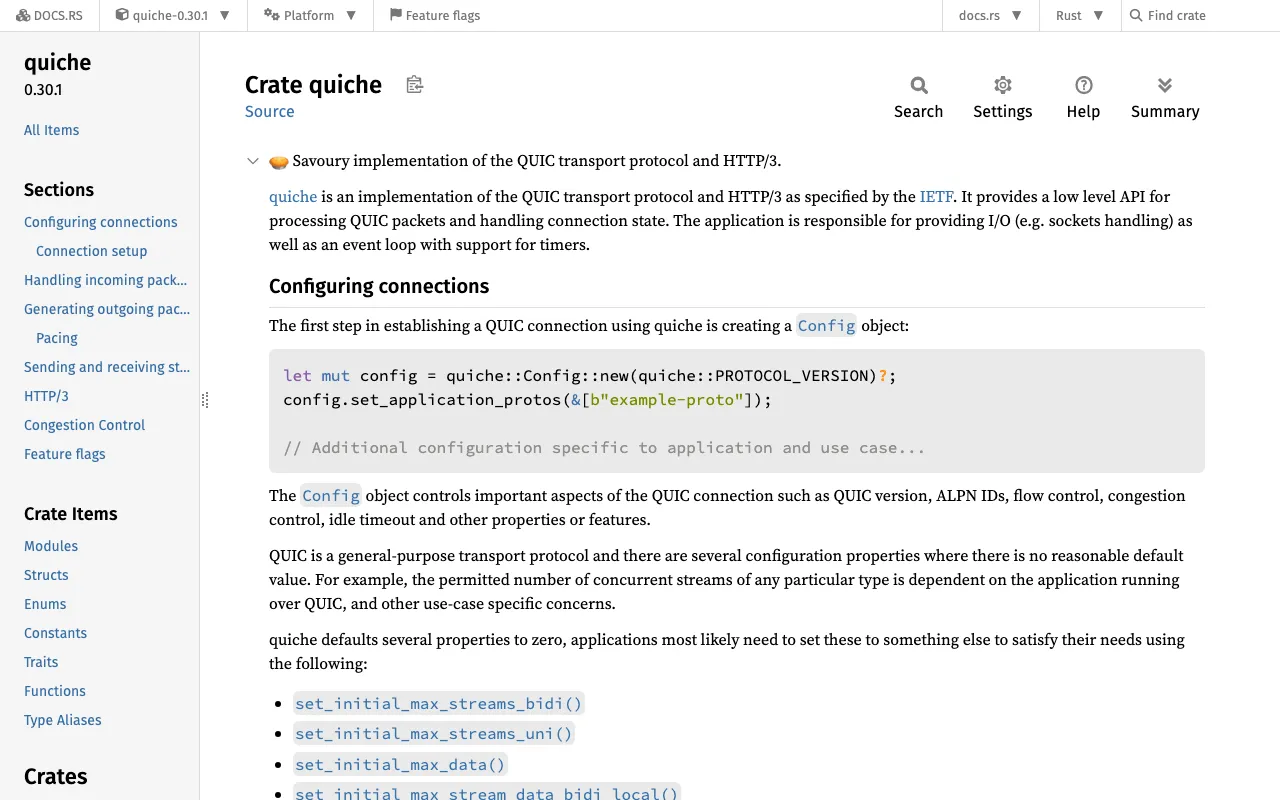
quiche implements IETF QUIC and HTTP/3 with a low-level Rust API. Applications supply sockets, timers, and pacing while the library handles protocol state.
quiche is a Rust library that implements the QUIC transport protocol and HTTP/3 as standardized by the IETF. It exposes a low-level API for parsing QUIC packets, advancing connection state, and emitting outbound frames while leaving network I/O, event loops, and timers to the embedding application.
Connection setup uses configurable objects for version, ALPN, flow control, congestion control, and idle timeouts. Clients call connect helpers while servers accept inbound handshakes, then recv and send methods move traffic with explicit receive metadata. Applications must schedule timeouts based on quiche hints and optionally pace sends using timing fields on outgoing packets.
An HTTP/3 module layers request and response handling above QUIC. A C API wraps the Rust surface for C and C++ consumers, producing a static libquiche archive when built with the ffi feature. Example clients and servers in the source tree illustrate integration patterns.
Cloudflare uses quiche on its edge for HTTP/3, and other projects such as Android DNS resolution and curl are listed as adopters. Docker images provide packaged client and server binaries for experimentation, and maintainers caution that bundled sample apps are demonstrations rather than production services.
Free domain registration with DNS learning resources
DigitalPlat FreeDomain lets people register free domains under several extensions, point custom nameservers at a DNS provider, and follow guides from setup through deployment.

Cross-platform Tauri desktop GUI for Clash Meta proxying
Clash Verge Rev is a desktop GUI for the Clash Meta proxy kernel on Windows, macOS, and Linux. It offers profile management, system proxy modes, and keeps configuration on your device.
Desktop GUI client for proxy cores
v2rayN is a graphical client for Windows, Linux, and macOS that works with Xray, sing-box, and related proxy stacks. Prebuilt packages ship for common CPU architectures.
Self-deployed reverse proxy for NAT and firewall bypass
frp pairs a public-facing frps server with frpc clients to expose TCP, UDP, HTTP, and HTTPS services behind NAT or firewalls, including P2P connect mode.

Extensible server platform with automatic TLS
Caddy is an extensible server platform that enables HTTPS by default. It is often used as an HTTPS and HTTP server with a modular Go-based architecture.

Dynamic HTTP reverse proxy and load balancer for microservices
Traefik routes HTTP traffic to microservices and balances load across backends. It watches orchestrators and registries to update routes without manual restarts.