
Socket.IO
Bidirectional real-time communication for web and Node
Socket.IO enables low-latency, event-based communication between clients and servers. It prefers WebSockets and falls back to HTTP long-polling when needed.

Outbound webhooks and event destination delivery
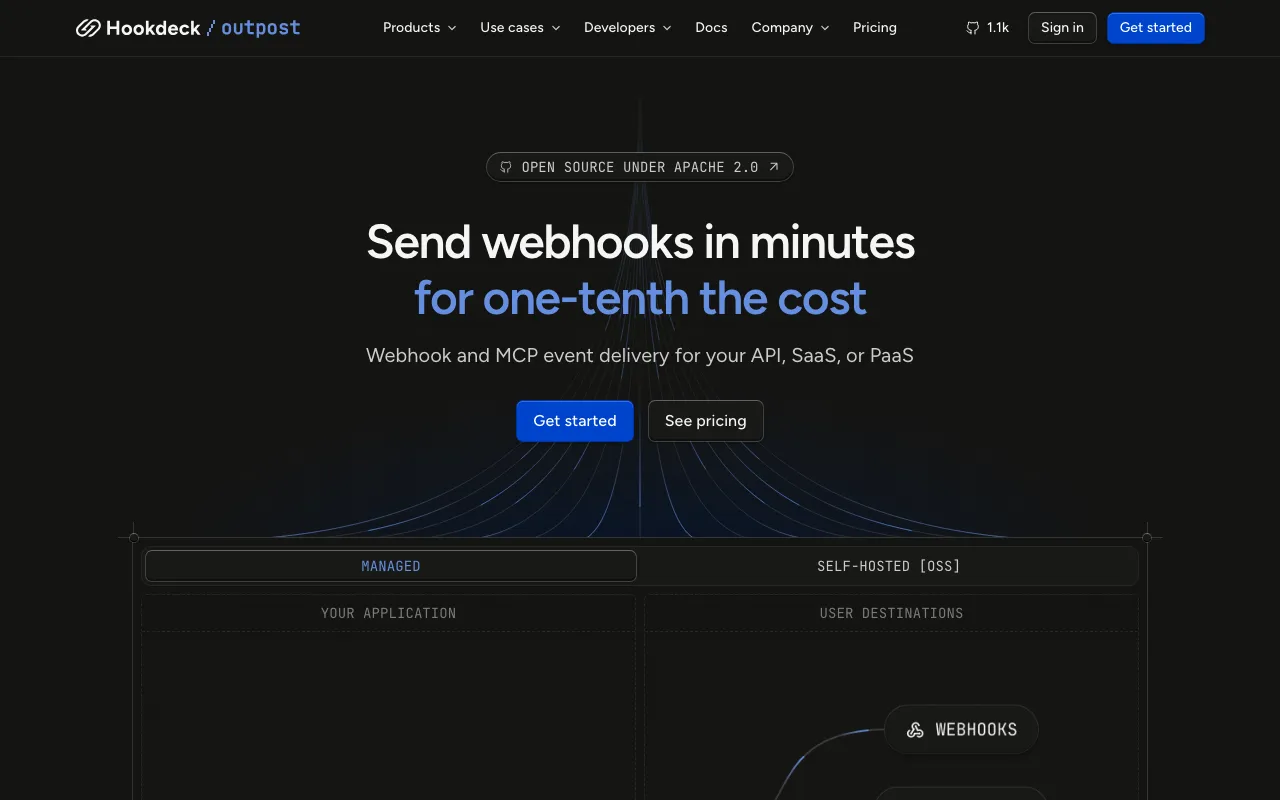
Outpost provides infrastructure for sending webhooks and delivering events from your platform to customer systems. It supports multiple destination types, retries, multi-tenant isolation, and a customer portal.
Outpost provides production-ready infrastructure for outbound webhooks and event destinations. Platforms can send events to customer endpoints using webhooks, message queues, brokers, and cloud bus integrations while handling retries, tenant isolation, and observability.
Supported destination types include webhooks, Amazon EventBridge, AWS SQS, AWS Kinesis, AWS S3, GCP Pub/Sub, Azure Service Bus, RabbitMQ, Kafka, Cloudflare Queues, and Hookdeck Event Gateway. Event topics and topic-based subscriptions follow a publish-and-subscribe model, with fanout to multiple endpoints and at-least-once delivery guarantees.
Operators can publish through the Outpost API or configure ingestion from a publish queue. Automatic and manual retries are configurable, and delivery failure alerts are available. A user-facing portal lets end customers view metrics, manage destinations, debug failures, and observe event flows. Webhook practices cover idempotency headers, timestamps, signatures, and signature rotation, with OpenTelemetry traces, metrics, and logs.
The runtime is written in Go and distributed as a binary and Docker container. It depends on Redis or a Redis cluster, PostgreSQL, and a supported message queue, and remains backward compatible with existing webhook payload formats, headers, and signatures. SDKs are available for Go, Python, and TypeScript, plus an MCP server.
Teams may self-host Outpost or use Hookdeck Outpost as a managed service running the same codebase, with local Docker deployment and hosted deployment options such as Railway.
Bidirectional real-time communication for web and Node
Socket.IO enables low-latency, event-based communication between clients and servers. It prefers WebSockets and falls back to HTTP long-polling when needed.

HTTP pub-sub push notification service
Ntfy sends push notifications to phones and desktops via simple HTTP PUT or POST requests and a REST API, without requiring sign-up on the public host.

Distributed task queue for Python workers and brokers
Celery distributes units of work called tasks from client applications to worker processes through a message broker. It supports RabbitMQ, Redis, Amazon SQS, and other transports with retries and scheduling features.

Realtime distributed message queue and pub-sub platform
NSQ is a distributed messaging system built for large-scale throughput. It avoids single points of failure and ships with official Go and Python client libraries.

Java client and real-time data platform for Valkey and Redis
Redisson is a Java client for Valkey and Redis with synchronous, asynchronous, reactive, and RxJava APIs. It adds distributed collections, locks, queues, caching helpers, and related services on top of standard Valkey or Redis deployments.
Node.js client for WhatsApp Web automation
whatsapp-web.js drives WhatsApp Web through Puppeteer so Node programs can send, receive, and manage chats with many web-client features. It targets multi-device accounts and documents session auth strategies.