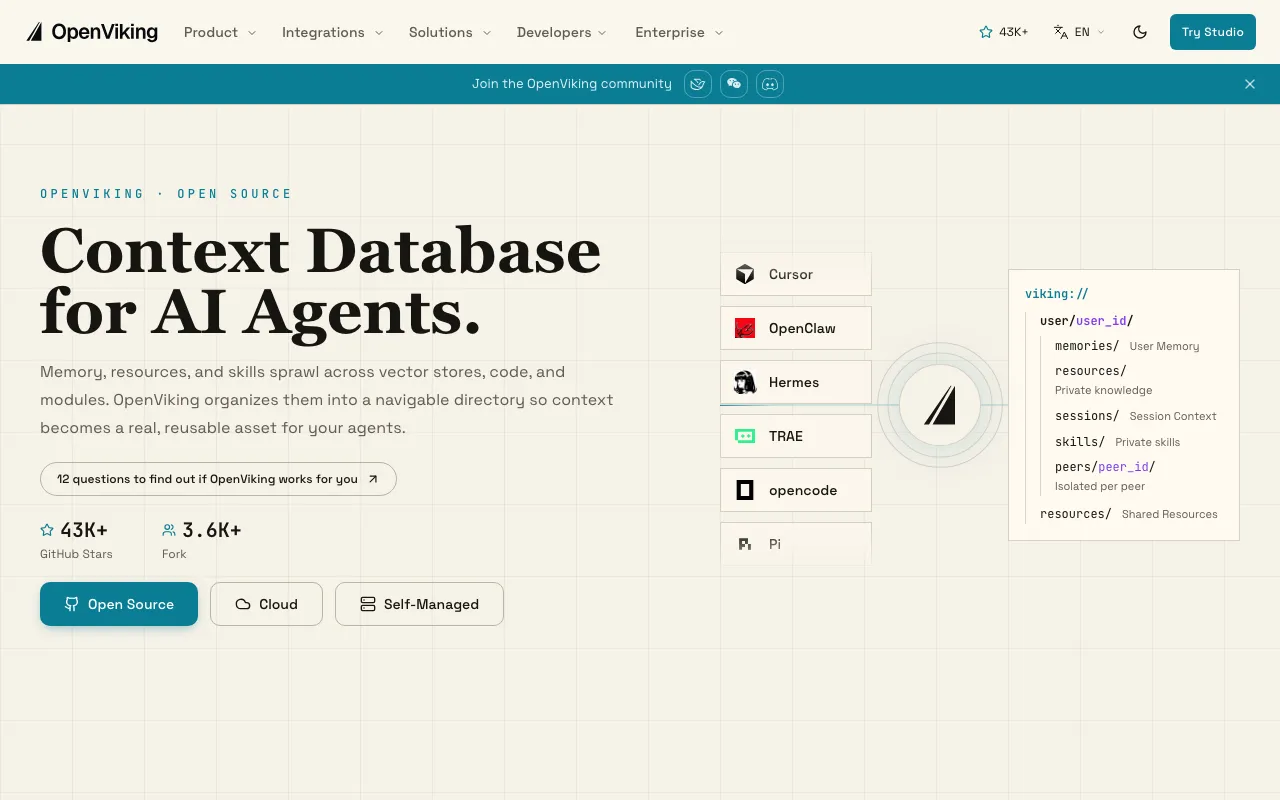
OpenViking unifies agent knowledge, long-term memory, and skills in a navigable virtual filesystem with layered summaries, scoped search, and plugins for popular coding agents.
Overview
OpenViking is a context database that stores what agents know as directories under a virtual URI scheme instead of opaque embedding-only stores. People and agents can list, read, grep, and edit stored context, with generated summaries at directory levels so relevance can be judged before loading full content.
Resources hold documents and code, memories retain preferences and experience, and skills describe how tasks should run. Retrieval can be limited to a subtree rather than a flat vector index, and session commits archive conversations while extracting inspectable memory files. Context is organized into abstract, overview, and detail tiers to reduce tokens during planning.
You can run an OpenViking server yourself, use a hosted offering from Volcengine, or try a browser studio without installing locally. Client access includes an ov command-line tool, HTTP API, and SDKs in Python, Go, and TypeScript, plus installer scripts that wire memory plugins into tools such as Claude Code, Codex, Cursor, and OpenCode.
For production, the server supports accounts, user isolation, and optional access controls on shared directories. A desktop console on macOS and Windows helps inspect recall events and sync local memories, and VikingBot provides an agent framework layered on the same storage.
Key features
- Virtual filesystem URIs for knowledge and memory
- L0, L1, and L2 context layers
- Directory-scoped semantic and keyword search
- Session commit to archived memories
- Agent memory plugins for major IDEs
- MCP and HTTP API access
- Multi-tenant accounts and ACLs
- Official Docker image with console UI
Use cases
- Cross-session memory for coding agents
- Inspectable long-term user preferences
- Shared team knowledge with access boundaries
- RAG scoped to a project subtree
- Self-hosted agent context storage




 Turbopuffer