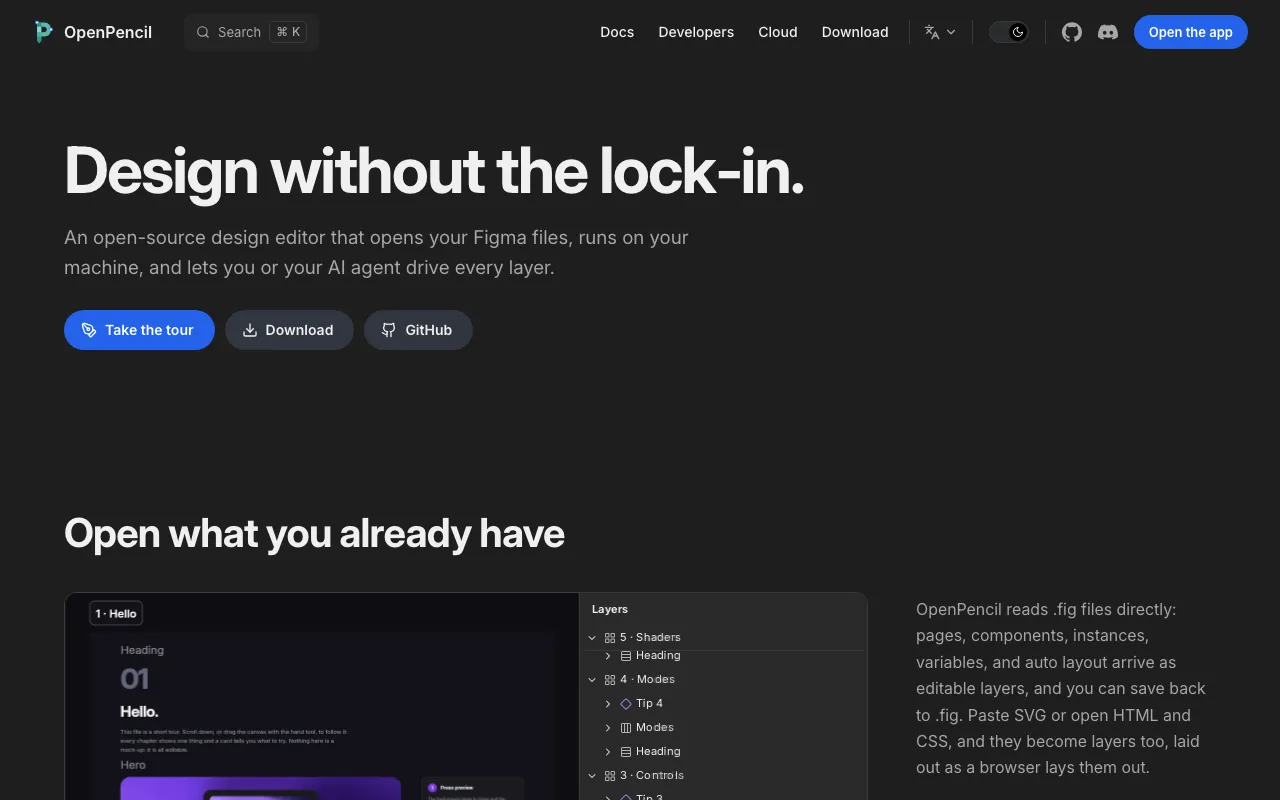
OpenPencil edits .fig and .pen design files on desktop or in the browser, with built-in AI, CLI automation, and optional team Cloud sync.
Overview
OpenPencil is an open-source design editor aimed at people who want local files, scriptable workflows, and native support for Figma .fig documents. You can open, edit, and save .fig and supported Pencil formats, paste content between apps, and work from a Tauri desktop build on macOS, Windows, and Linux or from a browser-based progressive web app.
The editor covers layout, components, variables as design tokens, boards with sticky notes and connectors, linting for naming and accessibility, and export paths to code formats such as JSX and Tailwind. A built-in chat assistant can create and modify canvas nodes when you supply your own API keys, and coding agents can reach the document through an MCP server or desktop integrations.
A headless CLI and Vue SDK let you inspect files, run XPath queries, lint documents, convert formats, and embed custom editing surfaces in other products. Real-time collaboration can run peer-to-peer over WebRTC without a central account, or teams can store shared documents on OpenPencil Cloud, including an option to run that server on your own infrastructure.
Compared with closed design platforms, the project emphasizes open formats, local-first storage, and APIs that mirror or extend familiar plugin-style automation so agents and scripts can drive the same operations as the graphical UI.
Key features
- Native .fig and .pen read and write
- Built-in AI chat with bring-your-own keys
- Headless CLI and MCP server
- Real-time P2P or Cloud collaboration
- Design linting and token extraction
- Vue SDK for custom editors
- Export to JSX, Tailwind, and Storybook
- FigJam-style boards and .jam files
Use cases
- Editing Figma files without vendor lock-in
- Agent-driven design automation
- Embedding a design canvas in another app
- Team design sync via self-hosted Cloud
- Design-to-code handoff workflows
Open-source alternative to

 Figma



 Bolt.new