
nvm
POSIX shell version manager for Node.js
nvm installs and switches between Node.js versions from the command line on POSIX shells including bash and zsh.

Next.js adapter for Cloudflare Workers deployment
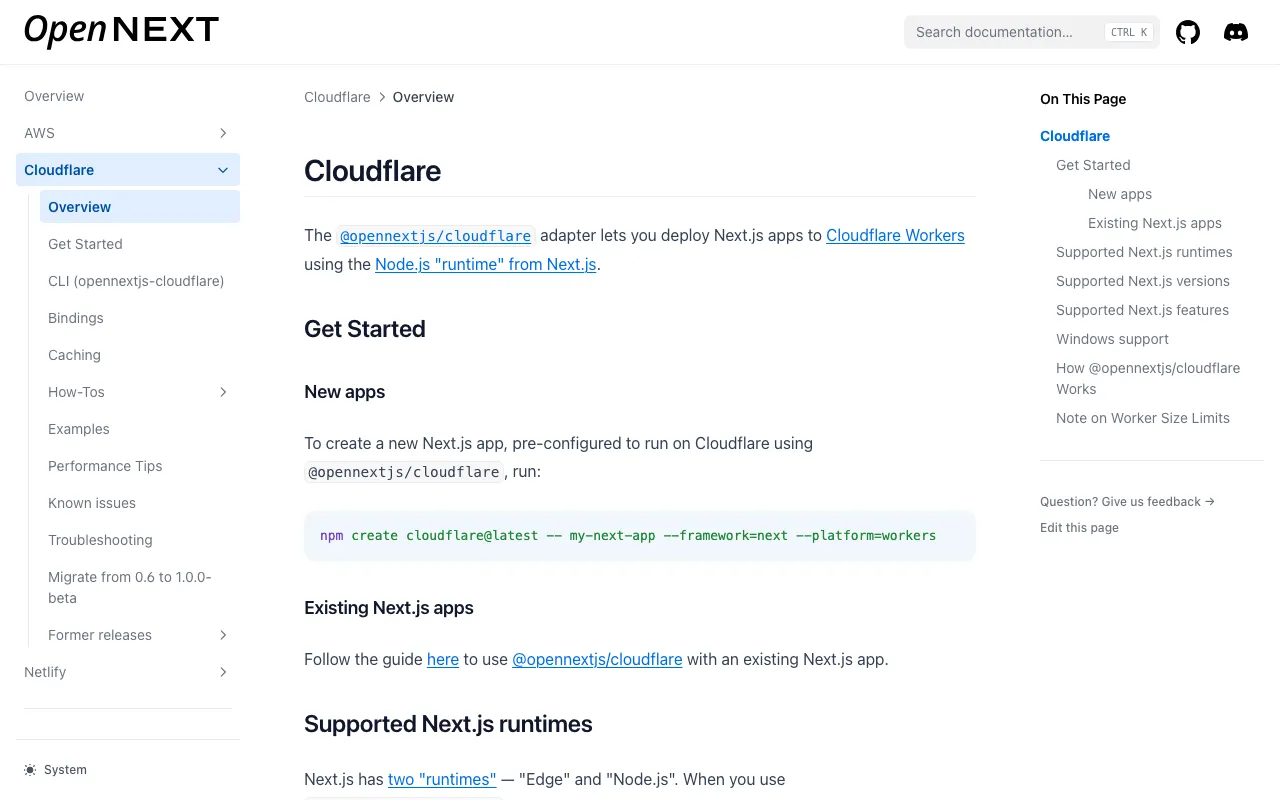
The @opennextjs/cloudflare package adapts Next.js standalone builds to run on Cloudflare Workers with the Node.js compatibility layer in workerd.
OpenNext for Cloudflare is an adapter that lets Next.js applications built with next build in standalone mode run on Cloudflare’s developer platform. It produces Workers-compatible output using the Workers Node.js compatibility layer in the workerd runtime, so apps can rely on the fuller Node.js runtime rather than the constrained Edge runtime.
Documentation contrasts this with older Cloudflare Next integrations that only supported the Edge runtime and therefore fewer Next.js features. Supported capabilities include App Router and Pages Router patterns, route handlers, dynamic routes, SSG, SSR, middleware, node middleware experiments, image optimization with Cloudflare Images, partial prerendering, ISR on Pages Router, composable caching, Turbopack builds, and related features across supported Next.js release lines.
Workflow: add the package, run npx @opennextjs/cloudflare, which builds via package.json scripts then transforms artifacts for local Wrangler runs and Cloudflare deployment. New projects can be scaffolded with create cloudflare using the Next framework on Workers. Windows is supported with caveats; WSL, Linux VMs, or Linux CI are recommended when native tooling is unreliable.
Worker upload size limits apply after build; Wrangler reports compressed size relevant to Cloudflare plan limits. The adapter is maintained as part of the broader OpenNext multi-platform effort alongside AWS and Netlify adapters.
POSIX shell version manager for Node.js
nvm installs and switches between Node.js versions from the command line on POSIX shells including bash and zsh.

Fast Python package and project manager
uv is a Rust-based tool that manages Python dependencies, virtual environments, scripts, and interpreters. It offers a pip-compatible interface and universal lockfiles for projects.

Go-based static site generator with flexible templating
Hugo is a static site generator written in Go. It turns content and templates into deployable HTML sites with asset pipelines for CSS, JavaScript, Sass, and images.

Frontend build tool for modern web projects
Vite is a build tool for modern web projects, combining a development server with an optimized production build. It targets a faster, leaner local development workflow.

Local runner for GitHub Actions workflows
A command-line tool that executes GitHub Actions workflows on your machine using Docker. It mirrors GitHub’s environment for faster feedback while editing workflow files.

Modular toolkit for assembling container systems
Moby bundles container build, runtime, registry, and orchestration components so integrators can craft custom container platforms instead of using a single fixed product.