
nvm
POSIX shell version manager for Node.js
nvm installs and switches between Node.js versions from the command line on POSIX shells including bash and zsh.

Open-source Next.js deployment adapter for AWS
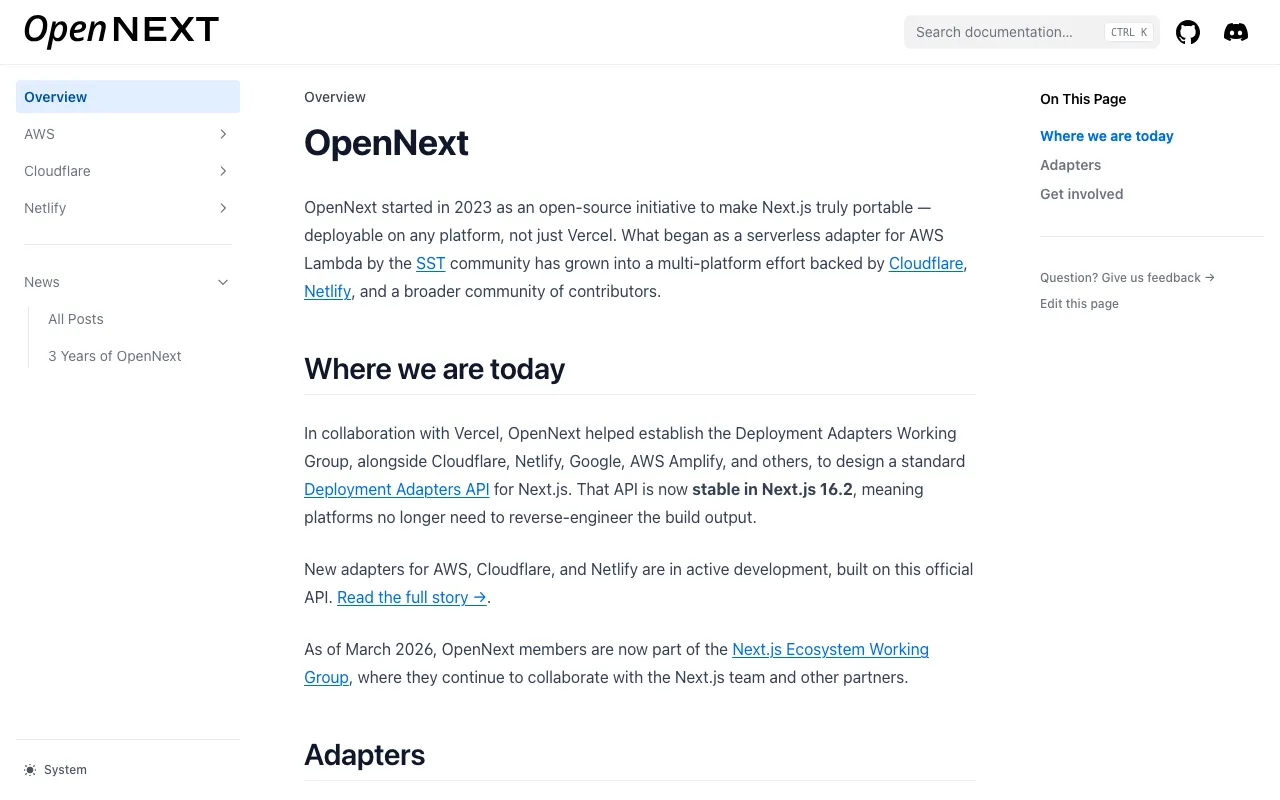
OpenNext transforms Next.js build output into packages deployable on AWS Lambda and classic Node.js servers while targeting broad Next.js feature coverage.
OpenNext is an adapter that takes the output of a Next.js build and repackages it for environments beyond the default hosting stack. It natively targets AWS Lambda and traditional Node.js server deployments, letting teams run App Router and Pages Router workloads with API routes, dynamic routes, static generation, SSR, ISR, middleware, server actions, image optimization, NextAuth.js, and edge-oriented setups.
Configuration is optional via an open-next.config.ts file beside next.config.js; otherwise defaults apply. A debug mode controlled by OPENNEXTDEBUG increases logging and disables minification for troubleshooting. The project publishes standard npm releases and automated prerelease builds from main and experimental branches.
Operational notes include a warmer function to reduce cold starts on Lambda, acknowledging that warm instances and lazy-loaded routes can still incur latency. Documented production users include Gymshark UK, Udacity, TUDN, and NHS England. OpenNext sits within a broader multi-platform adapter effort that also involves Cloudflare and Netlify contributors and work toward standardized Next.js deployment adapters.
Teams adopt it when they want Next.js applications portable across infrastructure they control, especially AWS serverless and Node hosting, without reimplementing framework output conventions themselves.
POSIX shell version manager for Node.js
nvm installs and switches between Node.js versions from the command line on POSIX shells including bash and zsh.

Fast Python package and project manager
uv is a Rust-based tool that manages Python dependencies, virtual environments, scripts, and interpreters. It offers a pip-compatible interface and universal lockfiles for projects.

Go-based static site generator with flexible templating
Hugo is a static site generator written in Go. It turns content and templates into deployable HTML sites with asset pipelines for CSS, JavaScript, Sass, and images.

Frontend build tool for modern web projects
Vite is a build tool for modern web projects, combining a development server with an optimized production build. It targets a faster, leaner local development workflow.

Local runner for GitHub Actions workflows
A command-line tool that executes GitHub Actions workflows on your machine using Docker. It mirrors GitHub’s environment for faster feedback while editing workflow files.

Modular toolkit for assembling container systems
Moby bundles container build, runtime, registry, and orchestration components so integrators can craft custom container platforms instead of using a single fixed product.