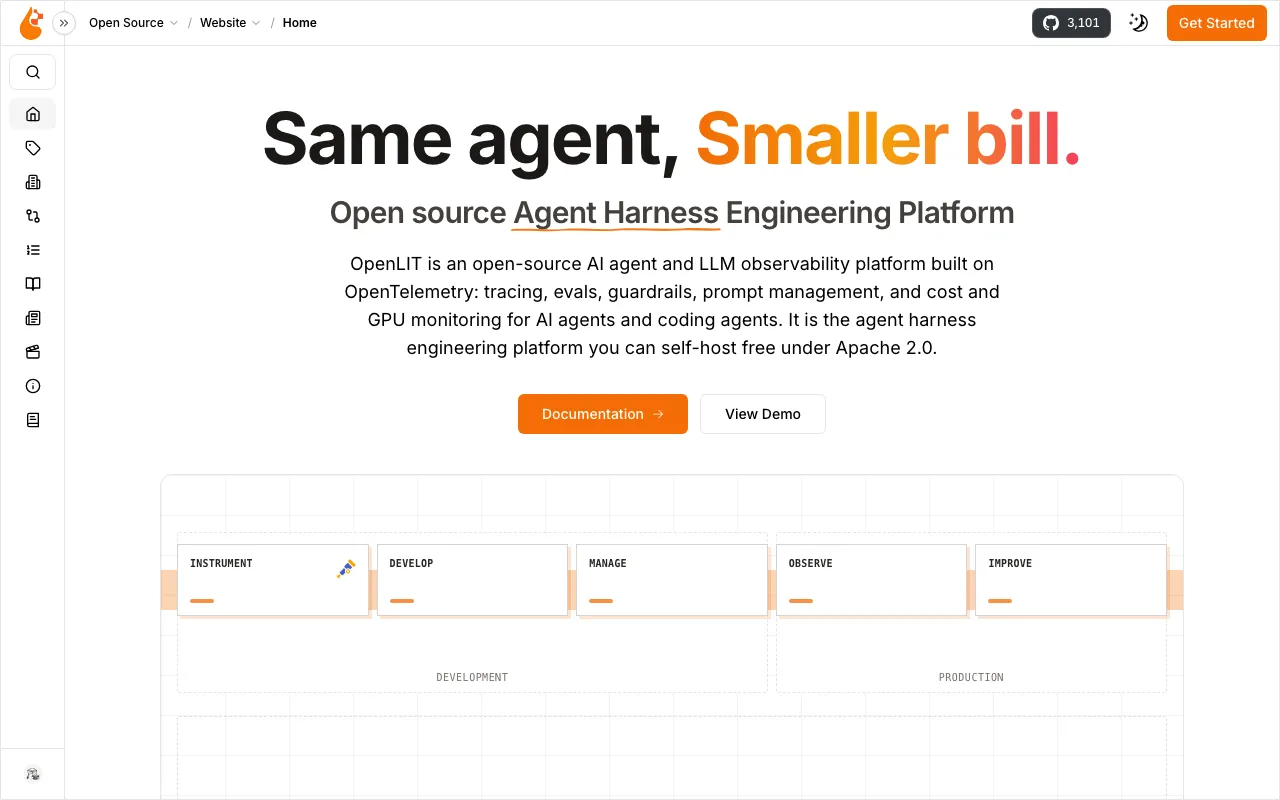
Self-hostable platform for tracing, evaluating, guarding and improving AI agents and coding agents using OpenTelemetry, with prompt management, cost tracking and GPU monitoring.
Overview
OpenLIT is an open-source platform that gives teams OpenTelemetry-native tracing, evaluations, guardrails, prompt and context management, and cost and GPU monitoring for AI agents and coding agents. It treats an agent as a model plus a harness (tools, context, prompts, memory, hooks, guardrails) and helps you observe failures, evaluate them and fix the harness.
Applications are instrumented with SDKs for Python, TypeScript and Go, typically with a single init call, which auto-instruments LLM providers, agent frameworks and vector databases and exports traces and metrics over OTLP. Coding agents such as Claude Code, Codex, Cursor, Windsurf and OpenCode are covered through a CLI that ingests their hook events, with no SDK or code changes. Telemetry follows the OpenTelemetry GenAI semantic conventions and can also be sent to Grafana, Datadog or any other OTLP backend.
The platform includes LLM-as-a-judge and programmatic evals that can run on production traces or as CI gates, runtime guardrails for prompt injection, sensitive topics and topic restriction, and a Prompt Hub for versioned prompts. A Rule Engine and Context store let you change agent behaviour without redeploying, a Vault holds API keys, and OpenGround compares models side by side on cost, latency and output.
Cost tracking supports custom pricing for fine-tuned models. A separate OpenTelemetry GPU collector reports utilization, memory, power and temperature for NVIDIA, AMD and Intel GPUs, correlated with traces. OpenLIT is designed to run in your own infrastructure with Docker or Kubernetes and uses ClickHouse for storage. Organisation-wide governance features such as custom roles, audit logs and alerts belong to a separate Enterprise edition.
Key features
- OpenTelemetry tracing of LLM calls, tools and agent steps
- Coding agent session observability via CLI
- LLM-as-a-judge and programmatic evals with CI gates
- Guardrails for prompt injection and sensitive topics
- Prompt Hub with versioning
- Rule Engine and Context store
- Vault for API keys
- GPU monitoring for NVIDIA, AMD and Intel
Use cases
- Tracing and debugging production AI agents
- Monitoring Claude Code, Codex and Cursor sessions
- Tracking LLM cost and latency
- Evaluating agent output quality in CI
- Comparing models and prompts before release
Open-source alternative to
BBraintrust“OpenLIT vs Braintrust: an open-source Braintrust alternative for agent evals and observability.” source


 Datadog