
Immich
Self-hosted photo and video library with mobile backup
Immich backs up, organizes, and browses personal photos and videos on hardware you run. Mobile and web clients share albums, search, and face grouping.

Self-hostable open-source image and video processing platform
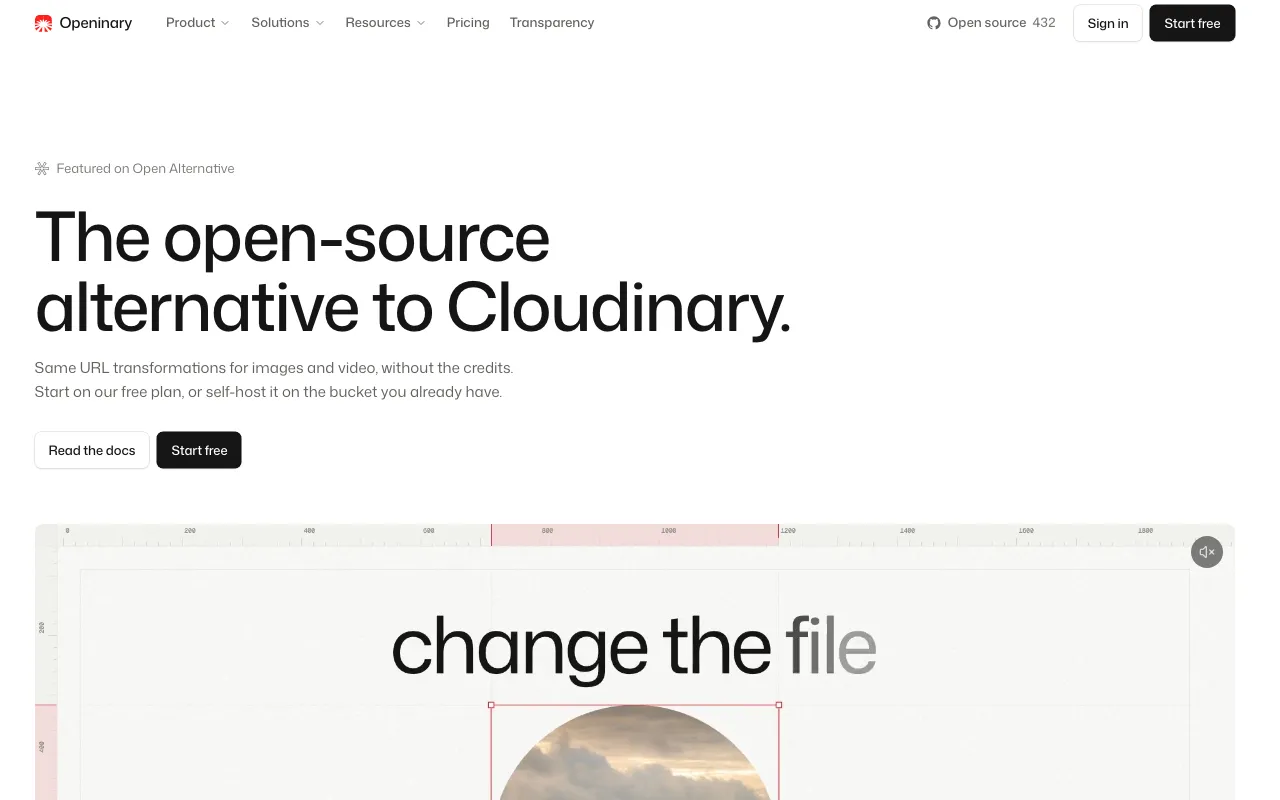
Openinary processes and delivers images and videos with URL-based transformations. It connects to S3-compatible storage and can run on your own infrastructure or as a managed cloud service.
Openinary is an open-source media processing platform for uploading, transforming, and serving images and videos. Transformations happen on the fly through URL parameters for width, crop, format, quality, and similar options, so each variant is generated on first request rather than pre-generated in folders.
The platform includes built-in S3-compatible storage with automatic caching, optimization with WebP, AVIF, and modern codecs, a REST API, and an admin dashboard for asset management. Video workflows support transcode, resize, and thumbnails from the same URL patterns, with job status for pending work. Transformed files are cached at the edge after the first hit.
You can point Openinary at Amazon S3, Cloudflare R2, MinIO, or other S3-compatible providers through environment configuration. A CLI scaffolds a project, writes docker-compose and environment files, and starts containers for a full stack with API and dashboard or API-only mode. A managed cloud option is also available.
Compared to Cloudinary, the source describes similar URL transformation syntax for images and video, signed URLs for private assets, API keys, delivery logs, and a React upload component. Self-hosted deployments keep originals in a bucket you control; the cloud offering stores files on the vendor side.
 Cloudinary
“The self-hostable alternative to Cloudinary” source
Self-hosted photo and video library with mobile backup
Immich backs up, organizes, and browses personal photos and videos on hardware you run. Mobile and web clients share albums, search, and face grouping.

End-to-end encrypted cloud storage for photos and credentials
Ente is an encrypted platform for storing data in the cloud without trusting the provider. Client apps cover photos, documents, and two-factor authentication.

Non-destructive raw photography workflow and lighttable
Desktop photography workflow software that manages digital negatives, provides a zoomable lighttable view, and develops raw images for export to local or remote storage.

Self-hosted personal media library and streaming web application
Stash is a Go-based web application that organizes, tags, and streams your local video and image collections from the browser. It can enrich media with scraped metadata, plugins, and password protection on your own network.

On-the-fly HTTP image resize and conversion server
imgproxy is a standalone HTTP server that fetches remote images, applies processing options from the URL, and returns resized or converted output so apps skip built-in image pipelines.

Open-source PIM and DAM platform with built-in AI agent
UnoPim is a Laravel-based product information and digital asset management platform. It centralizes and enriches catalogue data, supports multiple channels, locales and currencies, and includes an AI agent for managing products through chat.
 Google Photos