
Taichi
Python-embedded language for parallel GPU and CPU numerics
Taichi Lang is an imperative parallel language inside Python. A JIT compiler offloads heavy numeric code to GPU or CPU backends after you install it with pip.

Python library for fermionic and quantum chemistry algorithms
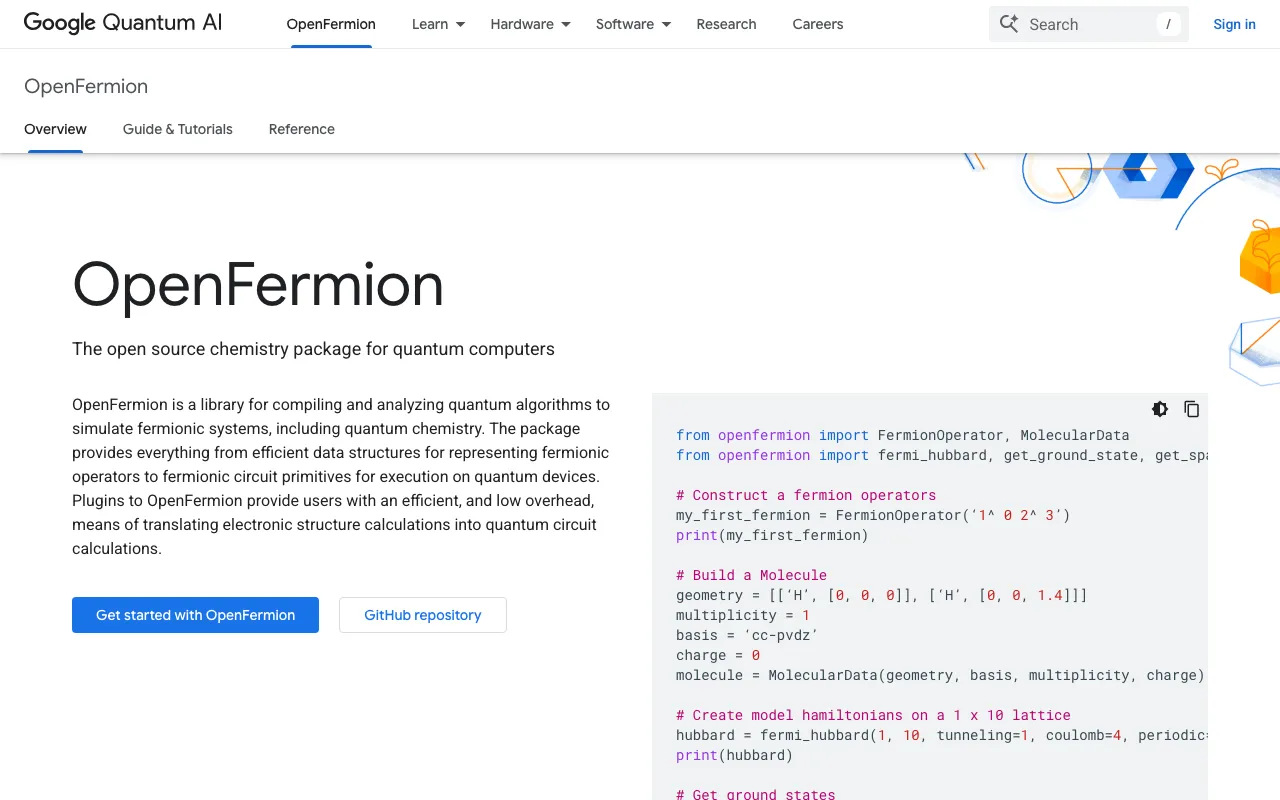
OpenFermion compiles and analyzes quantum algorithms to simulate fermionic systems, including quantum chemistry, with data structures for fermion and qubit Hamiltonians.
OpenFermion is an open-source Python package from the quantum computing community for compiling and analyzing quantum algorithms that simulate fermionic systems, with a strong focus on electronic structure and quantum chemistry. It supplies data structures and utilities to build, transform, and study fermionic and qubit Hamiltonians and related circuit primitives.
The core library installs via pip on Mac, Windows, or Linux. Optional Docker images bundle OpenFermion with select plugins when native chemistry tools are hard to install. Modular plugins connect to simulators of fermionic evolutions and to classical electronic-structure codes such as Psi4, PySCF, and DIRAC, translating chemistry calculations into quantum circuit workflows.
Documentation, API references, and Jupyter tutorials cover molecules, hubbard models, ground states, and integration with quantum frameworks. The project is maintained with contribution guidelines, automated tests, and published citation information for research use.
Python-embedded language for parallel GPU and CPU numerics
Taichi Lang is an imperative parallel language inside Python. A JIT compiler offloads heavy numeric code to GPU or CPU backends after you install it with pip.

JavaScript GPGPU kernels for browser and Node
GPU.js transpiles JavaScript functions into GPU shader code for parallel math. It runs in browsers via WebGL or WebGPU and in Node, with CPU and WebAssembly fallbacks when no GPU is available.
CUDA C++ templates and Python DSLs for GEMM
CUTLASS provides abstractions for high-performance matrix multiplication and related linear algebra on NVIDIA GPUs. It offers C++ template components and Python CuTe DSL interfaces for kernel development.
Portable framework for high-performance BLAS-like linear algebra
BLIS is a C99 framework for building optimized dense linear algebra libraries with a new API, BLAS compatibility, and optional plugins.

JIT GPU compiler for high-performance .NET kernels
ILGPU compiles .NET languages to GPU kernels at runtime with no native dependencies in the compiler itself. It includes CPU accelerators for debugging and an algorithms library for common GPU primitives.
High-performance computer algebra and symbolic numerics for Julia
Symbolics.jl is a Julia CAS for symbolic arithmetic, differentiation, simplification, and code generation integrated with the SciML stack.