
Sa-Token
Java lightweight permission and session framework
Sa-Token adds login, permission checks, SSO, OAuth2, and microservice gateway auth to Java web projects with minimal boilerplate.

Access control for customer AI agents in logged-in apps
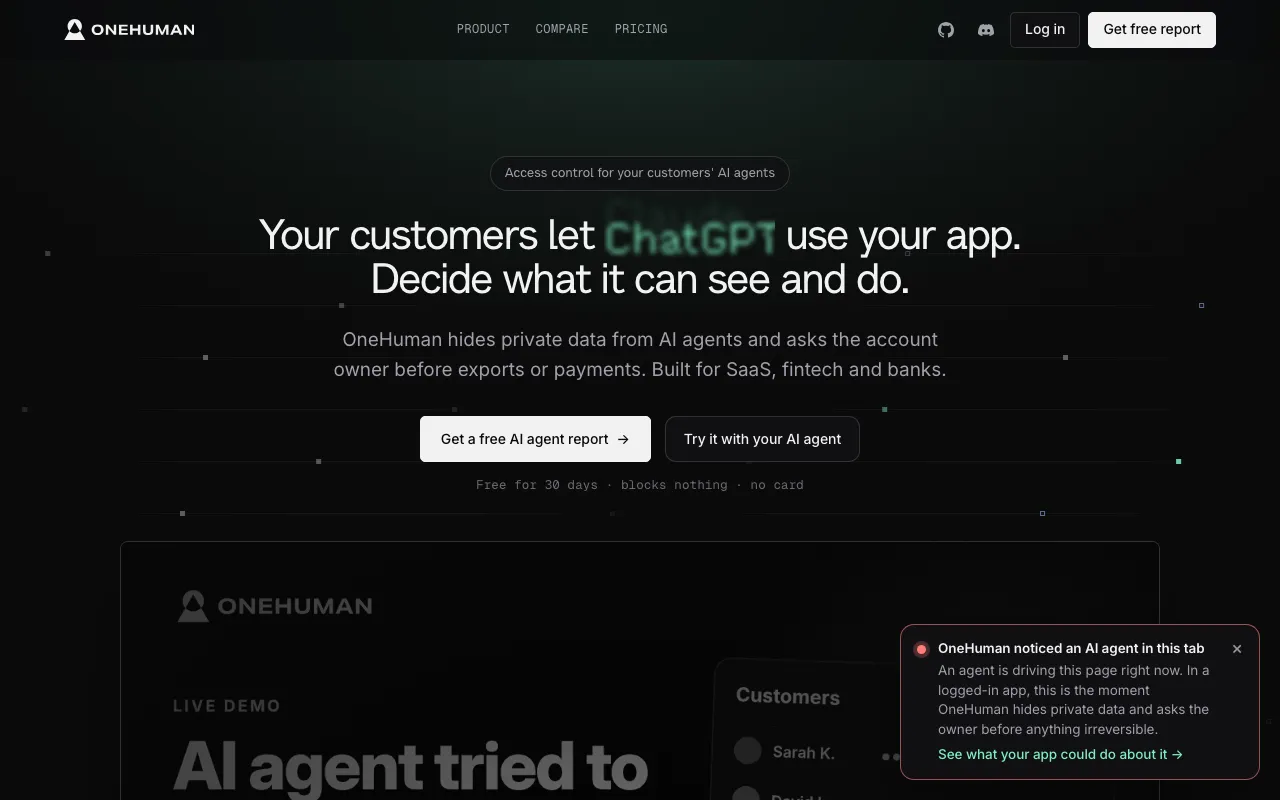
OneHuman controls what AI agents may see and do inside your customers' logged-in sessions. It masks private fields, gates risky actions with passkeys, and signs decisions on your server.
OneHuman targets B2B SaaS, fintech, and similar products where end users now drive Claude, ChatGPT, Codex, and other agents through an ordinary browser session. It focuses on agents customers bring into your product, not internal employee tooling.
The system works after login at the endpoints that return data. It can detect agent attach signals quickly, mask emails, phones, and balances from agent views, and require the account owner's passkey before exports, deletes, or billing changes. Pointer kinematics help distinguish human clicks from automation, with unknown outcomes handled separately from human allow paths.
Each allow, hide, or approval decision can be signed with Ed25519 on your infrastructure, and proofs can be checked offline via the CLI verifier. Observe mode records what would have happened without blocking, while enforce mode applies rules when you are ready.
Setup centers on npx onehumanai init for Express and related Node stacks, with sidecar adapters for Python, .NET, and Java backends. Documentation describes middleware wiring, JSON policy files, and per-route protection helpers.
Java lightweight permission and session framework
Sa-Token adds login, permission checks, SSO, OAuth2, and microservice gateway auth to Java web projects with minimal boilerplate.

Node.js library for signing and verifying JSON Web Tokens
jsonwebtoken implements JWT creation and verification for Node.js using HMAC, RSA, ECDSA, and related algorithms. It exposes sign, verify, and decode helpers built on node-jws.

OAuth2 and OIDC reverse proxy authentication
OAuth2 Proxy sits before web apps as reverse proxy or middleware, sends users through OAuth2 or OIDC login, supports many identity providers, and can forward user details to upstream apps as headers

Open-source user login and session management
SuperTokens adds sign-up, sign-in, and session handling to applications through frontend SDKs, backend SDKs, and a core HTTP auth service.

Self-hosted identity provider with SSO and agent MCP gateway
Casdoor is an IAM server with a web console for users, apps, and providers. It issues tokens via OAuth, OIDC, SAML, CAS, LDAP, SCIM, and WebAuthn, and exposes an MCP gateway for AI tooling

Isomorphic TypeScript authorization for apps and APIs
CASL limits which resources a user may access using declarative rules shared across frontend, backend, and database layers.
 Amazon Cognito
 Auth0