
Ansible
Agentless IT automation and configuration engine
Ansible automates configuration management, deployments, cloud provisioning, ad-hoc tasks, and multi-node orchestration using SSH without installing agents on managed hosts.

Redis-backed background job queues for Node
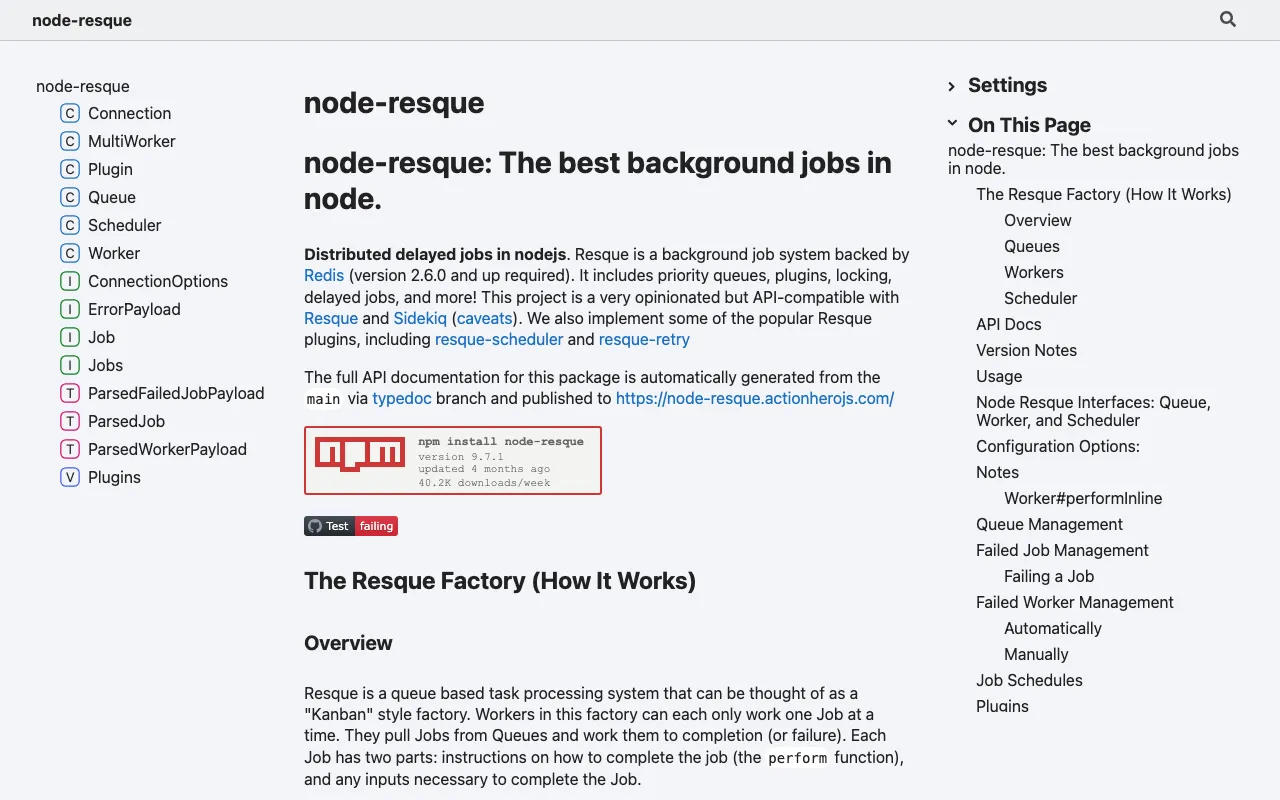
Node library for Resque-style background jobs on Redis, with workers, schedulers, delayed jobs, plugins, and failed-job handling.
Node Resque implements distributed background job processing for Node.js with Redis as the backing store. Jobs are defined with a perform function and arguments, placed on named queues, and picked up by workers that execute one job at a time.
The design mirrors a queue-based factory: regular work queues, a delayed job queue managed by a scheduler, and a failed queue for jobs that error at runtime. The scheduler promotes delayed work when its run time arrives rather than guaranteeing exact execution timestamps.
Three main classes structure typical deployments: Queue for enqueueing and administration, Worker for processing, and Scheduler for delayed jobs and cluster hygiene such as stuck worker detection. A multiWorker variant can run several workers in one process. The source notes API alignment with Ruby Resque and Sidekiq, and includes plugin patterns similar to resque-scheduler and resque-retry.
Connections are usually configured with Redis client details or an existing Redis client. Operators can inspect, retry, or remove failed jobs, clean stale workers, and attach custom plugins around enqueue and perform hooks. Documentation is published separately; docker-related examples are mentioned for deployment patterns.
Agentless IT automation and configuration engine
Ansible automates configuration management, deployments, cloud provisioning, ad-hoc tasks, and multi-node orchestration using SSH without installing agents on managed hosts.

Durable workflow and agent orchestration engine
Conductor runs versioned workflow graphs with persisted task state, retries, and observability. Workers in many languages execute business logic while the engine handles branching, loops, and AI tasks.

Scheduled task panel for multi-language scripts
Qinglong runs Python, JavaScript, Shell, and TypeScript jobs on a schedule. You manage scripts, env vars, and logs through a web UI or remote CLI.

Open-source TypeScript platform for durable AI workflows and agents
Trigger.dev lets teams define long-running background tasks and AI agents in TypeScript. Deployed runs get retries, queues, tracing, and scaling through the platform or self-hosted installs.

Web UI and API for Ansible automation
AWX layers a web interface, REST API, and task engine on Ansible. It is an upstream component related to Red Hat Ansible Automation Platform.

Redis-backed background job queue for Python
RQ is a Python library that queues functions for background workers backed by Redis or Valkey. It targets simple setup with scaling patterns for larger deployments.
 DBOS