Synchronous JVM drivers connect Java, Kotlin, and Scala applications to MongoDB for CRUD, aggregation, indexes, and BSON. Maven and Gradle dependency coordinates are documented.
Overview
MongoDB’s JVM drivers provide the official client for synchronous Java applications, with separate reference and API documentation for Kotlin and Scala variants. You add the driver with Maven or Gradle, connect to a deployment, and work with BSON through libraries split into BSON, core, and driver modules including modern and legacy Java APIs.
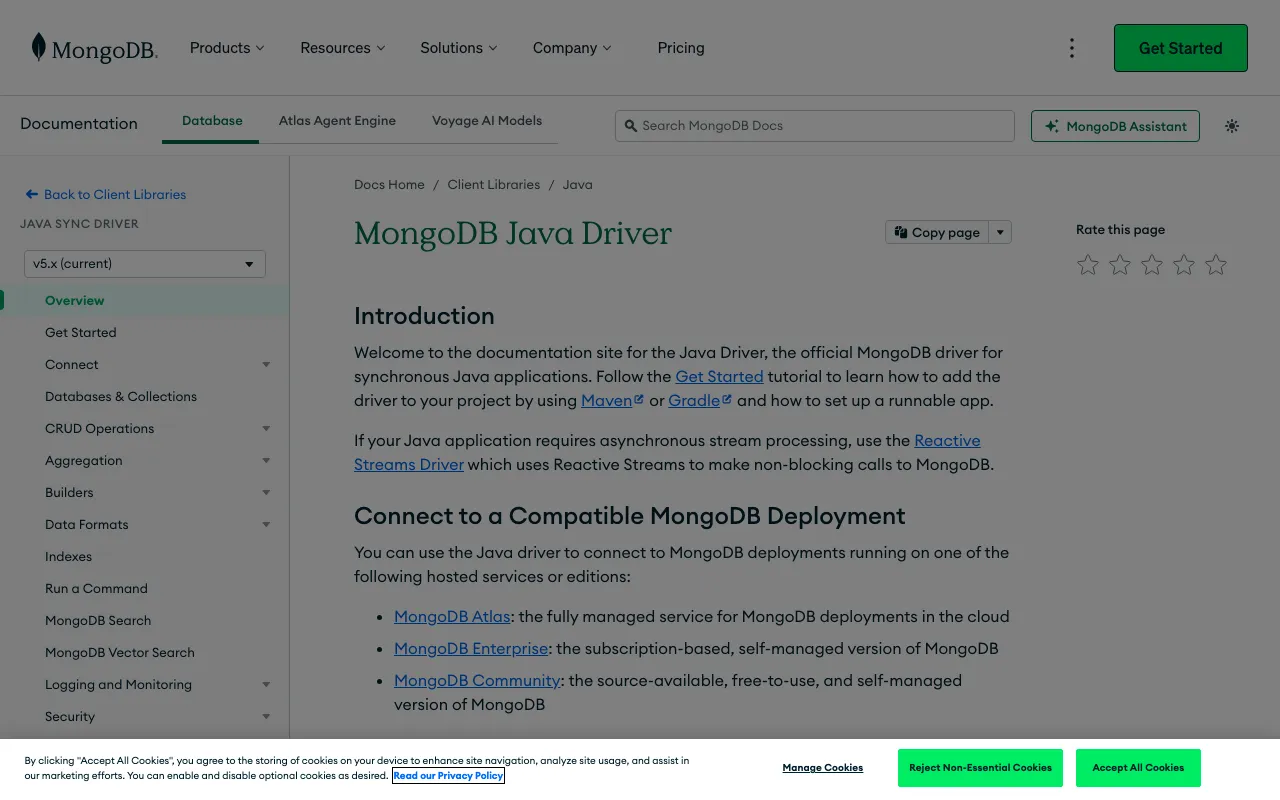
Documentation explains connecting to Atlas, Enterprise, or Community deployments, establishing connections, CRUD, aggregation pipelines, index management, and migration from the legacy API. A Reactive Streams driver is noted for non-blocking access when async stream processing is required.
Release notes, compatibility charts between driver and server versions, upgrade guides, and artifact signature validation for Maven-published builds are part of the reference material. Connection troubleshooting and community learning resources are linked from the docs site.
Binaries and dependency metadata are published for Maven, Gradle, Ivy, and related build tools, with snapshot builds available through Sonatype. Semantic versioning applies to driver releases.
Key features
- Java synchronous driver API
- Kotlin and Scala driver variants
- BSON encoding and records support
- CRUD and aggregation
- Index create and manage
- Legacy and modern Java APIs
- Reactive Streams driver option
- Maven and Gradle integration
Use cases
- JVM apps using MongoDB
- Kotlin or Scala MongoDB clients
- Synchronous CRUD and aggregations
- Migration from legacy driver API
- Non-blocking access via Reactive Streams