Hackingtool
AI-guided terminal toolkit for authorized security testing
Hackingtool bundles many security utilities in one console with optional AI help to pick tools and commands. It targets Linux and macOS and is meant for authorized testing only.

Open-source cyber threat intelligence sharing platform
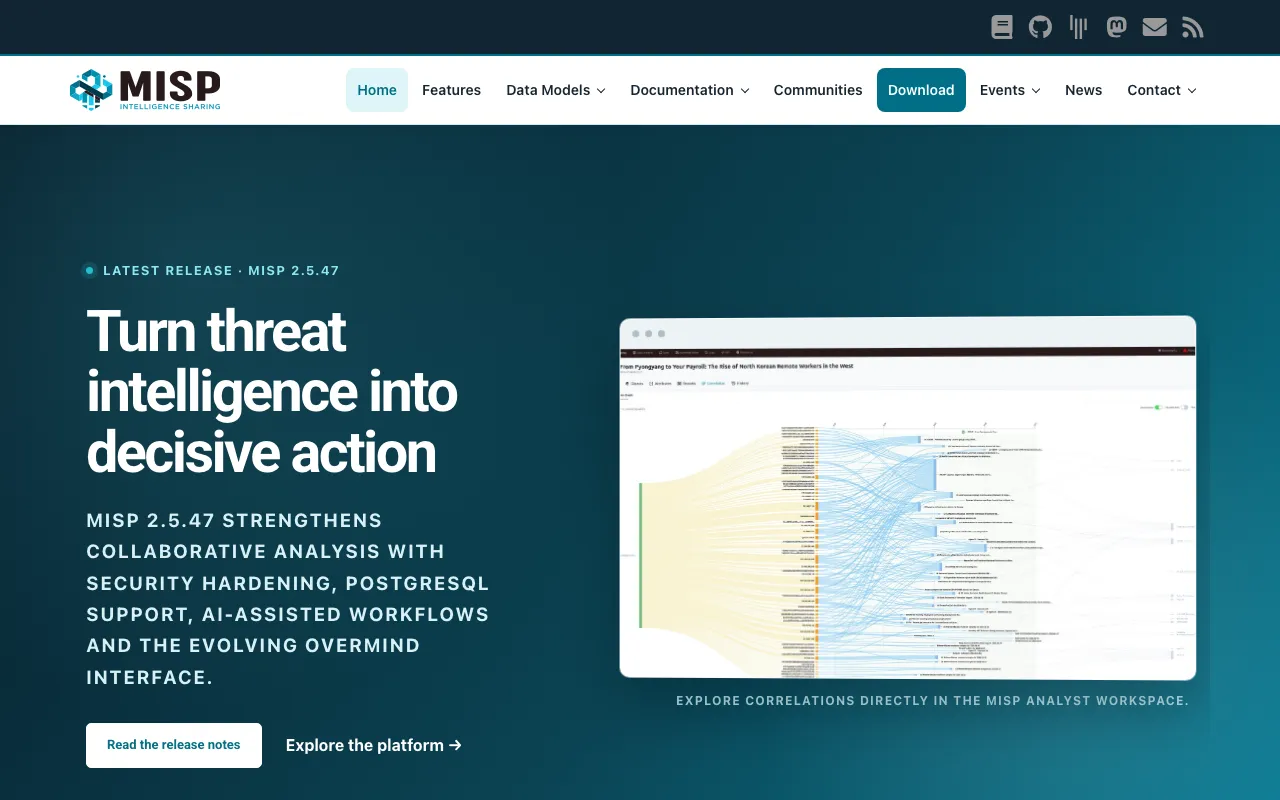
MISP collects, stores, and shares structured security indicators and threat data for incident analysts, with correlation, workflows, and API access.
MISP is open source software for collecting, storing, distributing, and sharing cybersecurity indicators and threat information. It targets incident analysts, security professionals, and malware analysts who need structured exchange during daily operations.
Events can mix machine-readable indicators with Markdown reports, objects, attributes, and cross-references. A correlation engine links related attributes, including fuzzy hash and CIDR-style matches. Sharing models, sharing groups, and synchronization between MISP instances support trust communities with fine-grained control.
The platform exposes a broad REST API documented as OpenAPI, supports STIX-oriented workflows, and bundles galaxy taxonomies such as MITRE ATT&CK. Workflows automate qualification and publication. Exports feed IDS, SIEM, and log analysis tools. Dashboards, RBAC, signing, and audit logging help regulated sharing.
Organizations run MISP on their own infrastructure on-premise, in the cloud, or via SaaS if they choose a hosted operator. Installation options are documented on the project site. The goal stated in project materials is practical sharing and consumption of intelligence without unnecessary complexity.
MISP doesn't name these products itself, but its own description shows it does the same job.
AI-guided terminal toolkit for authorized security testing
Hackingtool bundles many security utilities in one console with optional AI help to pick tools and commands. It targets Linux and macOS and is meant for authorized testing only.

Local NVR with realtime IP camera object detection
Frigate records IP camera streams, detects objects with local AI, and integrates with Home Assistant over MQTT.

Self-hosted multi-agent autonomous penetration testing platform
PentAGI is a multi-agent system that plans and runs authorized penetration tests from plain-language goals. Specialized agents work in an isolated Docker sandbox with professional security tools and produce reports.

Community-driven YAML vulnerability scanner for apps and infrastructure
Nuclei scans applications, APIs, networks, DNS, and cloud setups for security issues using customizable YAML templates. Security researchers contribute templates for trending vulnerabilities.

Command-line secret scanner for git repos and files
Gitleaks finds passwords, API keys, and tokens in git history, directories, files, or stdin. It uses configurable regex rules and fits into local workflows and CI.

Credential discovery, classification, and live verification scanner
TruffleHog scans repositories, filesystems, chats, and cloud storage for machine credentials. It classifies findings and can test whether secrets still work.