qmetrics.net

memsearch

Markdown-first semantic memory layer for coding agents

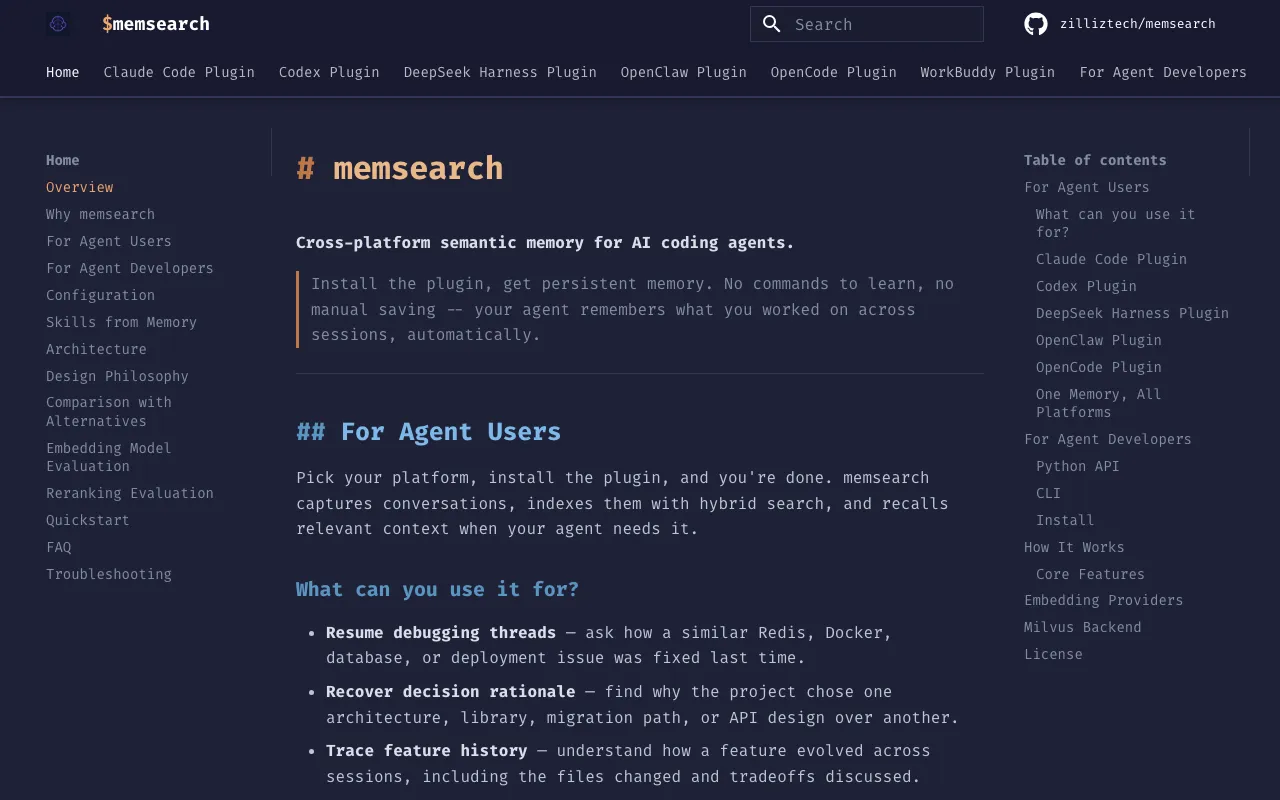
memsearch screenshot

memsearch indexes conversation summaries in Markdown with hybrid Milvus search, sharing memory across Claude Code, Codex, DSH, OpenClaw, OpenCode, and WorkBuddy plugins.

Overview

memsearch gives AI coding agents persistent, cross-session memory backed by Markdown files and a Milvus hybrid index. Plugins capture completed turns into .memsearch/memory journals, embed and index them with dense vectors plus BM25 sparse retrieval and RRF reranking, and recall context through progressive search, expand, and transcript layers.

Agent users install a platform plugin with little or no configuration; captures and recalls run automatically while skills such as memory-recall and memory-config handle explicit queries and setup. The same memory format and collection naming let conversations started in one agent appear in others when they share a project directory and backend.

Developers use the CLI and async Python MemSearch API to index paths, search, watch folders for live sync, and integrate custom agents. Markdown remains the source of truth; the vector store is a rebuildable shadow index with SHA-256 deduplication skipping unchanged chunks.

Milvus Lite defaults to a local file; optional Zilliz Cloud or self-hosted Milvus Server via Docker suit teams. Optional features include PROJECT.md and USER.md background maintenance, skill distillation into Agent Skills candidates, and ONNX bge-m3 embeddings without cloud API keys.

Key features

  • Cross-agent shared Markdown memory
  • Hybrid dense, BM25, and RRF search
  • Platform plugins for major coding agents
  • CLI watch and index commands
  • Python MemSearch async API
  • Milvus Lite or managed Milvus backends
  • Three-layer recall and transcript drill-down
  • Optional skills-from-memory distillation

Use cases

  • Resuming prior debugging discussions
  • Recovering architecture decision context
  • Tracing feature history across sessions
  • Sharing memory between Claude and Codex
  • Building custom agents with persistent RAG

Tags

Similar software

Superpowers

Agent skills methodology for disciplined coding

Superpowers adds composable skills and bootstrap instructions so coding agents brainstorm specs, plan in small tasks, follow test-driven development, and review work. Plugins install into many agent marketplaces and CLIs.

★ 328.1k⟳ 24 days agoMIT

ECC

Open-source agent engineering toolkit for coding harnesses

ECC adds planning, verification, review, memory, skills, and security scanning to coding agents such as Claude Code, Codex, and Cursor. It installs as plugins, packages, and managed adapters across multiple harnesses.

★ 311.7k⟳ 8 days agoMIT
Frameworks & PlatformsDesktop/CLI app

OpenCode

Open source coding agent for any model

OpenCode is an open source coding agent for desktop, terminal, mobile, or SDK use with many LLM providers and built-in development and read-only planning agents

★ 229.6k⟳ todayMIT
AI Assisted CodingDesktop/CLI app
Open Source Alternative to:Claude CodeCodiumate+3

Ponytail

Lazy senior-dev prompt skill for AI coding agents

Ponytail is a prompt skill that steers AI coding agents toward minimal, necessary code. It adds review and audit commands and optional usage metrics in supported hosts.

★ 199.9k⟳ 6 days agoMIT
AI Assisted CodingDesktop/CLI app

Visual Studio Code

Extensible editor for edit-build-debug workflows

Visual Studio Code combines a lightweight code editor with navigation, debugging, and an extension model. Builds are available for Windows, macOS, and Linux, with a browser-based option.

★ 195.8k⟳ todayMIT
AI Assisted CodingDesktop/CLI app
Open Source Alternative to:Windsurf

Dify

Open-source LLM app platform for agents, workflows and RAG

Dify is an LLM app development platform combining a visual workflow canvas, RAG pipelines, agents, model management and observability. It runs as a hosted cloud service or self-hosted with Docker Compose.

★ 162k⟳ todayApache-2.0
Open Source Alternative to:Relevance AI