Kubernetes
Open-source container scheduling and management system
Kubernetes (K8s) manages containerized applications across many hosts. It automates deployment, scaling, and ongoing operations for grouped containers.
Production-grade Kubernetes cluster lifecycle tool
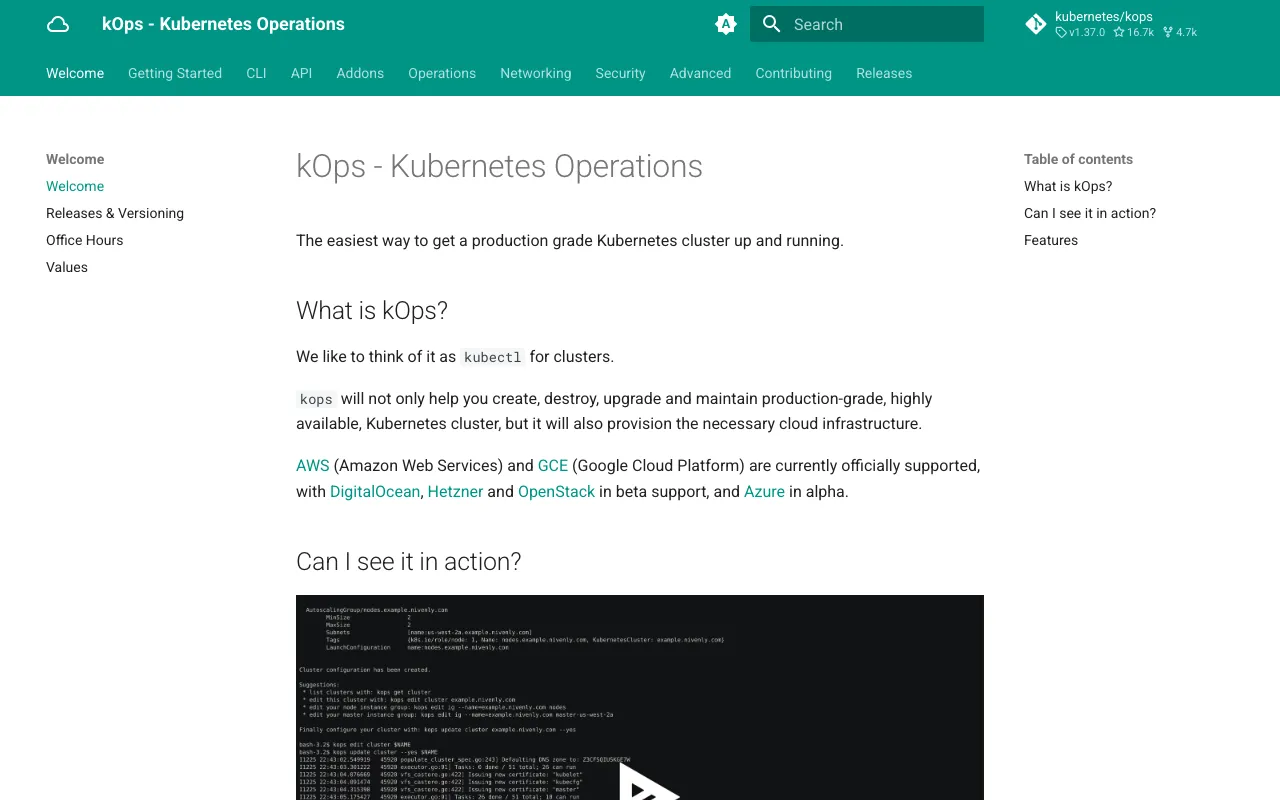
kOps creates, upgrades, and maintains highly available Kubernetes clusters and provisions supporting cloud infrastructure from the command line.
kOps, short for Kubernetes Operations, is a command-line tool oriented toward production Kubernetes clusters. Documentation describes it as analogous to kubectl, but focused on whole clusters rather than individual resources.
The tool creates, destroys, upgrades, and maintains highly available clusters and can provision the underlying cloud infrastructure. AWS and Google Cloud are officially supported, with DigitalOcean, Hetzner, and OpenStack in beta and Azure in alpha.
Documented capabilities include automated HA cluster provisioning, a state-sync model for dry runs and idempotent changes, optional Terraform output, YAML manifest APIs, configuration templating, choice of common CNI providers, ARM64 support, and hooks to add files or containers to nodes via cluster manifests. Managed Kubernetes add-ons can be installed with minimal configuration, and shell autocompletion is supported.
Users typically start from getting-started material for hosted Kubernetes services or on-premises targets. Documentation is published at the kOps SIG site.
Open-source container scheduling and management system
Kubernetes (K8s) manages containerized applications across many hosts. It automates deployment, scaling, and ongoing operations for grouped containers.

Compact certified Kubernetes distribution for constrained environments
K3s packages production-ready Kubernetes in a single small binary with lighter memory use, aimed at edge, IoT, CI, development, and ARM deployments.
Local Kubernetes cluster for development and learning
Minikube runs a Kubernetes cluster on macOS, Linux, and Windows. It focuses on local app development and supports common Kubernetes features via CLI controls.

Serverless functions platform for Kubernetes
OpenFaaS deploys event-driven functions and microservices on Kubernetes using OCI images, with scaling, metrics, and a UI portal.

Multi-cluster Kubernetes and container management platform
Rancher is a container management stack for running and operating Kubernetes across environments. It targets production teams that need centralized cluster control, security, and DevOps tooling.
Ansible automation for production-ready Kubernetes clusters
Kubespray deploys highly available Kubernetes clusters on public clouds, OpenStack, vSphere, or bare metal. Ansible playbooks drive installation and upgrades across many Linux distributions.