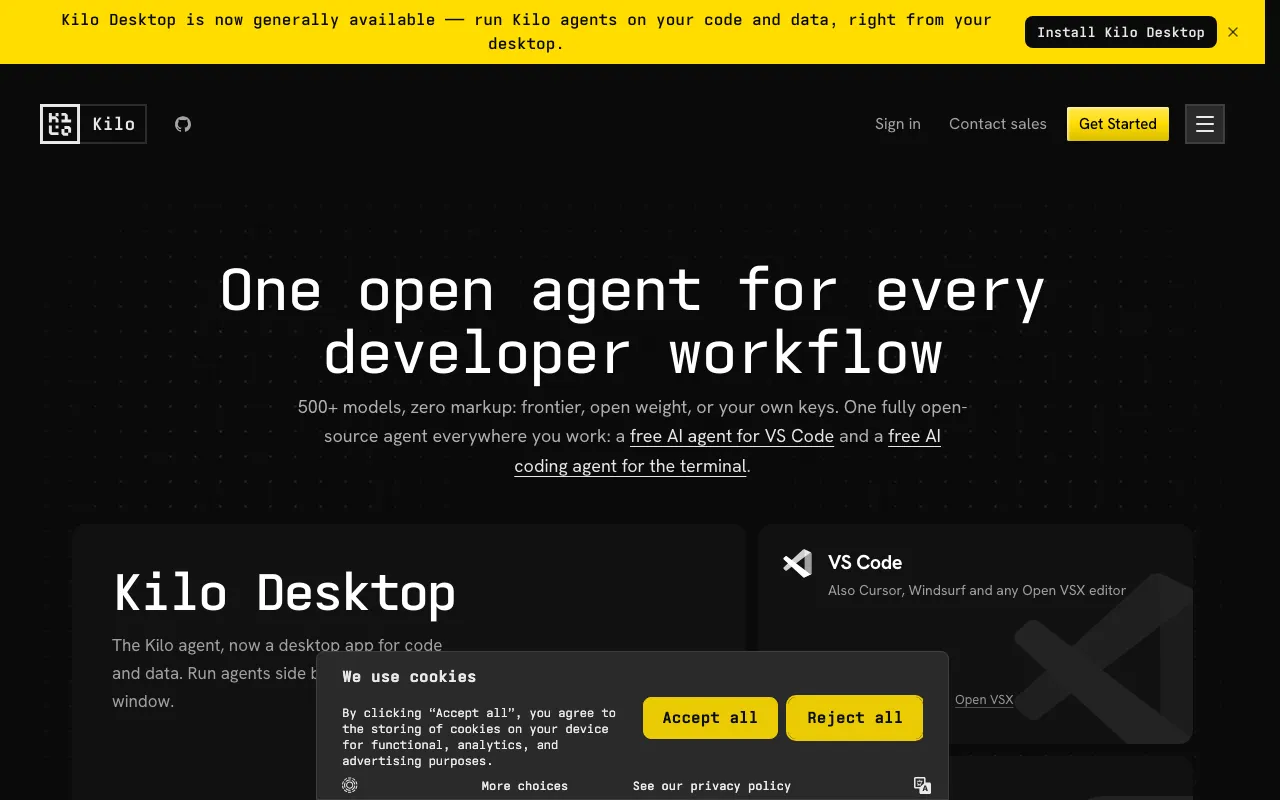
Kilo connects IDEs, JetBrains, CLI, and cloud surfaces to AI agents for coding, planning, debugging, and reviews across many models.
Overview
Kilo is an agentic engineering platform centered on an AI coding agent that runs in VS Code, JetBrains IDEs, a command-line interface, and optional cloud and Slack surfaces. Users can start without supplying API keys and choose among hundreds of models, switching models during a task and paying provider rates without markup according to the project materials.
Built-in agent modes include default coding, architecture planning, read-only codebase questions, and debugging. Capabilities described in the documentation include multi-file code generation, inline ghost-text autocomplete, self-review of agent output, terminal and browser control, and a marketplace for extra agents, skills, MCP servers, and plugins.
The CLI ships as downloadable binaries for Windows, macOS, and Linux, and supports an autonomous run mode intended for trusted CI/CD environments that auto-approves prompts. Separate web offerings cover cloud agents and automated pull request code reviews. A desktop application is also advertised for running agents side by side on macOS, Windows, and Linux.
Pricing-oriented features include bringing your own API keys and routing strategies such as efficient, frontier, and free model selection. The website presents the project as MIT-licensed source that can be forked and inspected, with gateway-based access to models and integrations across editor, terminal, cloud, and team chat workflows.
Key features
- VS Code and JetBrains integrations
- Multi-file code generation
- Inline autocomplete suggestions
- Code, Plan, Ask, and Debug agents
- Hundreds of switchable AI models
- CLI with CI autonomous mode
- Cloud agents and PR code reviews
- Marketplace for agents and MCP
Use cases
- IDE-assisted feature implementation
- Terminal agent workflows
- Autonomous CI pipeline coding tasks
- Automated pull request reviews
- Architecture planning before coding
Open-source alternative to
 Cursor
“Cursor alternative: why developers switch to Kilo Code” source



 Claude Code