qmetrics.net

KeystoneJS

Node.js headless CMS with GraphQL and React

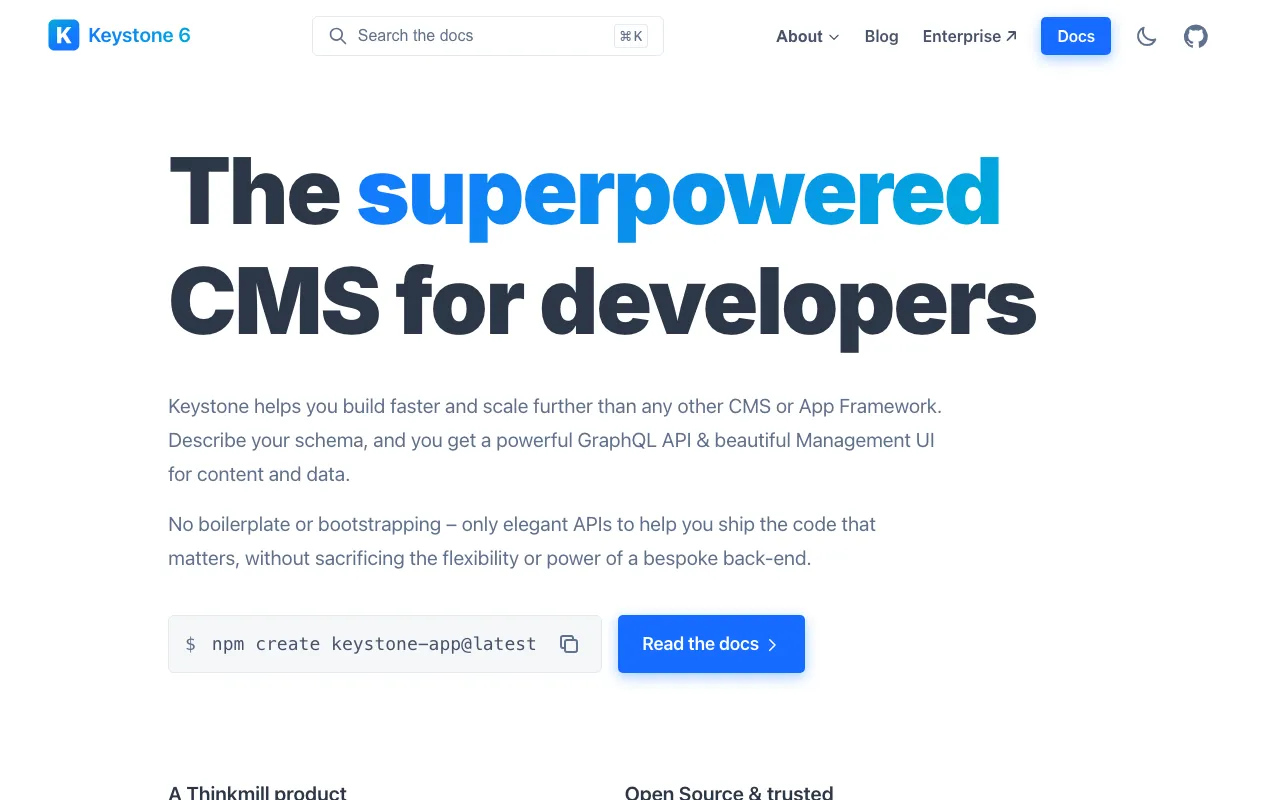
KeystoneJS screenshot

KeystoneJS lets developers define a content schema and receive a GraphQL API plus an admin UI for managing structured content and data on Node.js.

Overview

KeystoneJS is a headless content management system for Node.js that combines a GraphQL API with a React-based management interface. Developers describe lists, fields, and relationships in code, and Keystone generates APIs and editing screens aligned with that schema.

The platform supports primitive and advanced field types, relational data, filters, automated CRUD operations, session management, access control rules, event hooks, and database migrations through Prisma. Projects can be authored in TypeScript or JavaScript, and custom queries, mutations, and server logic can extend the generated API.

Editors work in a configurable admin environment that respects the same access rules as the API, including rich text and custom React components. Frontends in any framework can consume the GraphQL endpoint for websites, apps, commerce, or multichannel distribution.

Keystone is installed via npm and bootstrapped with a create-keystone-app command-line tool. Documentation, examples, and an API reference cover first setup and feature-specific learning paths. The website states it can be deployed to managed hosts or custom infrastructure and fits git-based development workflows with familiar CI tooling.

Key features

  • GraphQL content API
  • React-based management UI
  • Code-defined schema and lists
  • Fine-grained access control
  • Prisma database migrations
  • TypeScript and JavaScript support
  • Relational fields and filters
  • Custom queries and event hooks

Use cases

  • Structured content backends
  • Custom application CMS layers
  • Commerce and multichannel APIs
  • Headless website content
  • Team content editing with roles

Tags

Similar software

Payload

Next.js-native headless CMS and app framework

Payload is an open-source TypeScript framework that installs into a Next.js app folder. It provides a backend, admin UI, and APIs for content-driven or custom applications.

★ 46k⟳ todayMIT
Open Source Alternative to:Sanity

Directus

SQL-backed headless CMS with APIs and Studio

Directus wraps a SQL database with auto-generated REST and GraphQL APIs, a visual Studio for teammates, and MCP connectivity for AI tools on your data.

★ 38.7k⟳ 4 days agoSource-available
Alternative to:ContentfulSanity+1

TinaCMS

Git-backed headless CMS with visual Markdown editing

Open-source headless CMS for Markdown, MDX, JSON, and YAML with GraphQL queries and optional live preview. Content lives in your Git repository.

★ 13.9k⟳ yesterdayApache-2.0

Webiny

Self-hosted AI-programmable headless CMS on AWS serverless

Webiny is an open-source content platform you deploy into your own AWS account. It combines a headless CMS, visual website builder, and file manager with a TypeScript extension framework.

★ 8.1k⟳ todayMIT · open core
Open Source Alternative to:ContentfulSanity+1

Rowy

Low-code backend and spreadsheet CMS for Firebase

Rowy offers a browser-based, spreadsheet-style interface for Firestore and tools to build Cloud Functions workflows in JavaScript or TypeScript on Google Cloud.

★ 6.8k⟳ 2 years agoApache-2.0
Content Management Systems (CMS)No commits in 18+ monthsSelf-hostable

Yoopta Editor

Headless Notion-style block editor framework for React

Yoopta Editor is an open-source Slate-based React toolkit with plugins, themes, and UI components for building block editors, CMSes, or site builders.

★ 3.1k⟳ 6 months agoMIT