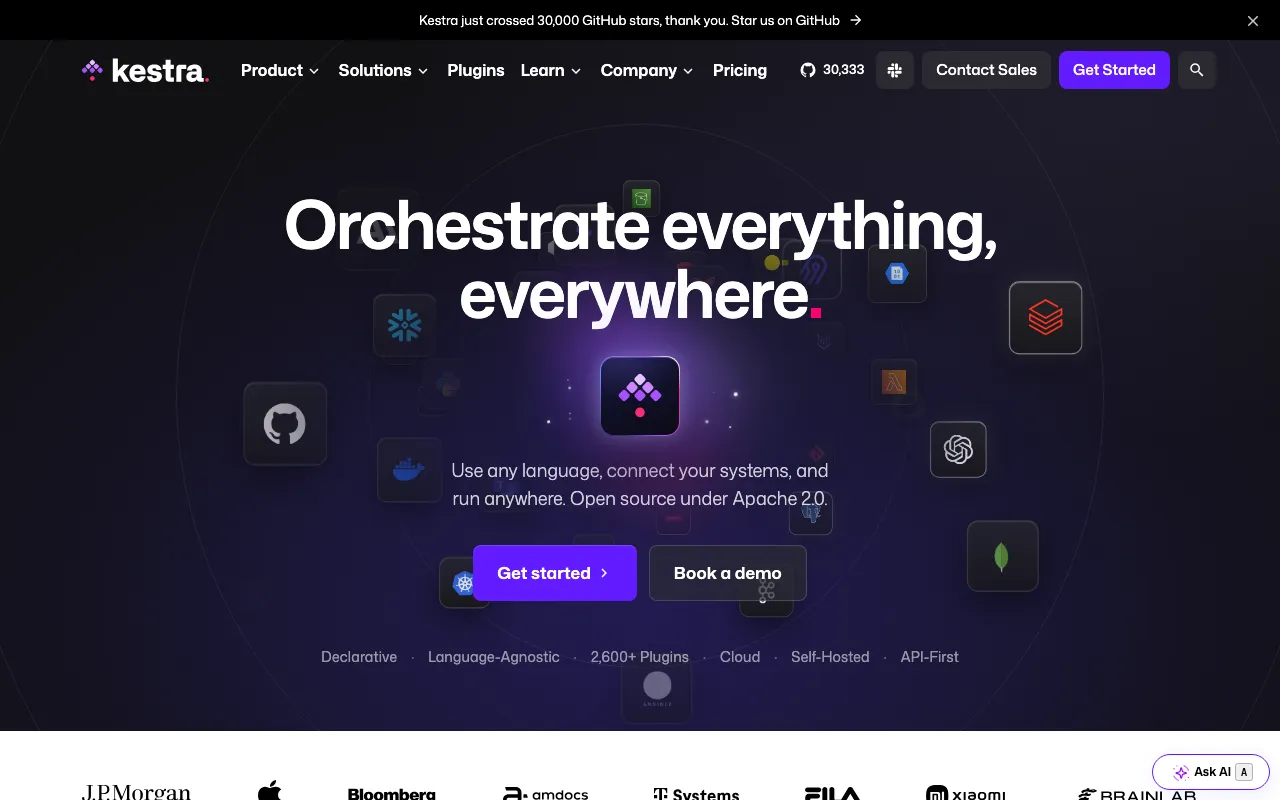
Kestra schedules and event-triggers workflows defined in YAML, with a web UI, plugins, and Git versioning for data, infrastructure, and process automation.
Overview
Kestra is an event-driven orchestration platform for data, AI, and infrastructure workflows. Teams define flows declaratively in YAML, run them on schedules or in response to events, and manage executions through a built-in UI while keeping definitions versioned and reviewable alongside Git and CI/CD practices.
Flows are made of tasks such as scripts, SQL queries, HTTP calls, container jobs, and cloud operations, organized into namespaces with inputs, outputs, retries, timeouts, branching, and error handling. Triggers can fire on cron schedules or external signals, including message buses and file arrivals via the plugin ecosystem. The UI offers YAML editing, a no-code builder, topology visualization, and an AI copilot sidebar for asking, editing, or planning flows.
Hundreds of plugins connect to databases, cloud storage, APIs, messaging systems, and scripting languages including Python, Node.js, Go, R, and shell. AI-oriented task types support LLM providers, agents, RAG pipelines, and an MCP server that exposes flows to external agents. Workers communicate with the control plane over gRPC so execution can span regions or restricted networks.
Getting started commonly uses a Docker image, with installation paths for Docker Compose, Kubernetes, and major cloud templates. Kestra Core is self-hosted for production experimentation, while separate managed cloud and enterprise offerings add multi-team governance features. Flow code stays synchronized when edited from the UI, API, or external tools so orchestration logic remains declarative.
Key features
- Declarative YAML workflow definitions
- Scheduled and event-driven triggers
- Web UI with no-code and YAML editors
- Large plugin ecosystem for integrations
- Git version control integration
- AI agents and RAG workflow tasks
- Retries, quotas, and error handling
- Docker-based local deployment
Use cases
- Data pipeline and ETL orchestration
- Infrastructure provisioning automation
- Business process workflows with approvals
- AI agent and LLM workflow coordination
- Event-driven microservice automation
Does the same job as
Kestra doesn't name these products itself, but its own description shows it does the same job.