Ragas
Toolkit for evaluating large language model applications
Ragas is a Python library for scoring LLM apps with objective metrics, generating test data, and integrating with common LLM frameworks and observability tools.

Benchmark and toolkit for LLM-generated GPU kernels
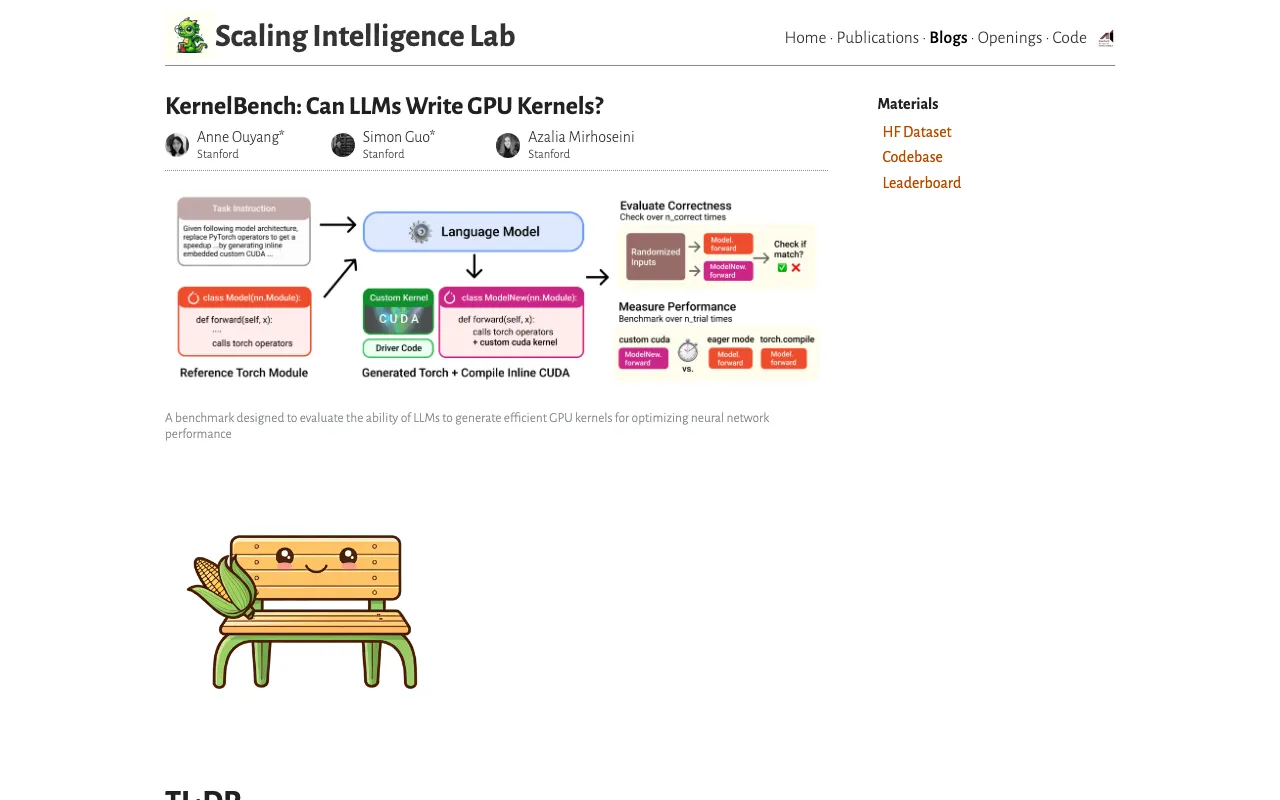
KernelBench evaluates whether language models can produce correct, fast CUDA and other GPU kernels that replace PyTorch operators on target hardware.
KernelBench is a benchmark and toolkit for assessing large language models on GPU kernel generation. The task is to transpile PyTorch operator descriptions into correct, efficient kernels in CUDA and additional DSLs, measured on a chosen GPU.
Problems are grouped into levels: single-kernel operators, simple fusion patterns, full model architectures, and Hugging Face model-style tasks. Evaluation checks correctness against reference PyTorch on randomized inputs and compares wall-clock runtime for speedup. The fast_p metric counts tasks that are both correct and exceed a speedup threshold relative to the PyTorch baseline.
Included scripts run and check individual samples, analyze benchmark results, and generate baseline timings. Backends include CUDA, Triton, HIP for AMD GPUs, and several other named DSLs. It can be imported as a library for timing and evaluation helpers, and supports local runs or remote evaluation through Modal when no local GPU is available.
KernelBench is framed as an open evaluation framework rather than a packaged agent scaffold; researchers are expected to clone or submodule it and adapt experiments. Profiling and correctness tooling are central to iterative kernel refinement workflows.
Toolkit for evaluating large language model applications
Ragas is a Python library for scoring LLM apps with objective metrics, generating test data, and integrating with common LLM frameworks and observability tools.
Multi-tier evaluation framework for agent skills
SkillEvaluator checks agent skills and plugins for quality, security, overlap, and real agent impact, with a CLI and reusable GitHub or GitLab CI templates.

Open toolkit for large vision-language model benchmarks
VLMEvalKit evaluates large vision-language models on many image and video benchmarks with one-command runs and generation-based scoring.

Open-source plugin-based agent harness from DeepSeek
DeepSeek Harness is an open-source agent harness built on an everything-is-a-plugin architecture powered by Cordis. It offers a web UI, desktop app, and extensible plugins for daily work, coding, and automation.

Self-improving open-source AI agent with memory, skills and messaging gateway
Open-source AI agent from Nous Research that keeps persistent memory, creates skills from experience, and runs from a terminal, desktop app or messaging platforms with any model provider.

Web scrape crawl and search infrastructure for AI agents
Firecrawl turns websites into LLM-ready markdown and structured data via API, CLI, and MCP. It supports scrape, crawl, map, batch jobs, optional cloud scale, and self-hosted server deployment.
 Anthropic Claude
 ChatGPT