
GoReplay
Capture and replay live HTTP traffic
GoReplay records HTTP from network interfaces and replays it to test servers for shadowing, load testing, and debugging. It runs as a command-line daemon without in-path proxy changes.

Record-and-replay API and integration testing from traffic
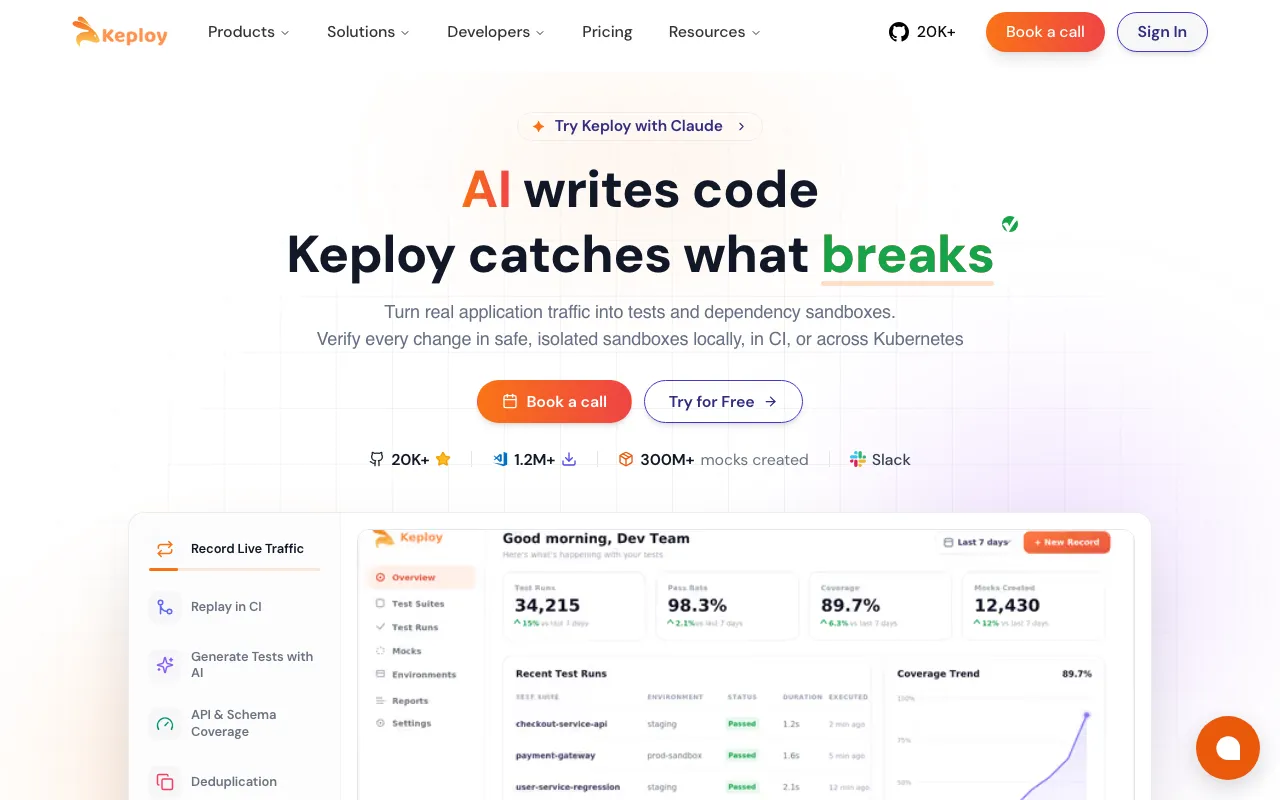
Keploy captures API calls, database queries, and streaming events, then replays them as tests and dependency mocks without changing application code.
Keploy is a developer-focused tool for API and integration testing that builds tests and data mocks from real application traffic. It records incoming requests and outgoing dependency calls using network-level capture, then replays that behavior so teams can run regression checks without standing up full external infrastructure each time.
Workflows center on recording while the application runs, then executing tests offline against mocks. Recorded flows can cover HTTP APIs plus dependencies such as Postgres, MySQL, MongoDB, Kafka, RabbitMQ, and other external systems, which Keploy replays deterministically. Interception happens at the network layer rather than through per-language SDKs in typical setups, which keeps the approach language-agnostic.
Coverage reporting spans statement and branch metrics for developers and API schema or business-case coverage for QA-oriented workflows. CI/CD runs on the CLI or in pipelines, a console manages recordings, unified reporting spans test types, time freezing applies during replay, and a mock registry enables reuse across environments. AI-assisted expansion can propose extra cases from recordings and OpenAPI schemas.
Compared with manually authored API collections or hand-maintained HTTP mocks, Keploy generates tests and dependency stubs from observed behavior, including non-HTTP dependencies. Tests can run locally, in CI/CD, or across Kubernetes for verifying changes before merge or deploy.
Capture and replay live HTTP traffic
GoReplay records HTTP from network interfaces and replays it to test servers for shadowing, load testing, and debugging. It runs as a command-line daemon without in-path proxy changes.

JavaScript API mocking through network-level request interception
Mock Service Worker lets you define HTTP mocks once and reuse them in browsers and Node.js. Applications keep calling real APIs while responses are substituted at the network layer.

Node.js HTTP server testing via superagent
Supertest offers a fluent API for asserting HTTP behavior against Node.js servers during automated tests. It builds on superagent so you can express status, headers, and body expectations in code.
Open continuous testing platform with built-in AI assistant
MeterSphere is an open continuous testing tool with AI-assisted case generation, test management, and API testing for teams. It uses a system-organization-project hierarchy for collaboration.

Unified open-source test automation framework
Karate combines API testing, mocks, performance testing, and UI automation in one framework with a readable syntax. Tests run via JUnit, a CLI, or CI/CD with parallel execution.

Local desktop and CLI tools for REST API mocking
Mockoon lets you design and run mock HTTP APIs on your machine without cloud accounts. A desktop app handles editing; a CLI runs mocks in CI, Docker, and serverless setups.