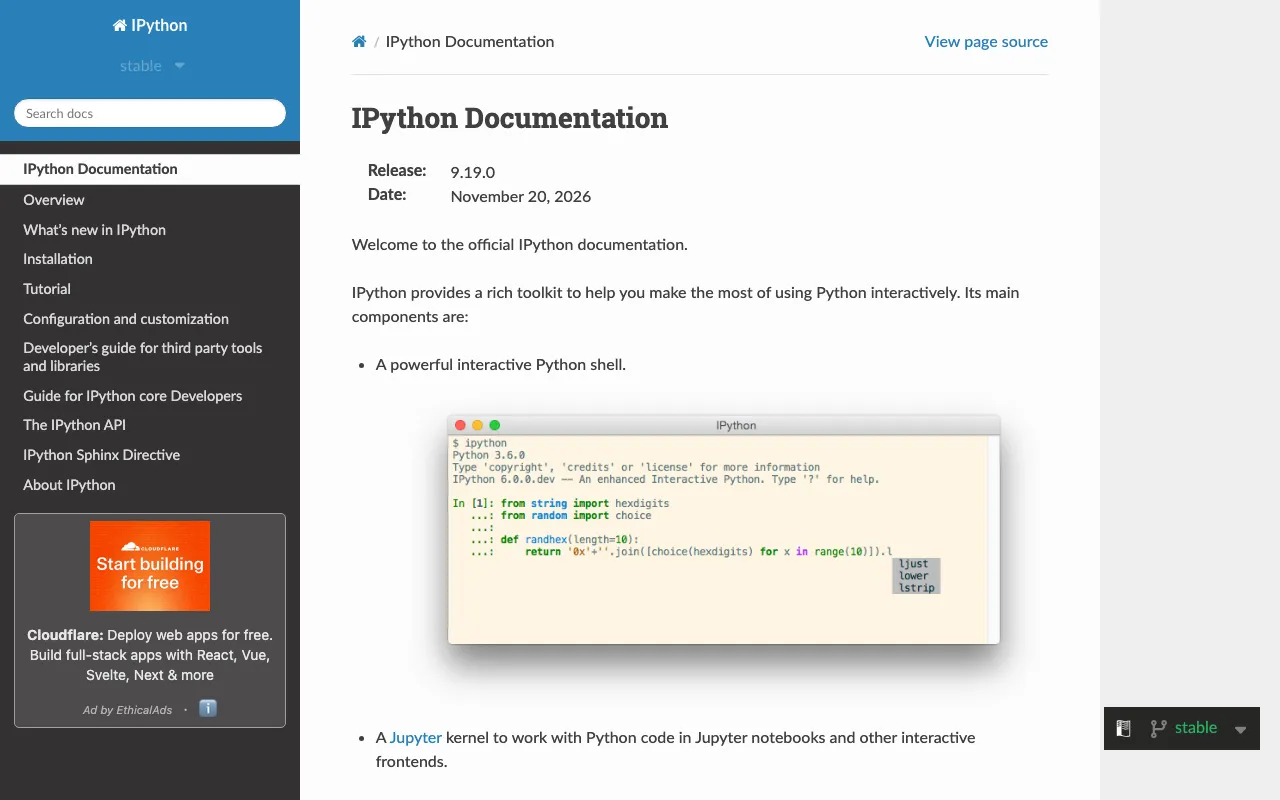
An interactive Python command shell and Jupyter kernel with introspection, history, magics, and embeddable REPL features.
Overview
IPython (Interactive Python) is a command shell for interactive computing, originally centered on Python. It provides object introspection, persistent input history, cached outputs with auto-generated references, and extensible tab completion for variables, keywords, filenames, and function arguments.
An extensible magic-command system controls the environment and automates tasks related to the shell or the operating system. Configuration can be switched between setups without juggling startup environment variables. The shell also supports session logging and reloading, special-purpose syntax processing, system-shell access with aliases, embedding in other Python programs and GUIs, and integrated access to pdb and the Python profiler.
The command-line interface adds multi-line editing via prompttoolkit, syntax highlighting while typing, and integration with external command-line editors. As a Jupyter kernel, it can drive notebooks and other frontends, enabling rich displays of HTML, images, LaTeX, audio, and video and interactive widgets when used with ipywidgets.
Notebook, Qt console, and several related tools now live under the Jupyter project; IPython itself remains the core interactive shell and kernel implementation.
Key features
- Interactive Python shell
- Jupyter-compatible kernel
- Object introspection and magics
- Persistent command history
- Extensible tab completion
- Rich media display in frontends
- Multi-line CLI editing
- Embeddable in applications
Use cases
- Exploratory Python sessions
- Jupyter notebook kernels
- Data-science interactive workflows
- Debugging and profiling from a REPL
- Embedding a Python shell in GUIs


 Anthropic Claude
 ChatGPT