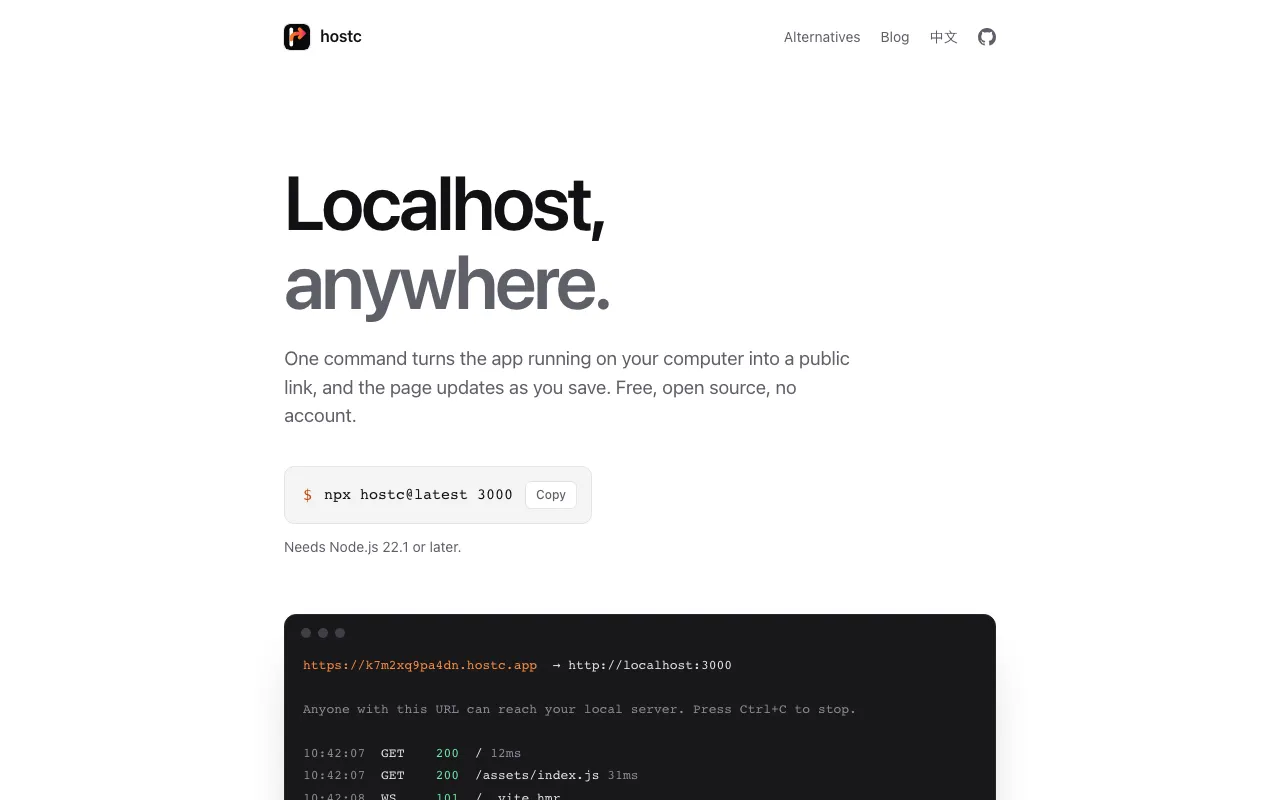
hostc exposes a local dev server through a public HTTPS URL with one npx command. WebSockets and hot reload pass through without signup, aimed at sharing work-in-progress safely.
Overview
hostc is a command-line tunnel aimed at developers who need a temporary public URL for a server running on localhost. After your app listens on a port, you run hostc against that port and receive a link you can open on other devices; requests log in the terminal as they arrive.
The tunnel preserves WebSocket traffic so Vite, Next.js, and similar dev servers can hot-reload clients connected through the public URL. Requests are rewritten so your app sees localhost hostnames, and the link can reconnect for a short window after network drops. No account or separate binary is required beyond a supported Node.js version.
The tool compares itself to broader Cloudflare Tunnel workflows but focuses on quick dev sharing with Server-Sent Events support and minimal setup. An experimental hostc codex mode exposes local Codex CLI use from a browser with explicit security warnings. You can also point the CLI at a self-hosted worker with --server.
Key features
- One-command public HTTPS tunnel
- WebSocket and HMR passthrough
- No account or auth token
- Request logging in the terminal
- QR code option for phone testing
- Automatic reconnect within time window
- Optional self-hosted worker backend
- Experimental browser Codex bridge
Use cases
- Sharing a dev build with a teammate
- Testing webhooks against localhost
- Previewing on a phone with hot reload
- Demoing AI-generated prototypes quickly
Does the same job as
hostc doesn't name these products itself, but its own description shows it does the same job.