Hackingtool
AI-guided terminal toolkit for authorized security testing
Hackingtool bundles many security utilities in one console with optional AI help to pick tools and commands. It targets Linux and macOS and is meant for authorized testing only.

Cross-platform browser forensic data export CLI
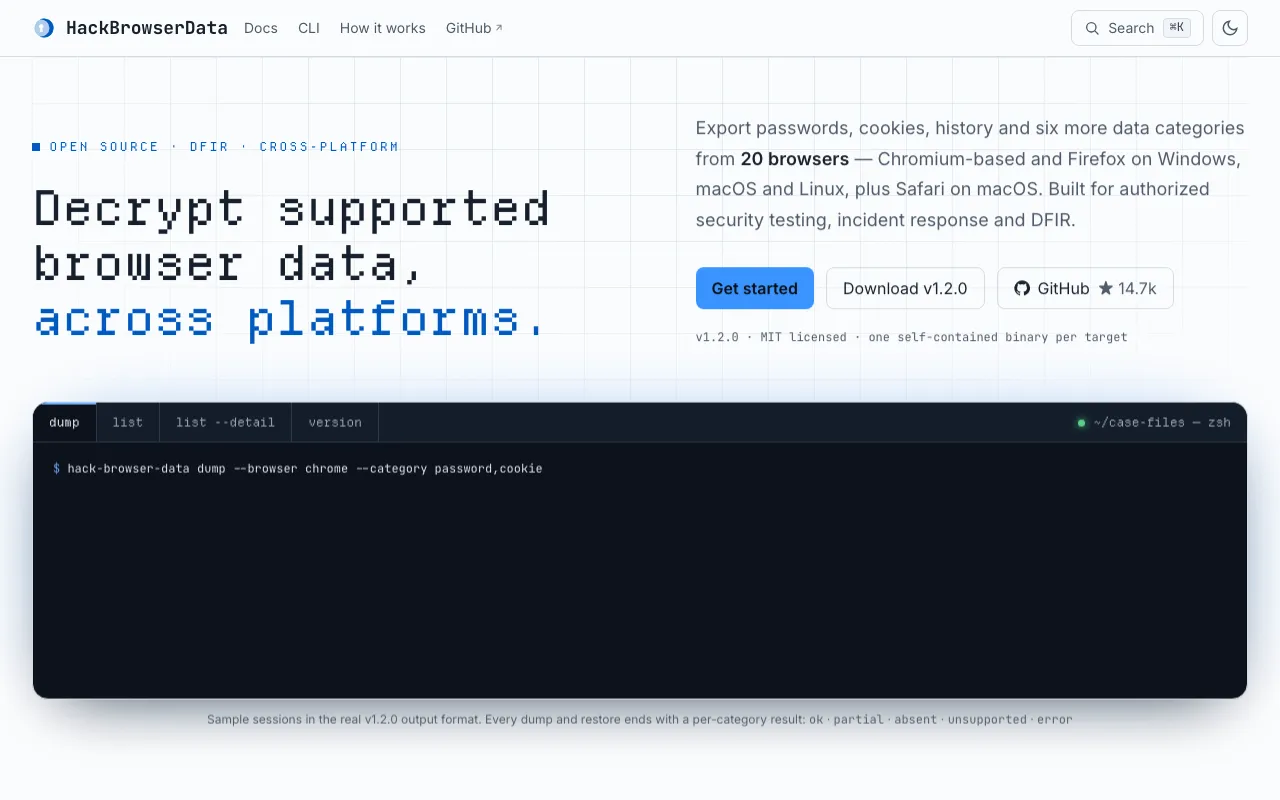
HackBrowserData decrypts and exports passwords, cookies, history, bookmarks, and more from many Chromium, Firefox, and Safari profiles on Windows, macOS, and Linux. It is aimed at authorized security research, incident response, and DFIR.
HackBrowserData is a single-binary command-line tool that reads local browser profiles, decrypts protected data where keys are available, and writes structured exports per category. Supported categories include passwords, cookies, bookmarks, history, downloads, credit cards on Chromium engines, extensions, and local or session storage where applicable.
Coverage spans numerous Chromium derivatives plus Firefox across three desktop operating systems, with Safari supported on macOS when system permissions allow. Documentation notes platform-specific requirements such as macOS keychain passwords, Full Disk Access for Safari, and optional Windows payloads for newer Chromium app-bound cookie encryption.
The default dump subcommand extracts all configured browsers and categories to a results directory in JSON, CSV, or a cookie-editor compatible format, with flags to target specific browsers, profiles, and output folders. A list command enumerates detected installations and profiles, optionally with per-category counts.
For cross-machine workflows, dumpkeys exports portable master keys on the origin host, archive packs only files needed for decryption, and restore decrypts copied data on an analyst machine using those keys. This supports examining Windows-only browsers from macOS or Linux without moving OS-bound secrets off the original system.
AI-guided terminal toolkit for authorized security testing
Hackingtool bundles many security utilities in one console with optional AI help to pick tools and commands. It targets Linux and macOS and is meant for authorized testing only.

Community-driven YAML vulnerability scanner for apps and infrastructure
Nuclei scans applications, APIs, networks, DNS, and cloud setups for security issues using customizable YAML templates. Security researchers contribute templates for trending vulnerabilities.
Self-hosted autonomous penetration testing platform with evidence
ARTEX runs multi-agent offensive security tests on your infrastructure, linking findings to captured HTTP traffic, scope rules, and human approval gates.

Mobile device compromise forensics toolkit
MVT gathers and analyzes forensic traces from Android and iOS devices to spot signs of spyware or targeting. It is a command-line toolkit for investigators, not casual self-checks.

Command-line vulnerability scanner for images and filesystems
Grype scans container images, directories, and SBOMs for known security vulnerabilities. It supports OpenVEX to filter or enrich results and installs via common package managers or containers.
Menu-driven penetration testing tools collection
Fsociety bundles many security scripts behind one Python menu for reconnaissance, attacks, sniffing, and post-exploitation.