nvm
POSIX shell version manager for Node.js
nvm installs and switches between Node.js versions from the command line on POSIX shells including bash and zsh.

Self-hosted OpenFeature-native feature flag relay
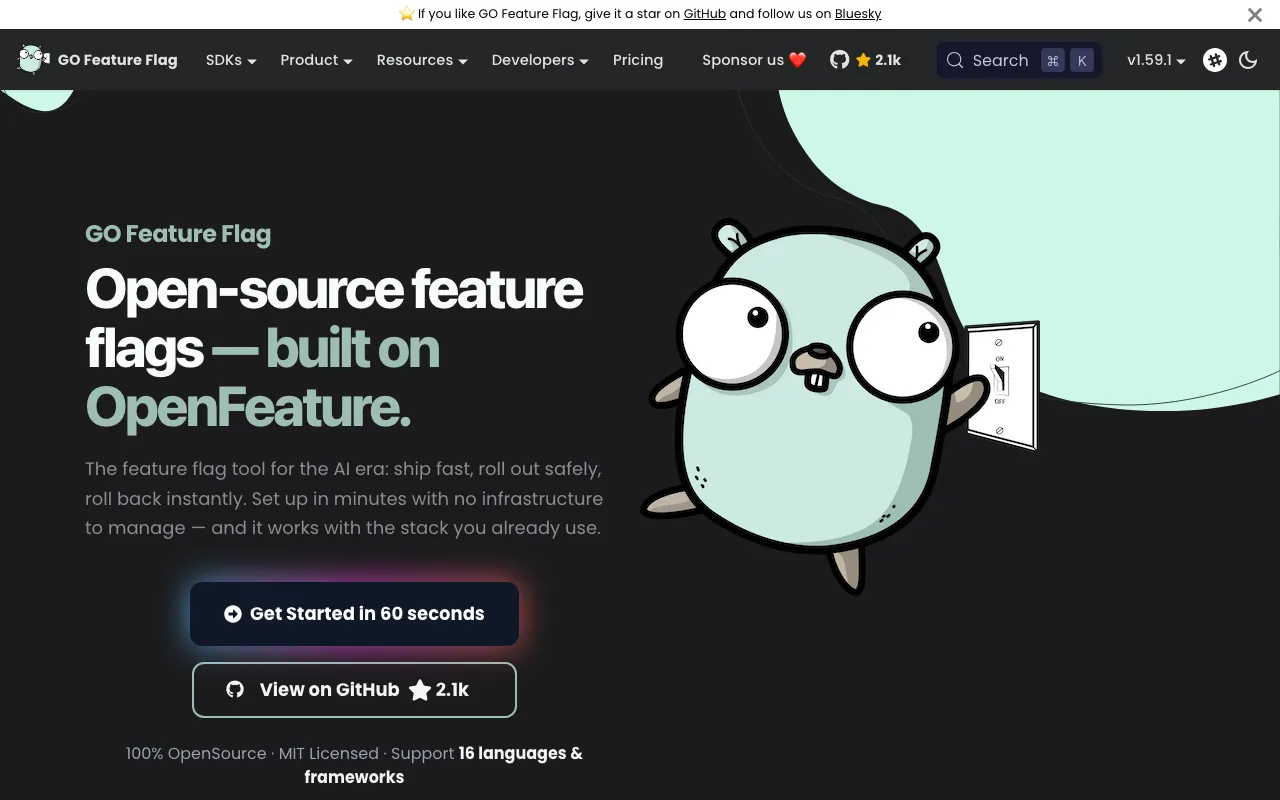
GO Feature Flag stores flag rules in files and evaluates them via a relay proxy or Go module. It targets OpenFeature SDKs across many languages without a flag database.
GO Feature Flag is an open-source feature flag system built around file-based configuration and the OpenFeature standard. Teams define flags in YAML, JSON, or TOML, with targeting rules, percentage rollouts, scheduled updates, and experimentation windows. Flag files can be loaded from HTTP, object storage, Git hosts, Kubernetes ConfigMaps, databases, and other retrievers.
The recommended deployment runs the relay proxy, a small API service that evaluates flags for applications using OpenFeature provider SDKs in languages such as JavaScript, Java, Python, .NET, and Go. Go-only projects can embed the Go module to evaluate flags in-process with polling refresh. Variations are not limited to booleans; string, numeric, and structured JSON values are supported.
Rollout strategies include canary percentages, progressive increases, scheduled changes, and time-boxed experiments. Notifiers can post to Slack or webhooks when configuration changes, and exporters send usage data to storage or streaming systems. The design avoids operating a dedicated flag database; configuration remains in files the team already controls.
Official documentation and the product site describe starting the relay with Docker, a configuration file, and a few lines of SDK initialization so teams can adopt flags without proprietary SaaS lock-in.
GO Feature Flag doesn't name these products itself, but its own description shows it does the same job.
POSIX shell version manager for Node.js
nvm installs and switches between Node.js versions from the command line on POSIX shells including bash and zsh.

Fast Python package and project manager
uv is a Rust-based tool that manages Python dependencies, virtual environments, scripts, and interpreters. It offers a pip-compatible interface and universal lockfiles for projects.

Go-based static site generator with flexible templating
Hugo is a static site generator written in Go. It turns content and templates into deployable HTML sites with asset pipelines for CSS, JavaScript, Sass, and images.

Frontend build tool for modern web projects
Vite is a build tool for modern web projects, combining a development server with an optimized production build. It targets a faster, leaner local development workflow.

Local runner for GitHub Actions workflows
A command-line tool that executes GitHub Actions workflows on your machine using Docker. It mirrors GitHub’s environment for faster feedback while editing workflow files.

Modular toolkit for assembling container systems
Moby bundles container build, runtime, registry, and orchestration components so integrators can craft custom container platforms instead of using a single fixed product.