Lazygit
Terminal user interface for everyday Git workflows
Lazygit wraps common Git operations in a keyboard-driven terminal UI. You can stage partial changes, rebase, cherry-pick, and inspect history without memorizing fragile command sequences.

Dynamic GitHub statistic cards for profile readmes
GitHub Readme Stats is no longer maintained. The project says: “This repository is no longer maintained.” source Look at the maintained alternatives below before choosing it.
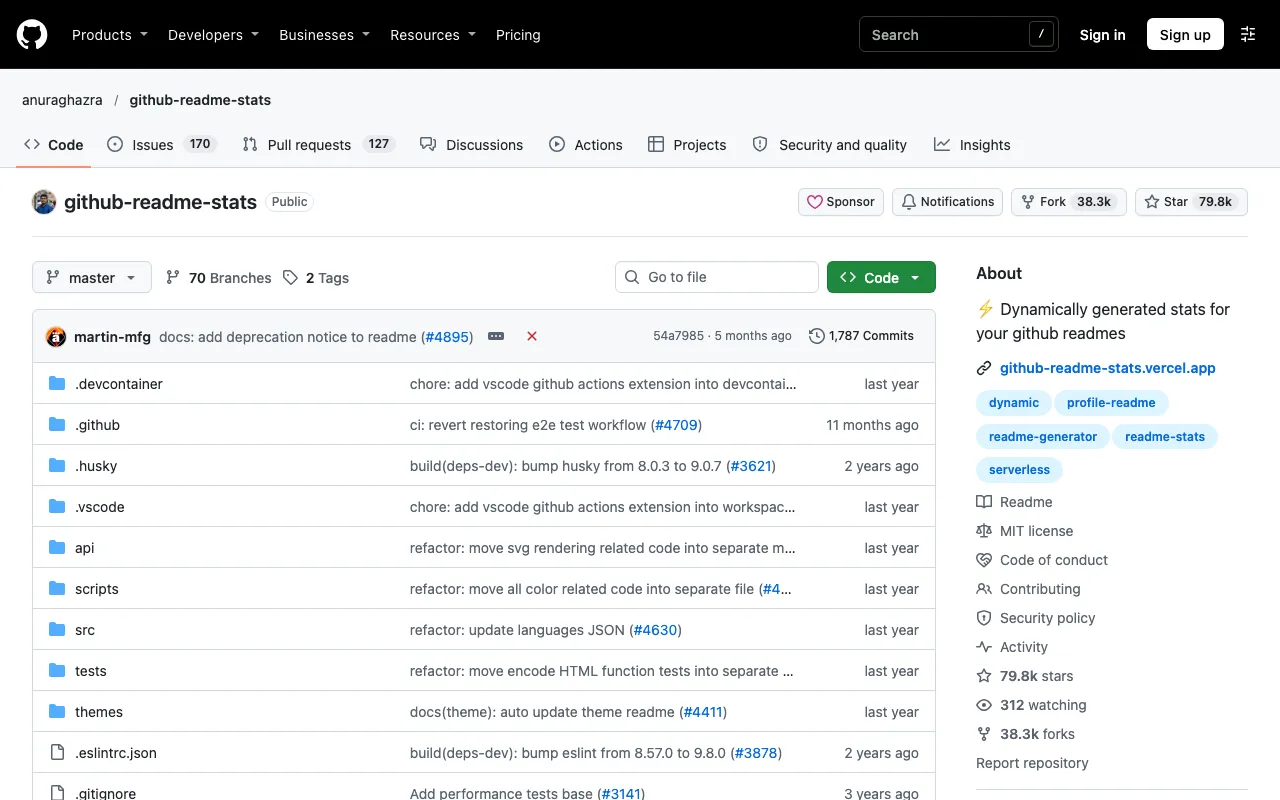
Embeddable image cards show GitHub activity, languages, pinned repos, gists, and optional WakaTime data on profiles. Appearance is controlled through URL parameters and themes.
The project renders stats as images users paste into GitHub markdown profiles. Cards can show stars, commits, pull requests, issues, contributions, ranks, and optional metrics such as reviews or merged PR percentages. Top-language cards summarize repository language breakdowns with several layout options including compact, donut, and pie styles.
Extra pin cards let profiles display more than six highlighted repositories, and gist pin cards surface gists similarly. Built-in themes and manual color parameters control appearance; a transparent theme targets GitHub light and dark defaults. Users can hide or show specific stats, filter commits by year, and tune caching headers when self-hosting.
A public hosted instance exists but documentation warns it may be unreliable under rate limits and recommends self-hosting on Vercel or other platforms, or using a GitHub Actions workflow in the profile repository. Private statistics require deploying an instance with a personal access token. Maintainers note the original repository is no longer maintained and point to successor projects.
Terminal user interface for everyday Git workflows
Lazygit wraps common Git operations in a keyboard-driven terminal UI. You can stage partial changes, rebase, cherry-pick, and inspect history without memorizing fragile command sequences.

Self-hosted Git forge with CI/CD and packages
Gitea is an all-in-one software development service you can run on your own infrastructure. It combines Git hosting with issues, reviews, project boards, package registries, and Gitea Actions CI/CD.

Self-hosted Git service with web collaboration tools
Gogs hosts Git repositories over SSH and HTTP(S) and adds issues, pull requests, wikis, and organization features through a browser UI.
Official GitHub terminal client
GitHub CLI brings issues, pull requests, and other GitHub workflows to the terminal beside git. It works with GitHub.com, Enterprise Cloud, and supported Enterprise Server deployments.

End-to-end developer platform with SCM, CI/CD, and registries
Harness Open Source combines code hosting, automated DevOps pipelines, hosted development environments called Gitspaces, and artifact registries in one platform.
Lightweight native Git hooks for Node projects
Husky wires Git hooks so teams can lint commit messages, run tests, or check code on commit and push. It uses core.hooksPath, stays around two kilobytes gzipped, and supports macOS, Linux, and Windows.