Lazygit
Terminal user interface for everyday Git workflows
Lazygit wraps common Git operations in a keyboard-driven terminal UI. You can stage partial changes, rebase, cherry-pick, and inspect history without memorizing fragile command sequences.

Safe Rust bindings to the libgit2 Git library
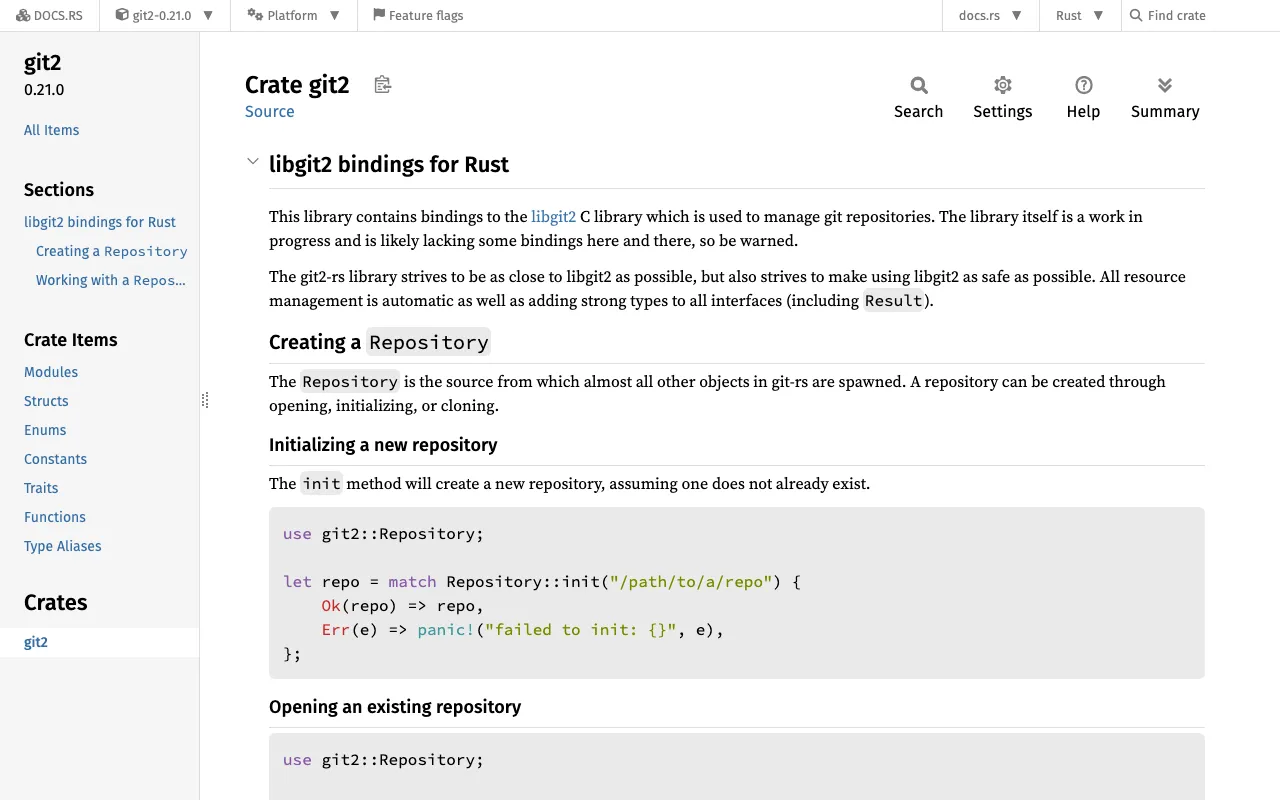
git2-rs exposes libgit2 to Rust programs for repository work. Local repository features are enabled by default; optional features add HTTPS and SSH networking.
git2-rs provides Rust bindings to libgit2, the C library used to manage Git repositories. The crate wraps libgit2 closely while adding stronger types and automatic resource management, including Result-based error handling across interfaces.
By default the library supports local repository operations without network access. Enabling the https and/or ssh Cargo features unlocks cloning and other remote workflows; both are recommended when code accepts user-supplied repository URLs. The bundled libgit2-sys crate vendors libgit2 sources, so a system install is optional—static linking applies when vendoring is on or no suitable system library is found, and dynamic linking is attempted when an appropriate version is present.
Typical use starts from a Repository opened, initialized, or cloned on disk. Most derived objects—commits, branches, diffs, and similar types—tie to that repository’s lifetime so handles cannot outlive the parent repo. The API covers indexing, merging, rebasing, diffs, configuration, remotes, and many other libgit2 capabilities exposed as Rust modules and structs.
git2-rs targets stable Rust and generally supports the prior stable release as well. It requires libgit2 2.0.0-rc.1 or newer patch releases. When the ssh feature is enabled on macOS, builds depend on libssh2 and OpenSSL per upstream crate guidance.
Terminal user interface for everyday Git workflows
Lazygit wraps common Git operations in a keyboard-driven terminal UI. You can stage partial changes, rebase, cherry-pick, and inspect history without memorizing fragile command sequences.

Self-hosted Git forge with CI/CD and packages
Gitea is an all-in-one software development service you can run on your own infrastructure. It combines Git hosting with issues, reviews, project boards, package registries, and Gitea Actions CI/CD.

Self-hosted Git service with web collaboration tools
Gogs hosts Git repositories over SSH and HTTP(S) and adds issues, pull requests, wikis, and organization features through a browser UI.
Official GitHub terminal client
GitHub CLI brings issues, pull requests, and other GitHub workflows to the terminal beside git. It works with GitHub.com, Enterprise Cloud, and supported Enterprise Server deployments.

End-to-end developer platform with SCM, CI/CD, and registries
Harness Open Source combines code hosting, automated DevOps pipelines, hosted development environments called Gitspaces, and artifact registries in one platform.
Lightweight native Git hooks for Node projects
Husky wires Git hooks so teams can lint commit messages, run tests, or check code on commit and push. It uses core.hooksPath, stays around two kilobytes gzipped, and supports macOS, Linux, and Windows.