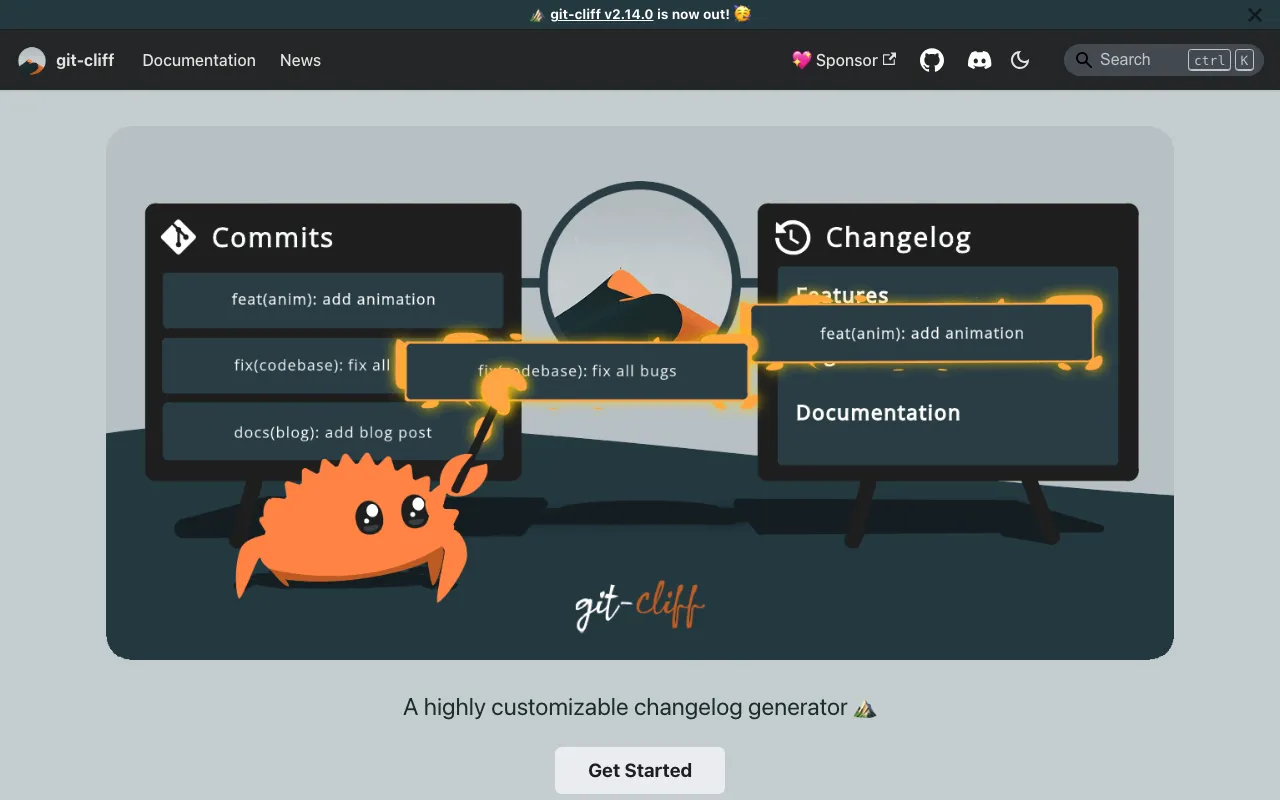
git-cliff builds changelog files from commits using conventional commits or custom regex parsers and templates.
Overview
git-cliff reads Git history and writes changelog files formatted to your template. It understands conventional commits out of the box and can also parse messages with regex-based custom rules when teams use their own conventions.
Output layout is driven by a configuration file and templating system, so headings, grouping, and sections can match project standards such as keep-a-changelog style notes. It runs as a command-line tool and can be wired into release automation alongside semantic versioning workflows.
The project ships documentation for installation, usage, configuration, and templating. It integrates with Rust, Python, and Node.js projects as a CLI, and can be embedded as a Rust library. Community write-ups and related tooling mention pairing it with conventional-recommended-bump for version bumps.
git-cliff targets maintainers who want repeatable release notes generated from commits rather than hand-maintained lists.
Key features
- Conventional Commits parsing
- Regex-powered custom parsers
- Configurable changelog templates
- Git history as sole input
- CLI for CI and local releases
- Rust library embedding
- Documentation for config and templating
- Cross-language project integration
Use cases
- Automated release changelog files
- Repos following Conventional Commits
- Custom commit message categorization
- Rust or Node release pipelines
- Standardized keep-a-changelog output