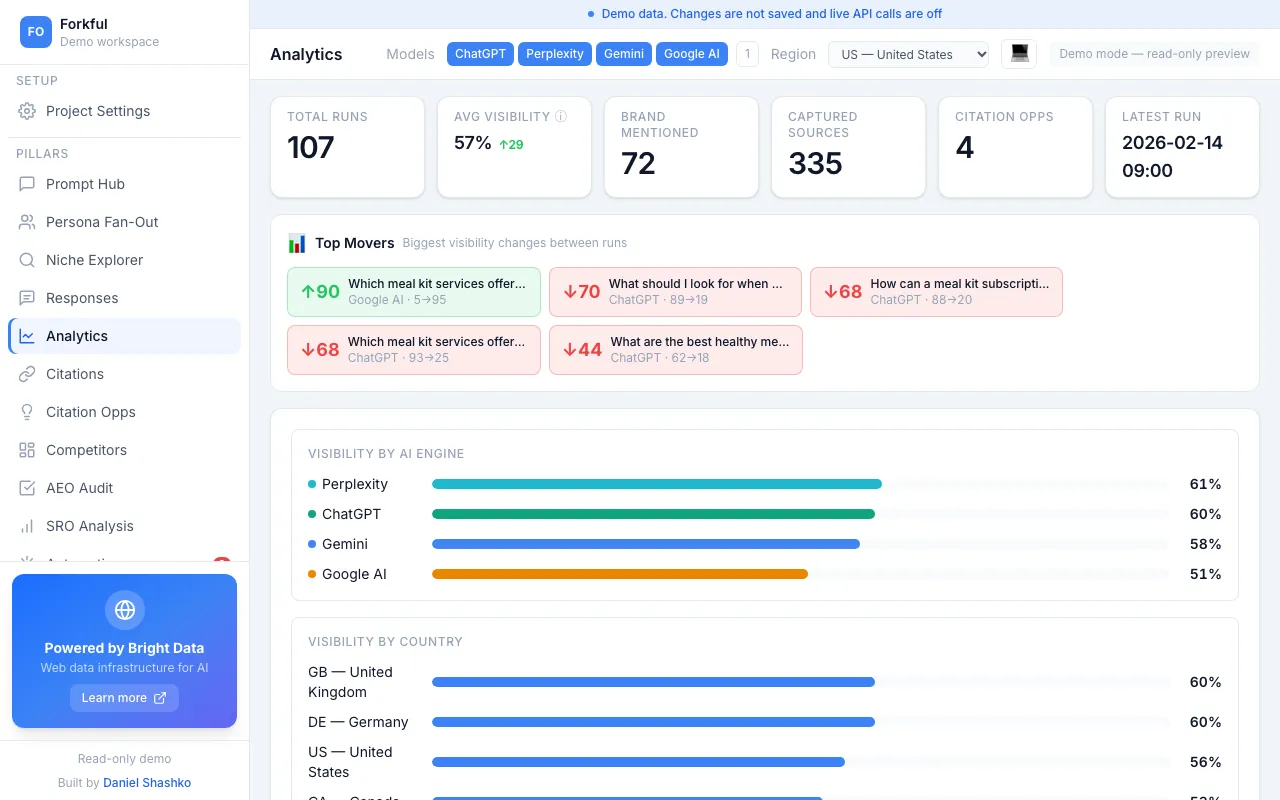
Dashboard, MCP, and CLI track brand mentions across ChatGPT, Perplexity, Gemini, and Google AI Mode with scoring, citations, and audits.
Overview
GEO/AEO Tracker is an open-source, self-hosted tool for measuring how AI engines surface a brand. Each run scores visibility from zero to one hundred on mentions, position, frequency, citations, and sentiment, with citation analysis, competitor battlecards, and SRO analysis pipelines.
Data defaults to browser storage via IndexedDB and localStorage, with optional sync through your own Supabase project. Tracking uses bring-your-own keys for Bright Data, OpenRouter, and Gemini; software is MIT-licensed while API calls bill per use.
The web UI spans project settings, prompt hubs, persona fan-out, niche explorer, response browsing, analytics charts, citation tools, AEO site audits, SRO deep analysis, Rank Signal experiments, automation templates, and documentation. An MCP server on your deployment lets agents query visibility; a CLI supports audits and batch workflows.
Deploy locally with Node or to Vercel with sample data until API keys are added. Demo-only mode can serve read-only sample data without live calls.
Key features
- Four-engine parallel brand tracking
- Visibility score zero to one hundred
- AEO page audit without API key
- SRO and Rank Signal analysis
- Competitor battlecards
- MCP and CLI interfaces
- Optional Supabase cloud sync
- Geo-scoped country comparisons
Use cases
- SEO and marketing AI visibility
- Founder-owned brand monitoring
- AEO readiness site audits
- Competitive citation research
Open-source alternative to
AAthenaHQ“GEO/AEO Tracker is an open-source, self-hosted alternative to paid AI visibility tools such as Semrush AI Visibility and AthenaHQ.” source
SSemrush AI Visibility“GEO/AEO Tracker is an open-source, self-hosted alternative to paid AI visibility tools such as Semrush AI Visibility and AthenaHQ.” source
Does the same job as
GEO AEO Tracker doesn't name these products itself, but its own description shows it does the same job.

 Profound





 Appcues
 Userflow