
Keycloak
Identity and access management for applications and services
Keycloak adds authentication and single sign-on to applications so they do not store or verify users themselves. It supports standard protocols and central admin tools.

Integrated Linux identity, policy, and audit management
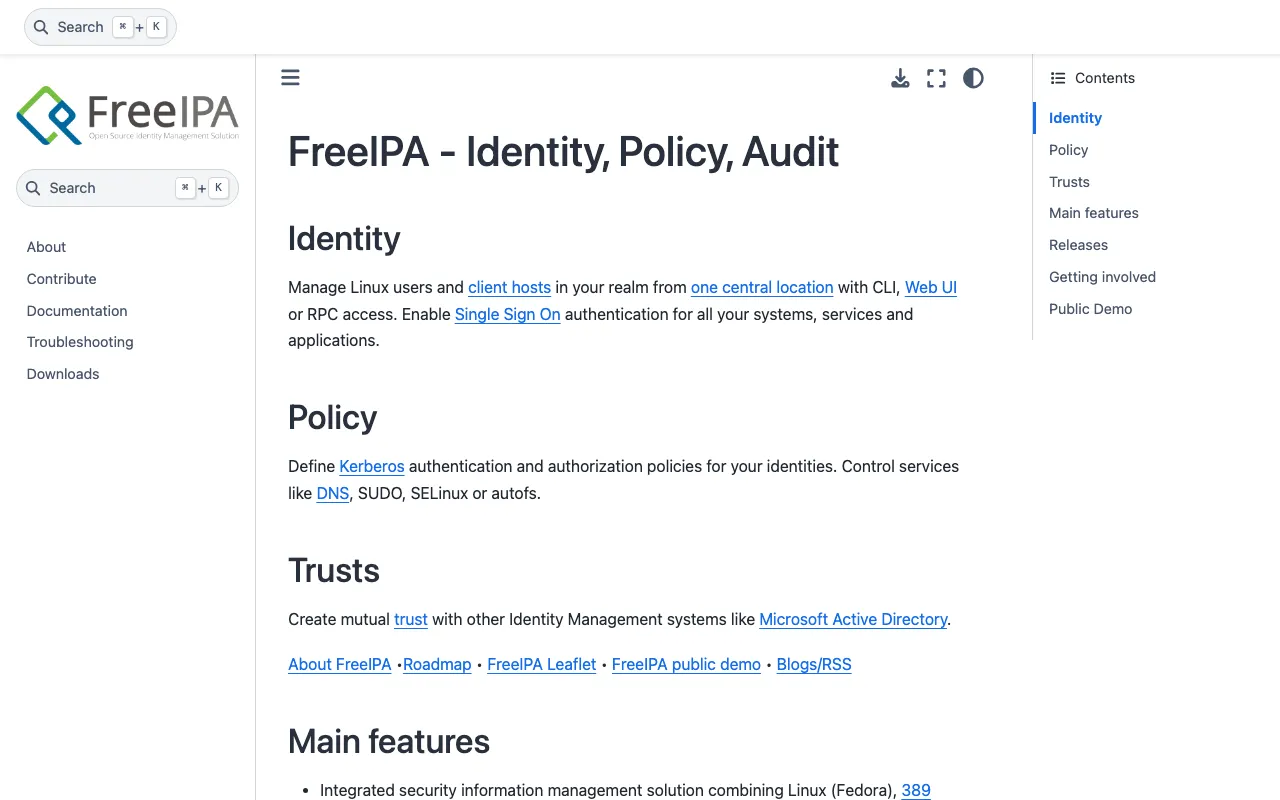
FreeIPA centralizes users, hosts, Kerberos, DNS, certificates, and access policy for Linux and UNIX estates via CLI, web UI, and RPC APIs.
FreeIPA is an integrated security information management solution for Linux and UNIX environments. Administrators use it to manage identity, authentication, and access control from centralized command-line and web-based tools instead of configuring each machine separately.
The stack combines directory services, MIT Kerberos, DNS, NTP, Dogtag certificate services, SSSD, and related components under unified installers and management interfaces. Users can sign on across enrolled hosts with shared credentials, access personal files across machines in an authenticated way, and be grouped for fine-grained service and file access.
Policy features include centralized passwords, SSH public keys, sudo rules, keytabs, and access control rules, with delegation of selected admin tasks to other power users. FreeIPA supports cross-realm Kerberos trust or user synchronization with Microsoft Active Directory.
Deployments expose CLI, web UI, XML-RPC, and JSON-RPC APIs, plus a Python SDK. Documentation describes multi-master replication, automation-friendly installation, and a public demo instance for trying enrollment and authentication flows.
Identity and access management for applications and services
Keycloak adds authentication and single sign-on to applications so they do not store or verify users themselves. It supports standard protocols and central admin tools.

Open-source bastion host for privileged access
JumpServer is a privileged access management platform that unifies secure access to SSH, RDP, Kubernetes, databases, and web assets.

Composable TypeScript authentication and authorization framework
Better Auth is a framework-agnostic authentication and authorization framework for TypeScript. You configure it in code and extend it with plugins for flows like social login, organizations, and enterprise SSO.
 Stytch

Open-source security infrastructure for secrets, certs, and access
Infisical is a security infrastructure platform where teams manage application secrets, certificates, privileged access, and AI agent credentials in one place.

Self-hosted SSO portal with multi-factor authentication
Authentication and authorization server that sits in front of reverse proxies. Provides a web portal for login, OpenID Connect, and granular access rules with several second-factor methods.

Web authentication libraries for JavaScript frameworks
Auth.js (NextAuth) adds sign-in, sessions, and OAuth to modern JavaScript apps. Packages target Next.js, SvelteKit, Express, Qwik, and other runtimes.
 Amazon Cognito
 Auth0