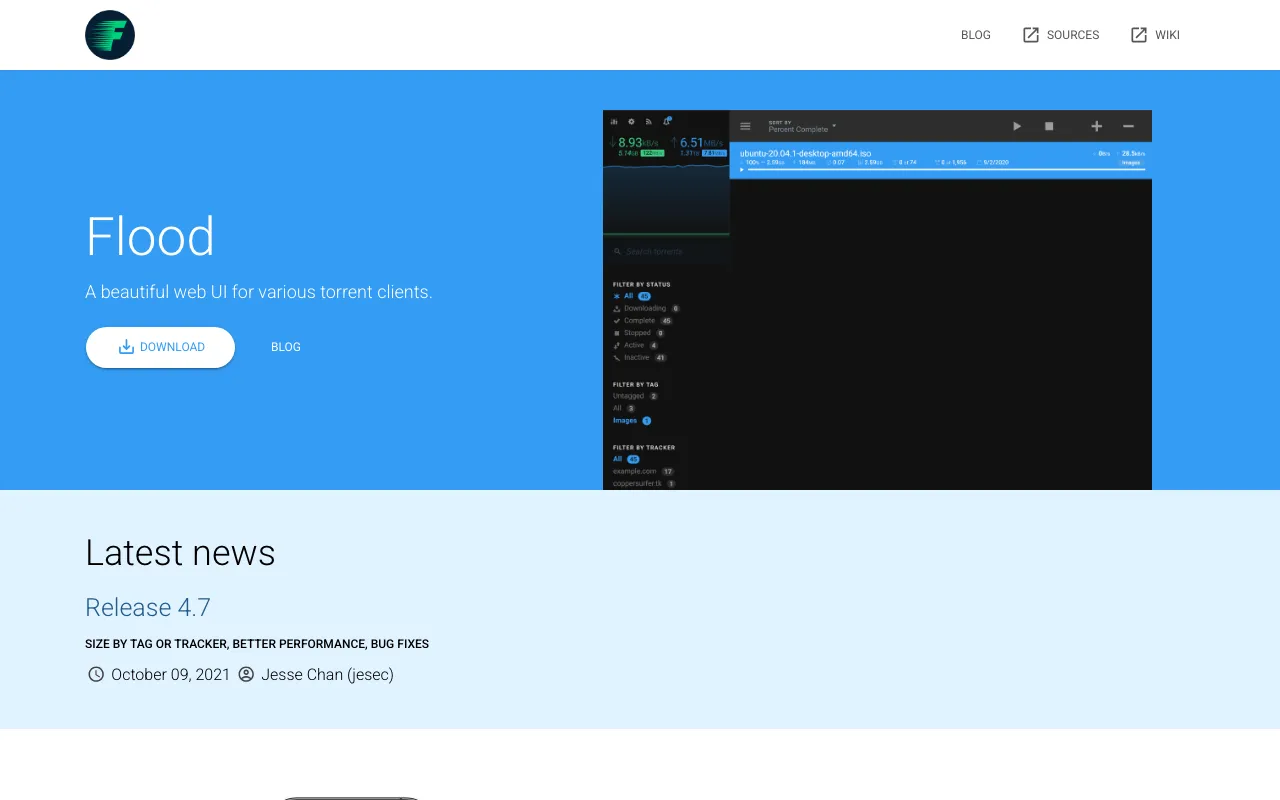
Flood is a Node.js service with a React web front end that talks to supported torrent clients and exposes administration in the browser. It works with rTorrent, Transmission, and qBittorrent.
Overview
Flood acts as a monitoring and administration layer between you and an installed torrent client. A Node.js backend connects to the client’s API while the React interface presents torrents, transfers, and related controls through the web UI.
Supported backends include rTorrent variants, Transmission, and qBittorrent as listed in the project documentation. Flood publishes an OpenAPI specification and interactive Swagger documentation for its own HTTP API, and the maintainers point to community client libraries and integrations built on that API.
Installation paths include global npm or npx installs, building from source with pnpm, and official Docker images. Configuration is driven by command-line flags and environment variables, including base URI when reverse-proxying, port binding, allowed filesystem paths for file operations, and optional built-in user management that prompts for client connection details on first load.
The web experience emphasizes responsive layout, touch support, light and dark themes following system preference, and broad localization. Flood performs file operations itself and must see the same filesystem paths as the torrent client for moves and related actions to succeed.
Key features
- rTorrent, Transmission, qBittorrent support
- React web administration UI
- OpenAPI and Swagger docs
- Docker image distribution
- npm global and npx install
- Light and dark themes
- 20+ UI languages
- Command-line configuration
Use cases
- Remote torrent queue management
- Unified UI for multiple client types
- Self-hosted download server control
- API-driven automation around torrents
- Touch-friendly home server access






 Google Photos