
Vite
Frontend build tool for modern web projects
Vite is a build tool for modern web projects, combining a development server with an optimized production build. It targets a faster, leaner local development workflow.

Git-based feature flags and remote configuration
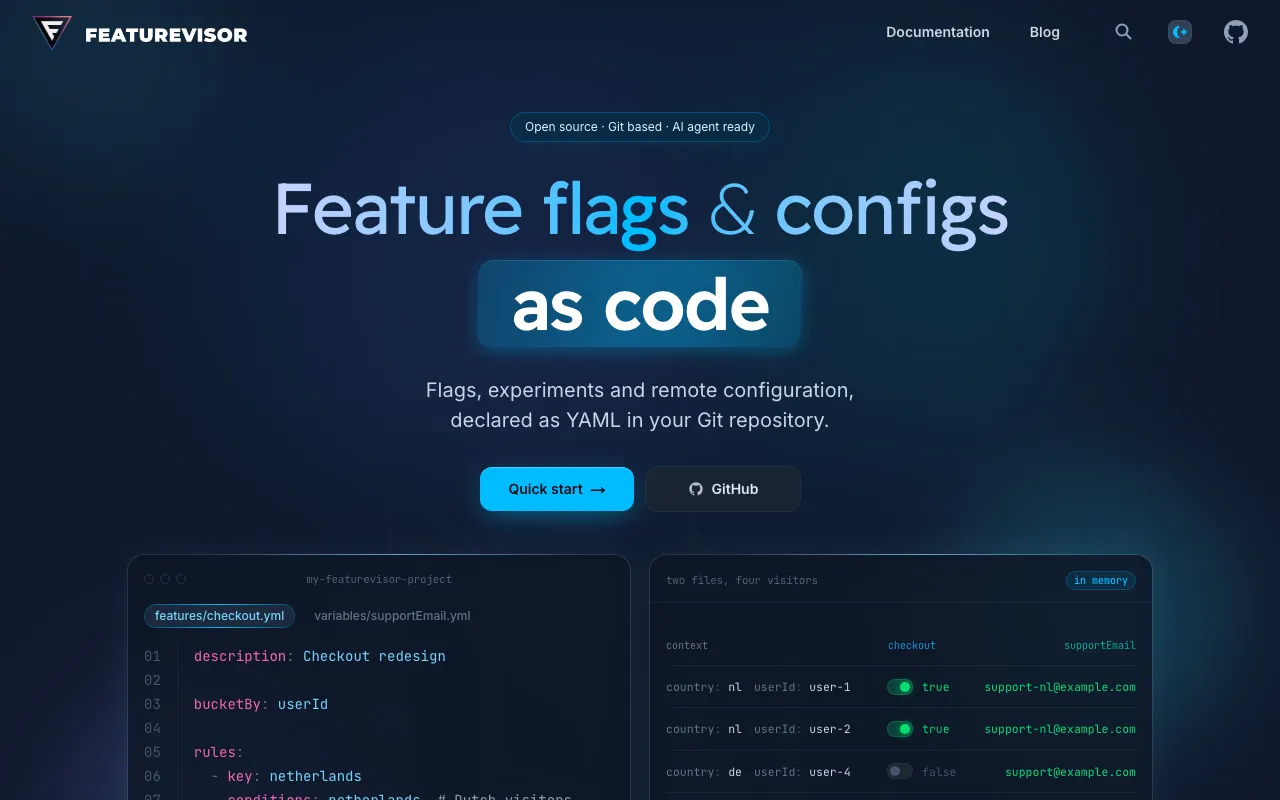
Featurevisor declares flags, experiments, and typed variables in YAML inside your Git repo. CI builds static datafiles for SDKs to evaluate in memory without per-flag network calls.
Featurevisor manages feature flags, experiment variations, and remote configuration as declarative files in a Git repository. Attributes, segments, features, and global variables are versioned like application code and reviewed through pull requests. A CI pipeline lints, tests, and builds datafiles that are uploaded to a CDN or custom static file server.
Client and server applications fetch the compiled datafile once and evaluate flags, A/B variations, feature-bound variables, and global variables locally against runtime context. Rules are ordered so the first matching segment wins; percentage rollouts bucket deterministically on attributes such as user id. Typed schemas validate strings, numbers, booleans, arrays, objects, and JSON when datafiles are built.
Global variables can stand alone with overrides and layered mutations, while feature variables follow the variation a user was assigned. Features may declare dependencies on other features or specific variations. Composed variables in the JavaScript SDK can group multiple evaluations into one object with optional overrides.
Official SDKs cover JavaScript, React, Vue, mobile stacks, and several server languages, plus OpenFeature providers. An agent skill teaches coding assistants to create features, segments, rollout rules, and SDK integrations; a local catalog command offers a browser UI to review changes. There is no central vendor-hosted control plane—the workflow is repository, pipeline, and your own file hosting.
Frontend build tool for modern web projects
Vite is a build tool for modern web projects, combining a development server with an optimized production build. It targets a faster, leaner local development workflow.

Modular toolkit for assembling container systems
Moby bundles container build, runtime, registry, and orchestration components so integrators can craft custom container platforms instead of using a single fixed product.

Agent-ready open-source backend cloud with unified app services
Appwrite bundles auth, databases, storage, functions, messaging, realtime, hosting, and firewall for building apps. It runs as managed cloud or self-hosted on Docker

Go and web frontend toolkit for desktop apps
Wails bundles Go backends with HTML, CSS, and JavaScript UIs into native desktop binaries. It uses OS WebViews instead of shipping a full browser runtime.

Electron and React starter for desktop applications
Electron React Boilerplate combines Electron, React, React Router, and Vite tooling so teams can develop, hot-reload, and package cross-platform desktop apps from one template.

Full-stack generator for web apps and microservices
JHipster is a development platform that scaffolds, develops, and deploys modern web applications and microservice architectures. It wires front ends, back ends, and cloud-native deployment in one workflow.
 Auth0
 Clerk