Astro
JavaScript web framework for content-driven sites
Astro builds content sites, web apps, and server APIs with server-first rendering, optional UI islands, and integrations for major frameworks.

Block-style web editor with JSON output
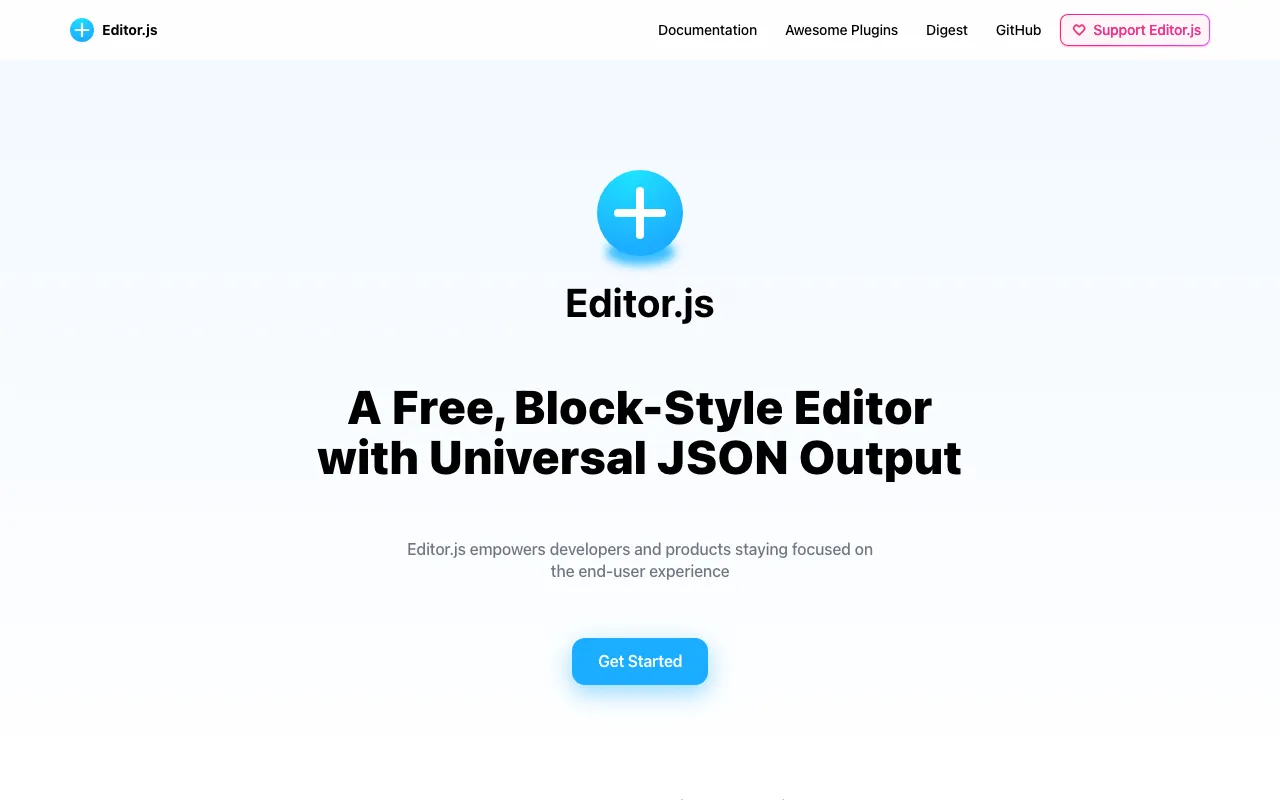
Editor.js is a block-based text editor for the web. Each content type is a plugin, and saved data is structured JSON instead of heavy HTML.
Editor.js presents a block-oriented writing surface where paragraphs, headers, images, lists, quotes, and other types are separate editable blocks rather than one monolithic rich-text region. The core coordinates plugins that supply each block type, which keeps the editor adaptable to new content kinds.
Saving calls editor.save() and returns JSON describing each block’s type and data. That format is meant for reuse on the web, mobile clients, AMP, speech tools, chatbots, and backend validation without parsing tangled markup. Classic WYSIWYG HTML output is explicitly not the primary model.
You install the core through NPM, Yarn, or CDN, add tool plugins, then initialize an Editor instance with configuration documented on editorjs.io. Community and official tools extend inline formatting, block tunes, and conversion between block types; collaborative editing, undo and redo, and unified toolbars appear on the project roadmap.
The ecosystem includes UI kits, icon sets, scaffolding for new tools, and guides for authors building custom block tools. CodeX maintains the editor and accepts sponsorships for ongoing maintenance of public docs and infrastructure.
JavaScript web framework for content-driven sites
Astro builds content sites, web apps, and server APIs with server-first rendering, optional UI islands, and integrations for major frameworks.

Full-stack Vue framework for web applications
Nuxt builds type-safe Vue apps with file routing, multiple render modes, server directory APIs, and a large module ecosystem.

React-based framework for fast content-driven sites
Gatsby is a React framework for building websites and apps, blending static generation with dynamic React capabilities. It pulls data from markdown, CMSs, and APIs through a unified GraphQL layer.

Flexbox-based modular CSS component framework
Bulma supplies ready-made responsive UI components as CSS only, without bundled JavaScript. You import or link its stylesheet and combine classes to build layouts.

Vue-based framework shipping one codebase to many platforms
uni-app lets developers write Vue.js front ends once and publish to mobile, web, mini-program, and quick-app targets from a single project.

Open-source low-code platform for internal business applications
ToolJet lets teams build admin panels, dashboards, and operational apps on existing databases and APIs. Create with a visual builder, prompts, or coding agents via MCP, then self-host or use cloud.
 Retool