
Sequin
Postgres change data capture to streams and search indexes
Sequin streams Postgres database changes to Kafka, queues, search indexes, and HTTP endpoints. It supports backfills and real-time delivery with a web console for configuration.

Distributed change data capture from operational databases
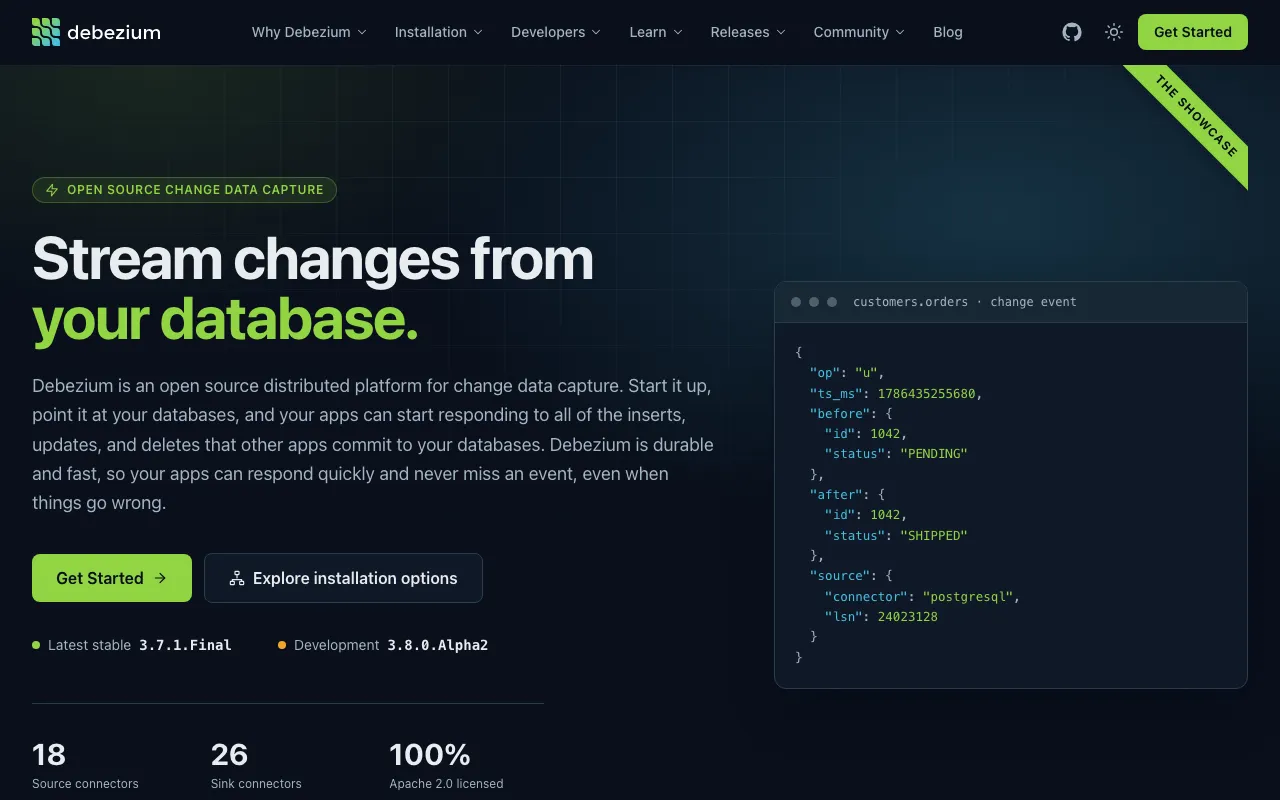
Debezium streams committed row-level database changes to Kafka, Debezium Server, or your application. It unifies CDC across many database engines.
Debezium monitors upstream databases and emits events for inserts, updates, and deletes after commit, so consumers see only durable changes rather than rolled-back transactions. A shared event model abstracts differences between database management systems.
The typical deployment uses Kafka Connect: each connector watches one database server and writes table changes to Kafka topics, with replication and ordering handled by Kafka. Clients can stop and resume consumption without missing history stored in the log. For lighter needs, an embedded connector engine can run inside an application and deliver events directly without Kafka.
Connectors exist for many sources including PostgreSQL, MySQL, MongoDB, SQL Server, Oracle, and others, with generic and database-specific modules. Sink and transform options extend pipelines toward caches, search indexes, analytics, vector stores, and messaging systems.
Installation paths include Kafka Connect clusters, standalone Debezium Server with alternate sinks, Kubernetes-oriented Debezium Platform and Operator, and embedded use. Documented setups target teams automating cache invalidation, replacing dual writes, sharing databases across apps, ETL, and CQRS-style read models.
Postgres change data capture to streams and search indexes
Sequin streams Postgres database changes to Kafka, queues, search indexes, and HTTP endpoints. It supports backfills and real-time delivery with a web console for configuration.

Declarative stream processor with broad connector support
Bento connects stream sources and sinks, transforms payloads in configurable pipelines, and runs as a binary, container, or serverless function.

Kafka-to-Elasticsearch log ingestion pipeline
go-stash consumes Kafka topics, filters and reshapes events, and bulk-writes them into Elasticsearch indexes.

Python utility converting office and media files to Markdown
MarkItDown converts many file types into Markdown for LLM and text analysis pipelines. It aims to preserve headings, lists, tables, and links rather than perfect human layout.

Open-source data integration platform for analysts, quants and AI agents
Open Data Platform (ODP) by OpenBB connects proprietary, licensed and public data sources once, then exposes them to Python, OpenBB Workspace, Excel, MCP servers for AI agents, and REST APIs.

Document parsing toolkit for generative AI pipelines
Docling ingests PDFs, office files, media, email, and many other formats into a unified document model. It targets downstream RAG and agent workflows with local execution options.