
Ansible
Agentless IT automation and configuration engine
Ansible automates configuration management, deployments, cloud provisioning, ad-hoc tasks, and multi-node orchestration using SSH without installing agents on managed hosts.

Local-first YAML workflow engine with built-in Web UI
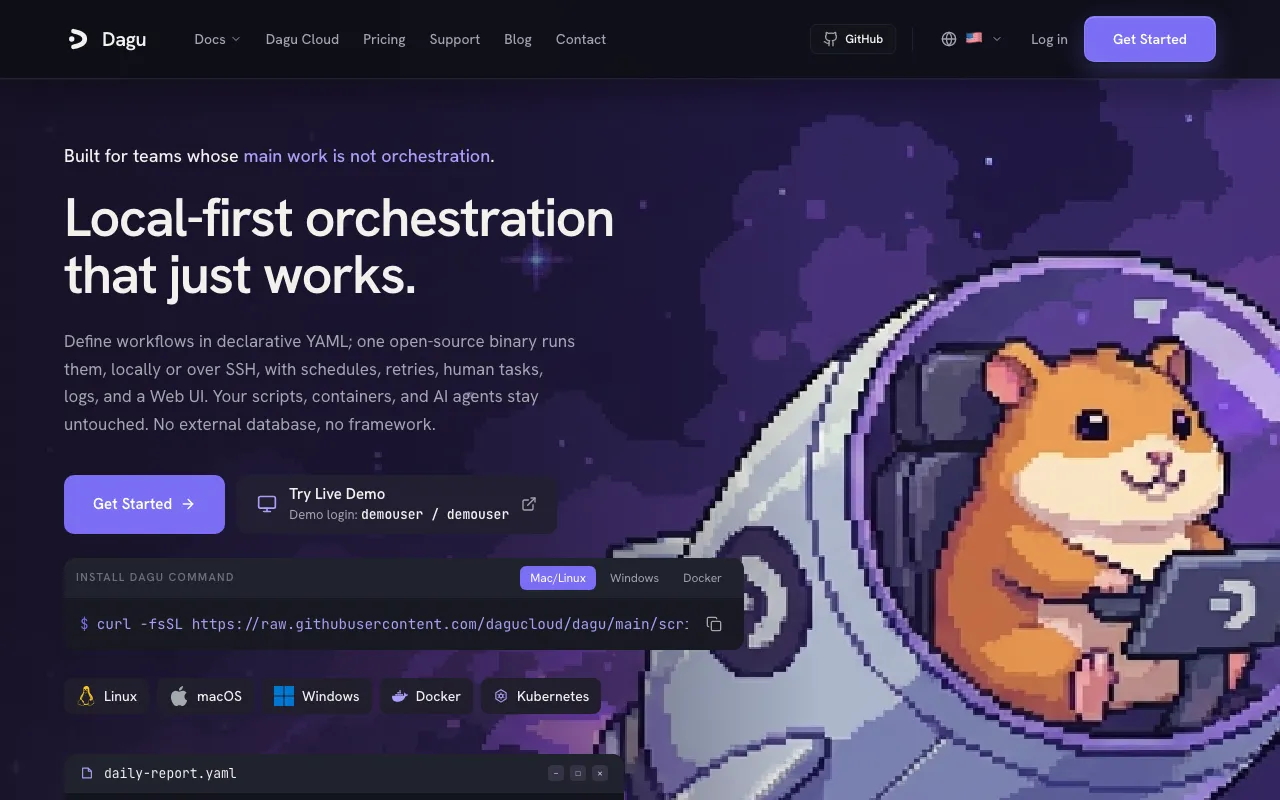
Dagu runs declarative DAG workflows from a single binary with scheduling, retries, logs, and a Web UI. No external database or message broker is required.
Dagu is a workflow engine for operations and internal automation that keeps orchestration in YAML beside your existing scripts. A single binary includes a Web UI and can run on Linux, macOS, and Windows without an external database or message broker.
Workflows are defined declaratively. Steps can invoke shell commands, Docker containers, Kubernetes Jobs, remote commands over SSH, and other actions without rewriting business logic into a framework SDK. Sub-DAGs, concurrency limits, cron schedules with timezones, overlap policies, retries, human tasks, and webhooks are handled by the engine.
State is stored in local files, and runs retain history, per-step logs, and notifications in one place. Workers can scale execution across machines, including label-routed coordinators, while temporary per-run workers suit ephemeral compute. An optional MCP server lets authenticated clients inspect runs, maintain wiki pages, and control execution.
Installation options include package managers, Docker, Helm on Kubernetes, and direct binaries. The same YAML can run on a single node, distributed workers, or ephemeral launchers, with outbound-only optional monitoring through Dagu Console.
Agentless IT automation and configuration engine
Ansible automates configuration management, deployments, cloud provisioning, ad-hoc tasks, and multi-node orchestration using SSH without installing agents on managed hosts.

Durable workflow and agent orchestration engine
Conductor runs versioned workflow graphs with persisted task state, retries, and observability. Workers in many languages execute business logic while the engine handles branching, loops, and AI tasks.

Scheduled task panel for multi-language scripts
Qinglong runs Python, JavaScript, Shell, and TypeScript jobs on a schedule. You manage scripts, env vars, and logs through a web UI or remote CLI.

Open-source TypeScript platform for durable AI workflows and agents
Trigger.dev lets teams define long-running background tasks and AI agents in TypeScript. Deployed runs get retries, queues, tracing, and scaling through the platform or self-hosted installs.

Web UI and API for Ansible automation
AWX layers a web interface, REST API, and task engine on Ansible. It is an upstream component related to Red Hat Ansible Automation Platform.

Redis-backed background job queue for Python
RQ is a Python library that queues functions for background workers backed by Redis or Valkey. It targets simple setup with scaling patterns for larger deployments.
 DBOS