
Traefik Labs
Dynamic HTTP reverse proxy and load balancer for microservices
Traefik routes HTTP traffic to microservices and balances load across backends. It watches orchestrators and registries to update routes without manual restarts.

Group communication engine for clustered high availability
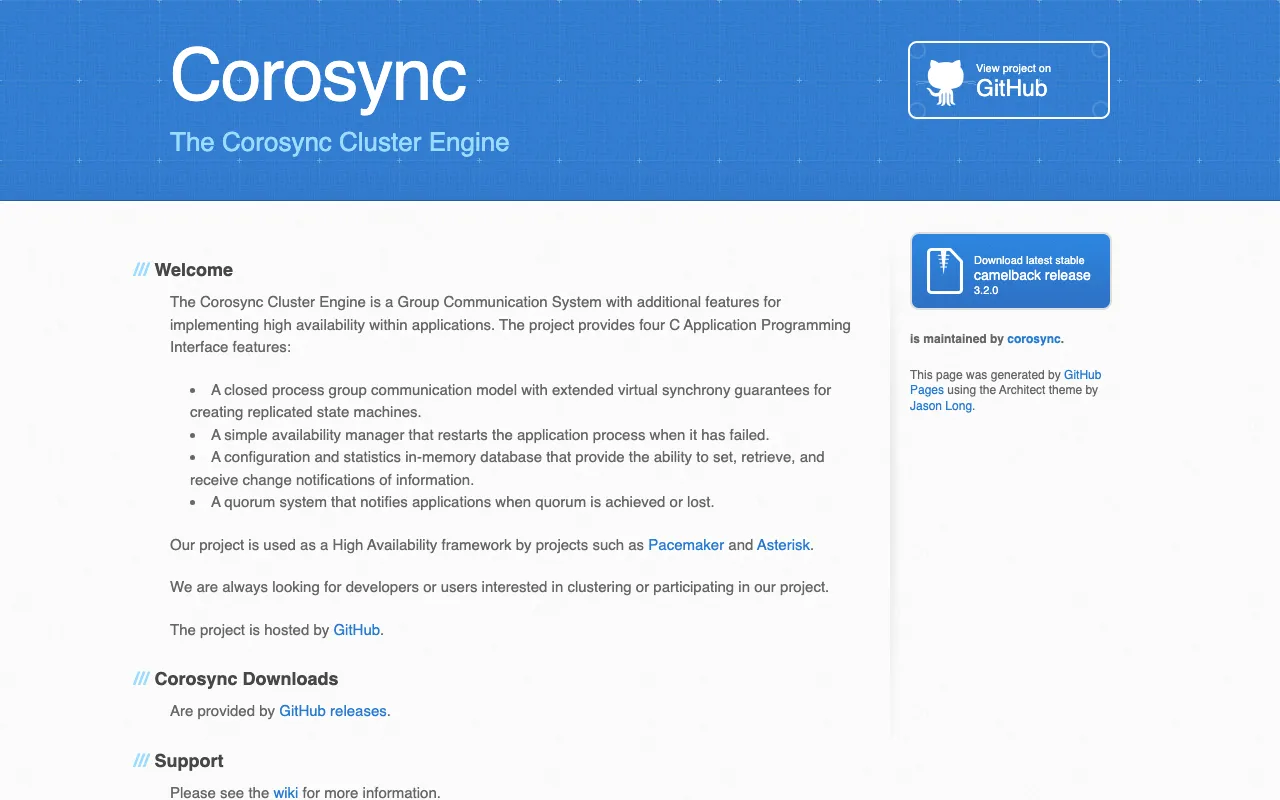
Corosync is a cluster group communication system with APIs for replicated state machines, process recovery, configuration data, and quorum notifications. Projects such as Pacemaker and Asterisk use it for high availability.
The Corosync Cluster Engine is a group communication system aimed at high availability within clustered applications. It exposes C APIs for building fault-tolerant software that must coordinate across multiple nodes.
Four API areas are highlighted on the project site. A closed process group model provides extended virtual synchrony for replicated state machines. A simple availability manager can restart an application process after failure. An in-memory configuration and statistics database supports set, get, and change notifications. A quorum subsystem tells applications when quorum is gained or lost.
Internal synchronization algorithms coordinate service state when network partitions occur or merge, including checkpoint handling and reference counting across cluster members. Corosync is positioned as a framework layer underneath cluster resource managers and telephony stacks rather than an end-user application by itself.
Release artifacts are published through GitHub releases, and the project maintains automated build and test infrastructure plus a wiki for support information.
Dynamic HTTP reverse proxy and load balancer for microservices
Traefik routes HTTP traffic to microservices and balances load across backends. It watches orchestrators and registries to update routes without manual restarts.

Plugin-chain DNS server and Kubernetes service discovery
CoreDNS is a Go DNS server where each feature is a plugin in a Corefile chain. It answers over classic DNS, TLS, HTTPS, HTTP/3, gRPC, and QUIC transports.

HTTP router and reverse proxy for service composition
Open HTTP proxy that matches large route sets, applies per-route filters, and can run as a Kubernetes Ingress controller.

Distributed orchestrator for stateful WebSocket backend processes
Plane runs and routes stateful WebSocket backends at scale. An HTTP API maps keys to process URLs, spawning workers when needed and stopping them after idle periods.

Network source of truth and automation platform
Nautobot models intended network state and runs automation jobs against that data for enterprises operating large, complex networks.

Free domain registration with DNS learning resources
DigitalPlat FreeDomain lets people register free domains under several extensions, point custom nameservers at a DNS provider, and follow guides from setup through deployment.