
Docling
Document parsing toolkit for generative AI pipelines
Docling ingests PDFs, office files, media, email, and many other formats into a unified document model. It targets downstream RAG and agent workflows with local execution options.

Incremental Python data framework for AI agent context
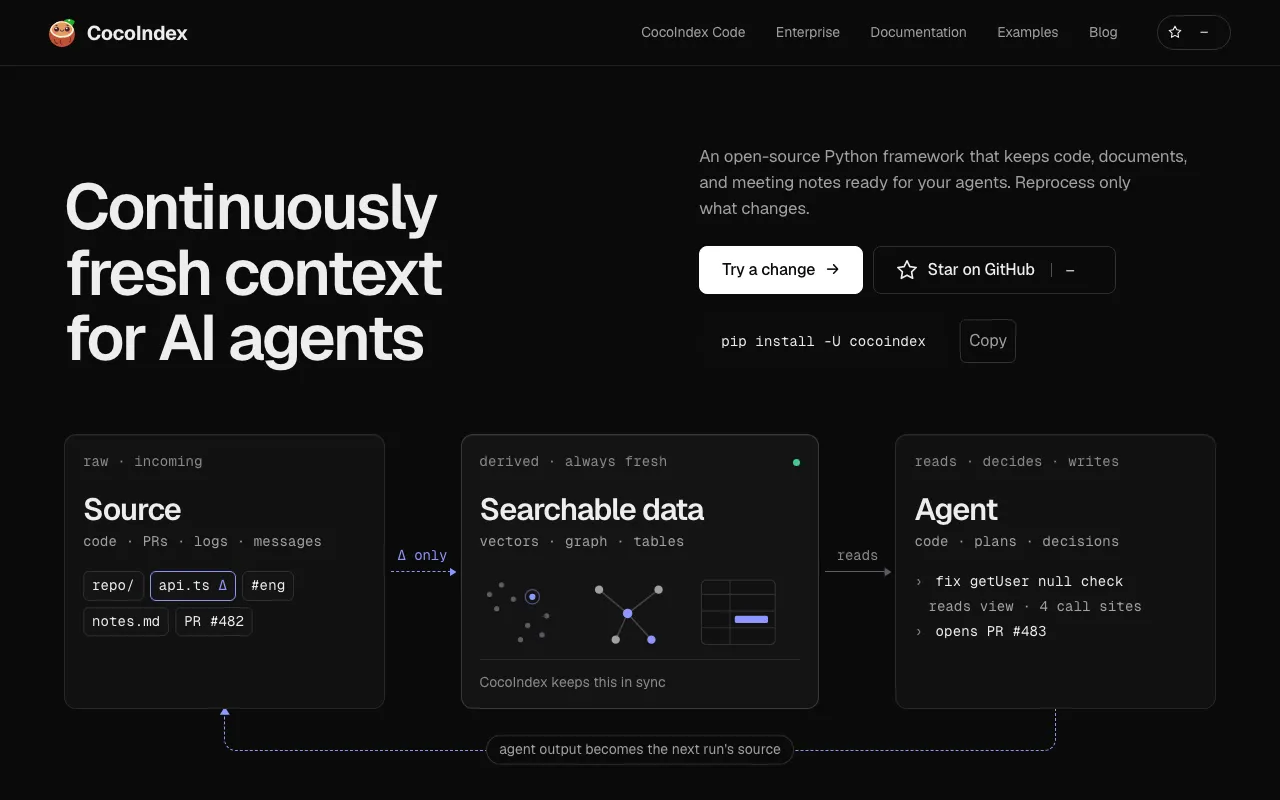
CocoIndex is a Python framework that turns codebases, documents, Slack, PDFs, video, and other sources into continuously updated context for AI agents and LLM apps, reprocessing only changed inputs.
CocoIndex is an incremental data framework aimed at long-horizon AI agents. It ingests sources such as codebases, meeting notes, inboxes, Slack, PDFs, and videos and keeps derived searchable data—including vectors, graphs, and tables—in sync with minimal full reprocessing.
Users declare what a target should contain in Python, and the engine keeps that target aligned by recomputing only the delta. A one-time run can backfill data; later runs re-embed or transform only changed files. Built-in or custom connectors cover code, files, databases, message queues, web APIs, and media.
The Rust core handles parallel chunking, memoization when inputs and function code are unchanged, logic tracking for code dependencies, source-to-target lineage, and concurrent processing within configured limits. Targets can include relational databases, warehouses, vector databases, graph databases, and message queues.
Example flows include real-time codebase indexing, meeting notes to knowledge graphs, and repository wikis generated with an LLM. Documentation describes using the framework with AI coding agents and compares its mental model to React for data engineering.
Document parsing toolkit for generative AI pipelines
Docling ingests PDFs, office files, media, email, and many other formats into a unified document model. It targets downstream RAG and agent workflows with local execution options.

Hub-backed library for loading and processing AI datasets
A Python library to download public datasets in one line, preprocess local or hub data, and feed NumPy, Pandas, PyTorch, TensorFlow, or JAX workflows with an Apache Arrow backend.

Document ingestion and preprocessing for LLM pipelines
Unstructured is a Python library for parsing images and documents into structured elements. It targets PDFs, Office files, HTML, and more for LLM ingestion workflows.

Python framework for reproducible data and ML pipelines
Kedro is an open-source Python framework for modular, maintainable data engineering and data science pipelines, hosted by LF AI & Data.
NeMo orchestration framework for synthetic datasets
NeMo Data Designer builds structured synthetic datasets with samplers, LLMs, validators, and seed data, using your chosen model endpoints.
Extended Python pickling for distributed code
cloudpickle serializes Python objects that standard pickle cannot, including lambdas and interactively defined functions and classes. It targets shipping code to remote workers in cluster setups.