Connects Python applications to ClickHouse over the native interface rather than HTTP. It offers a Client API and a DB API 2.0 compatible connection layer.
Overview
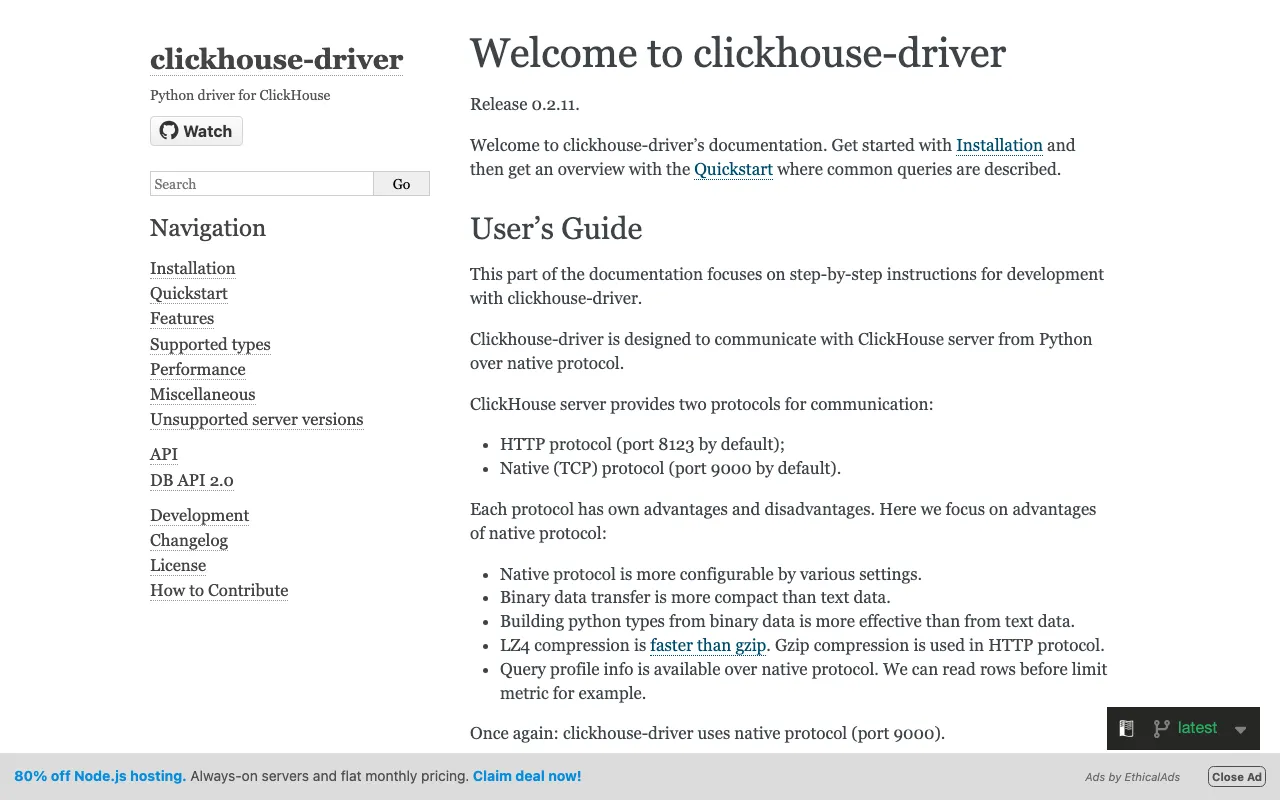
clickhouse-driver is a Python package for talking to ClickHouse servers through the native TCP protocol on the default port, as opposed to the HTTP interface. The authors highlight denser binary transfer, configurable server settings, LZ4 compression, query profile metadata, and block-wise result streaming as reasons to prefer the native path for application code.
The library exposes a straightforward Client with execute helpers for DDL, inserts, and selects, plus a connect-based DB API surface with cursors familiar to database programmers. It supports many ClickHouse column types, external data attachments, query settings, TLS, multiple hosts, progress callbacks, server logs, and optional NumPy, Pandas, or PyArrow integrations documented separately.
Asynchronous access is pointed to a sibling aioch project rather than being built into the core driver. Installation is available from PyPI or source, with documentation covering compression, secure connections, columnar result formats, and TCP keepalive behavior.
Consumers typically embed the driver in services, notebooks, or ETL jobs that need efficient bulk reads and writes against self-managed or hosted ClickHouse clusters.
Key features
- Native TCP protocol support
- Client and DB API interfaces
- Broad ClickHouse type coverage
- LZ4 compression and TLS
- Block-wise streaming results
- Query progress and profile info
- External data for queries
- Optional NumPy and Pandas paths
Use cases
- Python ETL into ClickHouse
- Low-latency analytical queries
- Services using DB API cursors
- Bulk insert from application code
- Monitoring query progress in apps