
Sa-Token
Java lightweight permission and session framework
Sa-Token adds login, permission checks, SSO, OAuth2, and microservice gateway auth to Java web projects with minimal boilerplate.

Policy-based authorization decision service for applications
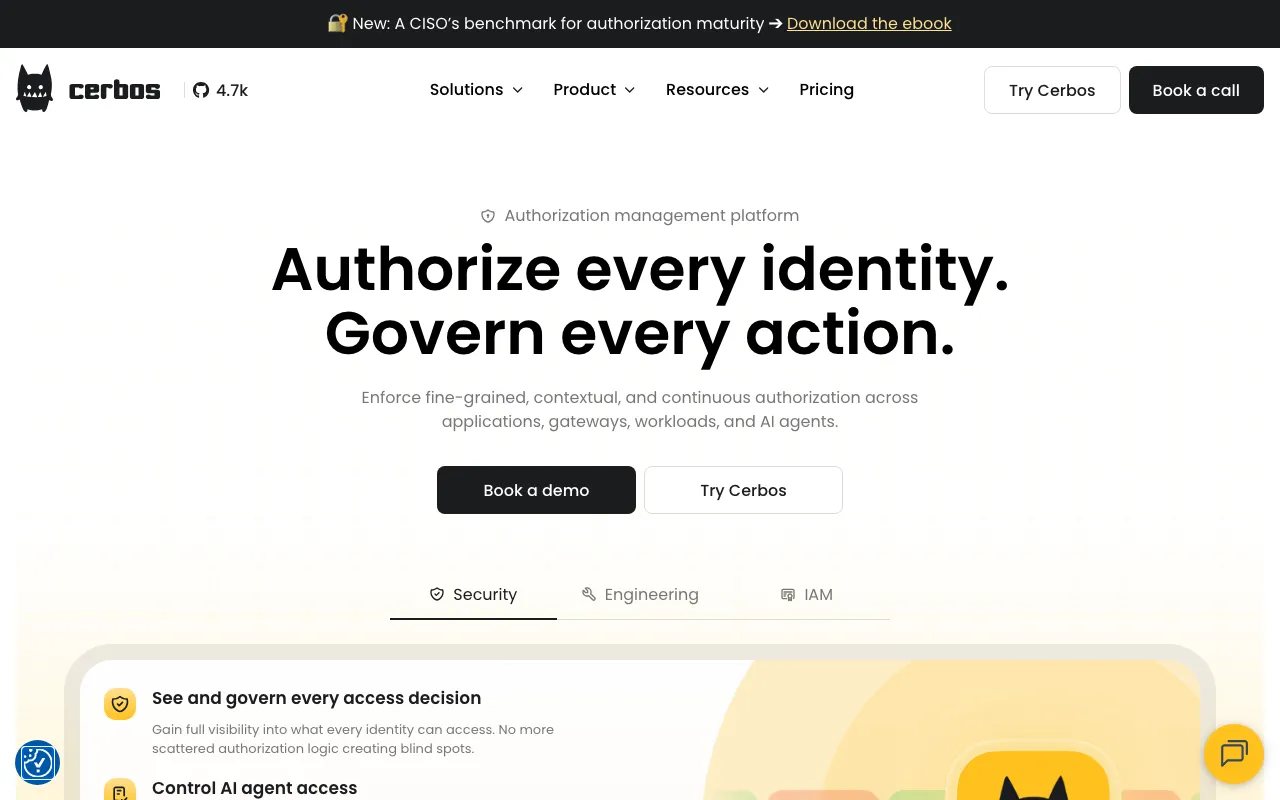
Cerbos is an authorization layer where you define YAML policies and call APIs to decide whether principals can perform actions on resources across apps, gateways, and workloads.
Cerbos separates access control from application code by acting as a Policy Decision Point. You describe resources, actions, and principals in YAML policies, store them on disk, in object stores, git repositories, or supported databases, and evaluate decisions through HTTP APIs at runtime.
The CheckResources API answers whether a given principal may access a specific resource, while PlanResources lists which resources of a kind a principal may use. Client SDKs and query-plan adapters integrate these calls from application code, and policies can combine RBAC with attribute-based conditions, derived roles, and principal-specific overrides.
The PDP runs as a stateless process in Kubernetes, as a systemd service, in containers, or on AWS Lambda. Cerbos Hub is an optional cloud control plane for authoring, testing, and distributing policies to self-hosted PDP fleets, including playgrounds and embedded PDP options for edge or in-browser checks.
The platform targets enterprise software and AI agent scenarios where identities include users, services, bots, and agents, with audit logging of allow and deny outcomes tied to policy versions for compliance-oriented workflows.
Cerbos doesn't name these products itself, but its own description shows it does the same job.
Java lightweight permission and session framework
Sa-Token adds login, permission checks, SSO, OAuth2, and microservice gateway auth to Java web projects with minimal boilerplate.

Node.js library for signing and verifying JSON Web Tokens
jsonwebtoken implements JWT creation and verification for Node.js using HMAC, RSA, ECDSA, and related algorithms. It exposes sign, verify, and decode helpers built on node-jws.

OAuth2 and OIDC reverse proxy authentication
OAuth2 Proxy sits before web apps as reverse proxy or middleware, sends users through OAuth2 or OIDC login, supports many identity providers, and can forward user details to upstream apps as headers

Open-source user login and session management
SuperTokens adds sign-up, sign-in, and session handling to applications through frontend SDKs, backend SDKs, and a core HTTP auth service.

Self-hosted identity provider with SSO and agent MCP gateway
Casdoor is an IAM server with a web console for users, apps, and providers. It issues tokens via OAuth, OIDC, SAML, CAS, LDAP, SCIM, and WebAuthn, and exposes an MCP gateway for AI tooling

Isomorphic TypeScript authorization for apps and APIs
CASL limits which resources a user may access using declarative rules shared across frontend, backend, and database layers.
 Amazon Cognito
 Auth0