qmetrics.net

Caveman

Skill and local proxy for leaner coding agent sessions

AI Assisted CodingDesktop/CLI app
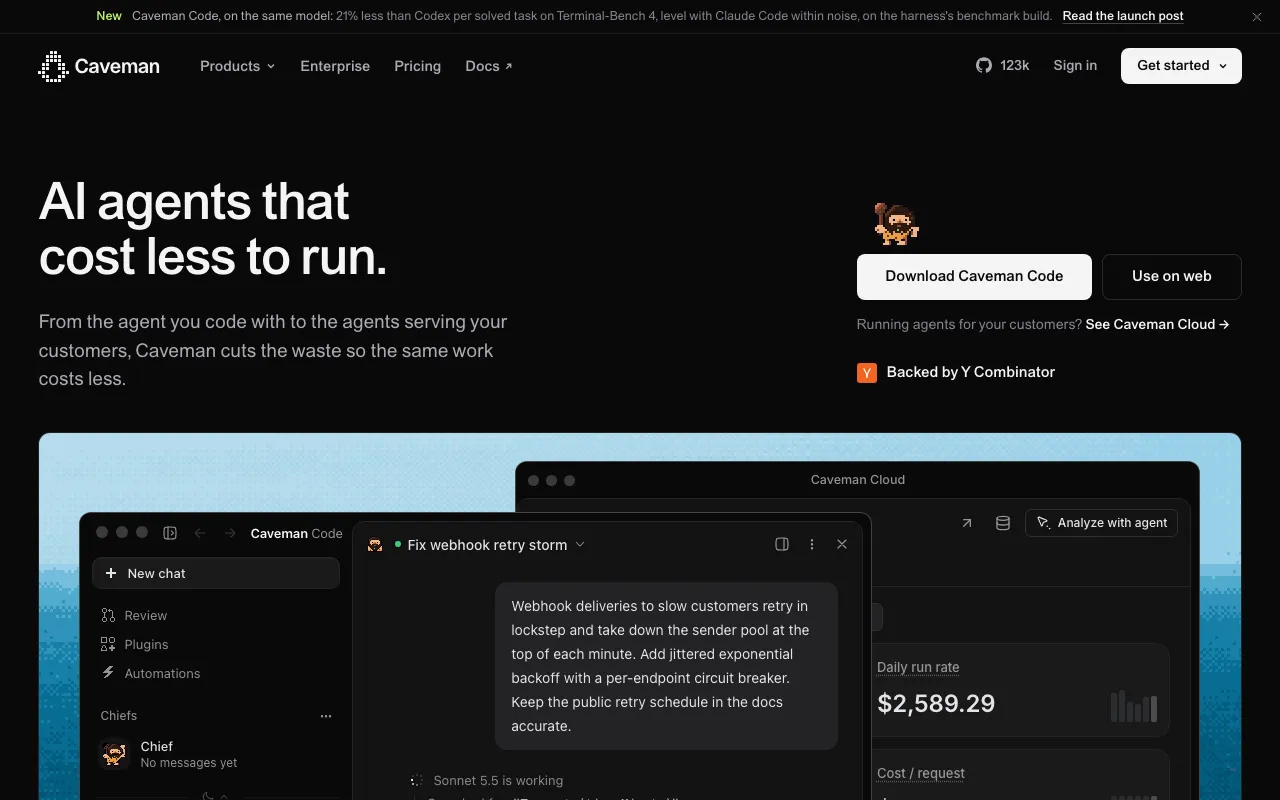
Caveman screenshot

Caveman installs a skill and on-machine proxy that shorten agent replies and shrink large tool output before models read it. Code, commands, and errors stay verbatim while sessions use fewer tokens.

Overview

Caveman targets coding agents such as Claude Code, Codex, Gemini CLI, and OpenCode. After a one-line install with Node.js, it can attach to many supported agents and use the API keys or subscriptions already on the computer.

The "say less" layer applies a structured short voice to model answers while leaving code blocks, paths, commands, and error text unchanged. Separate "read less" compressors trim logs, JSON, CSV, YAML, and similar tool output before the model sees it, with originals kept on disk for recovery.

Optional modules include automatic model and effort selection, reusable script blocks for repeated commands, browsing compression, prompt-cache warming during pauses, and terminal commands to inspect status or toggle features. Slash commands expose modes such as caveman, ultracave, and megacave.

Install instructions list macOS, Linux, and Windows with PowerShell. The open skill can be used alone without the full proxy. Related commercial offerings described on the project site include separate Code and Cloud products beyond the open skill.

Key features

  • Shorter agent answers with exact code payloads
  • Compressed logs and structured file reads
  • One installer for many coding agents
  • Reusable Blocks scripts in the repo
  • Auto model and effort routing
  • Slash-command voice modes
  • Original tool output retained locally
  • Terminal status and feature toggles

Use cases

  • Reducing token use in daily agent coding
  • Shrinking large test or log output in sessions
  • Standardizing terse agent responses on a team
  • Reusing saved scripts across agent runs

Tags

Similar software

Superpowers

Agent skills methodology for disciplined coding

Superpowers adds composable skills and bootstrap instructions so coding agents brainstorm specs, plan in small tasks, follow test-driven development, and review work. Plugins install into many agent marketplaces and CLIs.

★ 328.1k⟳ 24 days agoMIT

ECC

Open-source agent engineering toolkit for coding harnesses

ECC adds planning, verification, review, memory, skills, and security scanning to coding agents such as Claude Code, Codex, and Cursor. It installs as plugins, packages, and managed adapters across multiple harnesses.

★ 311.7k⟳ 8 days agoMIT
Frameworks & PlatformsDesktop/CLI app

OpenCode

Open source coding agent for any model

OpenCode is an open source coding agent for desktop, terminal, mobile, or SDK use with many LLM providers and built-in development and read-only planning agents

★ 229.6k⟳ todayMIT
AI Assisted CodingDesktop/CLI app
Open Source Alternative to:Claude CodeCodiumate+3

Ponytail

Lazy senior-dev prompt skill for AI coding agents

Ponytail is a prompt skill that steers AI coding agents toward minimal, necessary code. It adds review and audit commands and optional usage metrics in supported hosts.

★ 199.9k⟳ 6 days agoMIT
AI Assisted CodingDesktop/CLI app

Visual Studio Code

Extensible editor for edit-build-debug workflows

Visual Studio Code combines a lightweight code editor with navigation, debugging, and an extension model. Builds are available for Windows, macOS, and Linux, with a browser-based option.

★ 195.8k⟳ todayMIT
AI Assisted CodingDesktop/CLI app
Open Source Alternative to:Windsurf

Dify

Open-source LLM app platform for agents, workflows and RAG

Dify is an LLM app development platform combining a visual workflow canvas, RAG pipelines, agents, model management and observability. It runs as a hosted cloud service or self-hosted with Docker Compose.

★ 162k⟳ todayApache-2.0
Open Source Alternative to:Relevance AI