nvm
POSIX shell version manager for Node.js
nvm installs and switches between Node.js versions from the command line on POSIX shells including bash and zsh.

Ruby and SSH based remote deployment automation framework
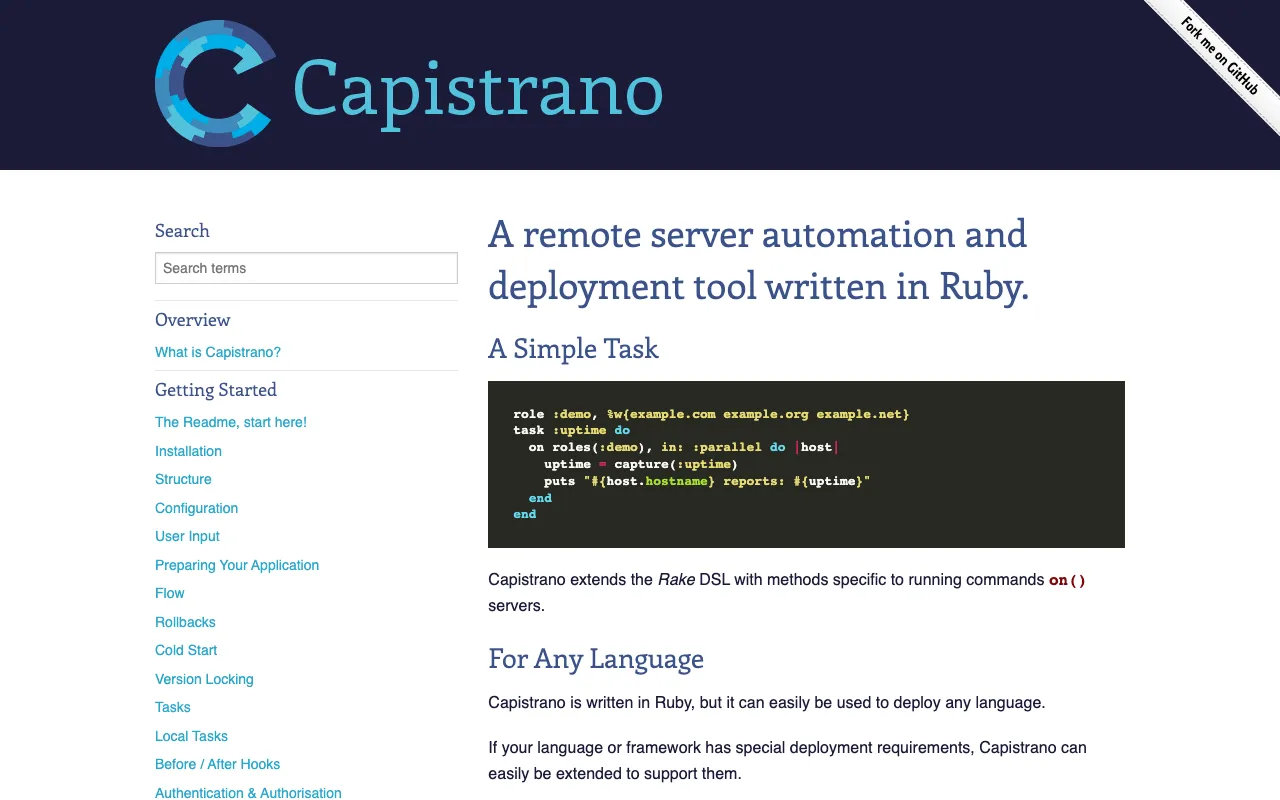
Capistrano is a framework for automated deployment scripts built on Ruby, Rake, and SSH. The cap command connects to servers and runs repeatable deploy steps for any language or stack.
Capistrano automates what teams already do over SSH: connect to application servers and run deployment steps in a repeatable, scalable way. Although written in Ruby, it deploys Rails, Java, PHP, and other projects. After installation, deployments are driven from the command line with the cap tool.
The framework defines conventional deployment structure so teams do not reinvent layout, remote paths, or common task patterns. One deployment definition can parameterize multiple stages such as QA, staging, and production by varying only what differs, like host addresses. Tasks can run in parallel across a fleet of servers with connection pooling, and servers can carry roles so work runs only where it belongs.
Extensibility comes through Rubygems and community task libraries; many frameworks ship built-in Capistrano tasks. Under the hood everything reduces to non-interactive SSH commands, which keeps behavior explicit but expects comfort with remote shell administration.
Capistrano deploys code but does not by itself know how to restart your app server or process manager; those steps are custom tasks or gems. It expects key-based SSH, a POSIX shell on targets, and provisioning of runtimes and databases outside Capistrano. Projects are "capified" to generate stage templates that you then tailor to your servers and SCM.
POSIX shell version manager for Node.js
nvm installs and switches between Node.js versions from the command line on POSIX shells including bash and zsh.

Fast Python package and project manager
uv is a Rust-based tool that manages Python dependencies, virtual environments, scripts, and interpreters. It offers a pip-compatible interface and universal lockfiles for projects.

Go-based static site generator with flexible templating
Hugo is a static site generator written in Go. It turns content and templates into deployable HTML sites with asset pipelines for CSS, JavaScript, Sass, and images.

Frontend build tool for modern web projects
Vite is a build tool for modern web projects, combining a development server with an optimized production build. It targets a faster, leaner local development workflow.

Local runner for GitHub Actions workflows
A command-line tool that executes GitHub Actions workflows on your machine using Docker. It mirrors GitHub’s environment for faster feedback while editing workflow files.

Modular toolkit for assembling container systems
Moby bundles container build, runtime, registry, and orchestration components so integrators can craft custom container platforms instead of using a single fixed product.