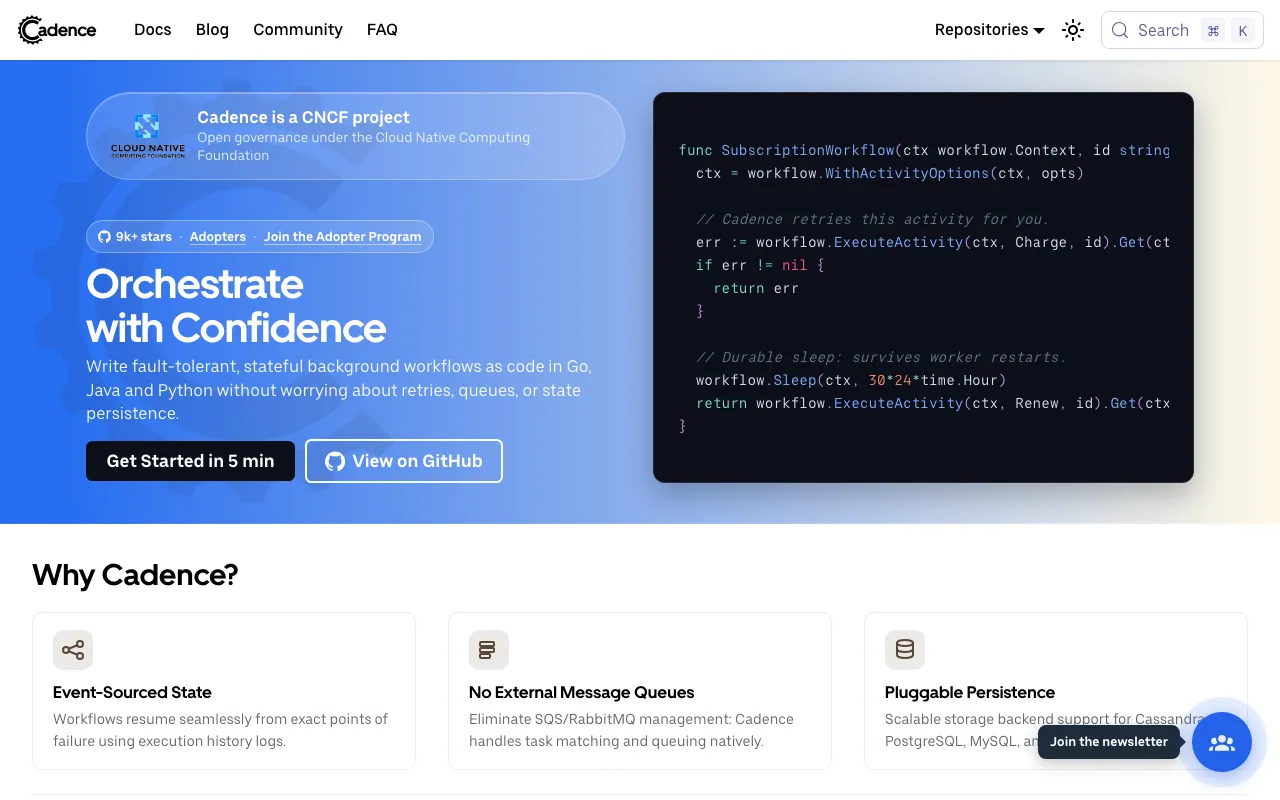
Cadence runs long-lived, fault-tolerant workflows with pluggable persistence and client SDKs in Go and Java.
Overview
Cadence Workflow is an open-source platform for building and running scalable, fault-tolerant, long-running workflows. The orchestration engine executes asynchronous business logic across distributed workers while preserving execution history so workflows can resume after failures.
A deployment includes Cadence backend services, a database such as Cassandra, MySQL, or PostgreSQL, and optionally Kafka with Elasticsearch for advanced visibility. Application code runs in workers you operate using official Go or Java client libraries, with community Python and Ruby SDKs also mentioned. You start workflows through SDKs or the Cadence CLI.
Cadence advertises event-sourced state, native task matching without separate message buses for core queuing, and pluggable persistence backends. Operators can run locally, via Docker Compose, on Kubernetes with Helm, or follow guided installation material. Cadence Web UI exposes workflow histories, diagnostics, batch actions, and schedules.
The website positions Cadence for mission-critical distributed applications and notes adoption at large product companies. Documentation covers data converters, encryption, schedules, shard management, and domain isolation for multi-tenant clusters.
Key features
- Durable workflow orchestration
- Event-sourced execution history
- Go and Java worker SDKs
- Cadence CLI for operations
- Web UI for histories and batch actions
- Cassandra, MySQL, or PostgreSQL persistence
- Schedules and recurring workflow runs
- Kubernetes and Docker deployment paths
Use cases
- Long-running business processes across microservices
- Reliable retries after worker or host failures
- Operational control of workflows from CLI or Web UI
- Self-hosted alternative to managing ad hoc job queues
Does the same job as
Cadence doesn't name these products itself, but its own description shows it does the same job.

 DBOS