
Vite
Frontend build tool for modern web projects
Vite is a build tool for modern web projects, combining a development server with an optimized production build. It targets a faster, leaner local development workflow.

Haskell library and tool for building packages
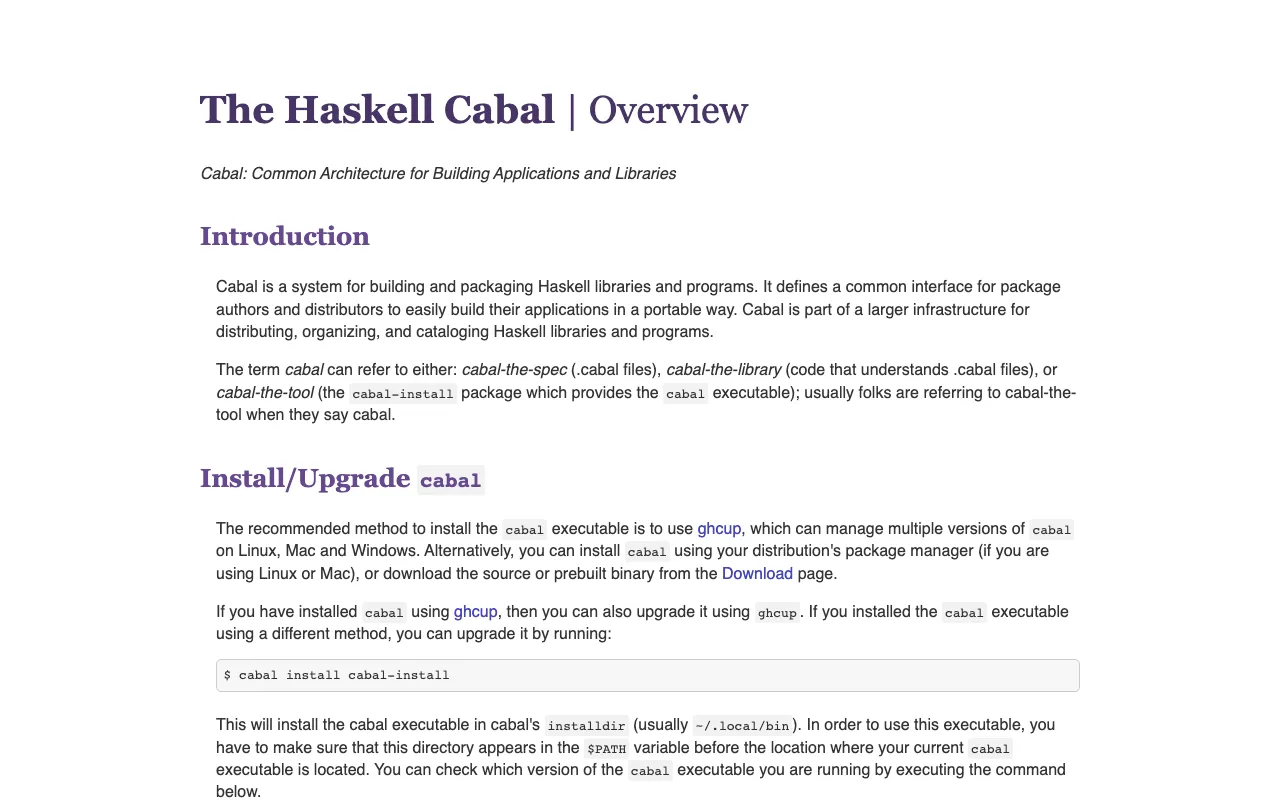
Cabal is Haskell’s common system for building and packaging libraries and programs, centered on the cabal-install command-line tool.
Cabal is a system for building and packaging Haskell libraries and programs. It defines a shared interface for authors and distributors to build applications in a portable way, and sits in a larger ecosystem for organizing Haskell libraries and programs.
The name cabal can mean the .cabal file format, the Cabal library that reads those files, or cabal-install, which provides the cabal executable most users mean. The tool can initialize projects, build and run executables, manage dependencies, and upgrade itself when already installed.
You can install via GHCup on Linux, Mac, and Windows, via distribution package managers, or from prebuilt binaries. Quick start flows include cabal init and cabal run for a new executable project. A user manual and getting-started material support day-to-day use.
The upstream repository bundles the Cabal library, Cabal-syntax, Cabal-hooks, cabal-install, and the dependency solver as related packages maintained together.
Frontend build tool for modern web projects
Vite is a build tool for modern web projects, combining a development server with an optimized production build. It targets a faster, leaner local development workflow.

Modular toolkit for assembling container systems
Moby bundles container build, runtime, registry, and orchestration components so integrators can craft custom container platforms instead of using a single fixed product.

Agent-ready open-source backend cloud with unified app services
Appwrite bundles auth, databases, storage, functions, messaging, realtime, hosting, and firewall for building apps. It runs as managed cloud or self-hosted on Docker

Go and web frontend toolkit for desktop apps
Wails bundles Go backends with HTML, CSS, and JavaScript UIs into native desktop binaries. It uses OS WebViews instead of shipping a full browser runtime.

Electron and React starter for desktop applications
Electron React Boilerplate combines Electron, React, React Router, and Vite tooling so teams can develop, hot-reload, and package cross-platform desktop apps from one template.

Full-stack generator for web apps and microservices
JHipster is a development platform that scaffolds, develops, and deploys modern web applications and microservice architectures. It wires front ends, back ends, and cloud-native deployment in one workflow.
 Auth0
 Clerk