
Vite
Frontend build tool for modern web projects
Vite is a build tool for modern web projects, combining a development server with an optimized production build. It targets a faster, leaner local development workflow.

Shared browser and Node version queries for front-end build tools
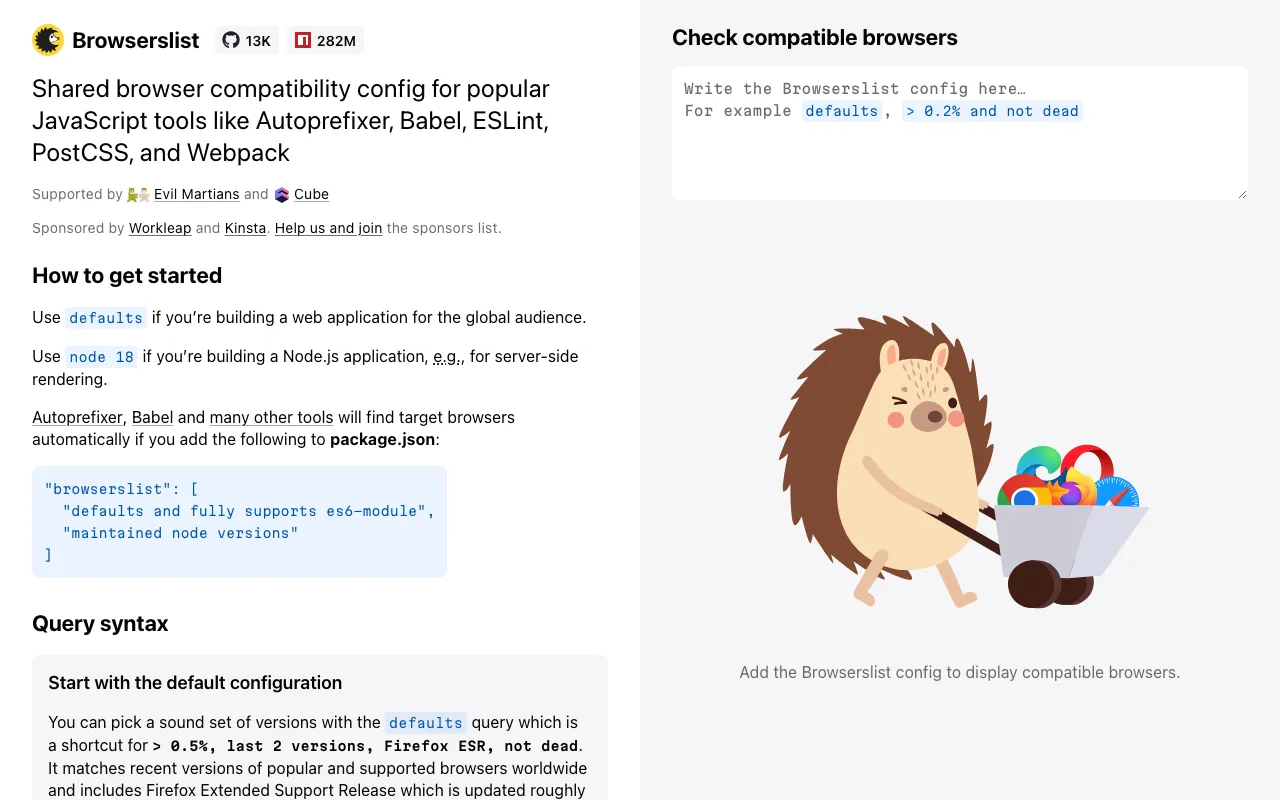
Central config format and resolver that tells Autoprefixer, Babel, Stylelint, PostCSS, and similar tools which browsers and Node versions to target.
Browserslist is the shared configuration layer front-end tools use to agree on target browsers and Node.js runtimes. Define queries once in package.json, a .browserslistrc file, environment variables, or shareable presets, and participating tools pick them up automatically when they run in your project tree.
Queries express policies such as last two versions, global or regional usage thresholds, Baseline feature sets, specific browser or Node version ranges, and Can I Use feature support levels. Combinators support unions, intersections, and negation so teams can balance compatibility with bundle size, often starting from the defaults shortcut for common web apps.
Resolution relies on caniuse-lite data for market and capability statistics. A built-in CLI prints the resolved browser set, companion tools lint configs, update the database, compile queries to user-agent regexes, and import analytics stats for custom usage queries.
The playground at browsersl.ist and documentation explain syntax and pitfalls, such as pairing last versions with usage filters and using not dead to drop unmaintained browsers. Shareable npm packages prefixed browserslist-config- let organizations publish org-wide targets.
Frontend build tool for modern web projects
Vite is a build tool for modern web projects, combining a development server with an optimized production build. It targets a faster, leaner local development workflow.

Modular toolkit for assembling container systems
Moby bundles container build, runtime, registry, and orchestration components so integrators can craft custom container platforms instead of using a single fixed product.

Agent-ready open-source backend cloud with unified app services
Appwrite bundles auth, databases, storage, functions, messaging, realtime, hosting, and firewall for building apps. It runs as managed cloud or self-hosted on Docker

Go and web frontend toolkit for desktop apps
Wails bundles Go backends with HTML, CSS, and JavaScript UIs into native desktop binaries. It uses OS WebViews instead of shipping a full browser runtime.

Electron and React starter for desktop applications
Electron React Boilerplate combines Electron, React, React Router, and Vite tooling so teams can develop, hot-reload, and package cross-platform desktop apps from one template.

Full-stack generator for web apps and microservices
JHipster is a development platform that scaffolds, develops, and deploys modern web applications and microservice architectures. It wires front ends, back ends, and cloud-native deployment in one workflow.
 Auth0
 Clerk