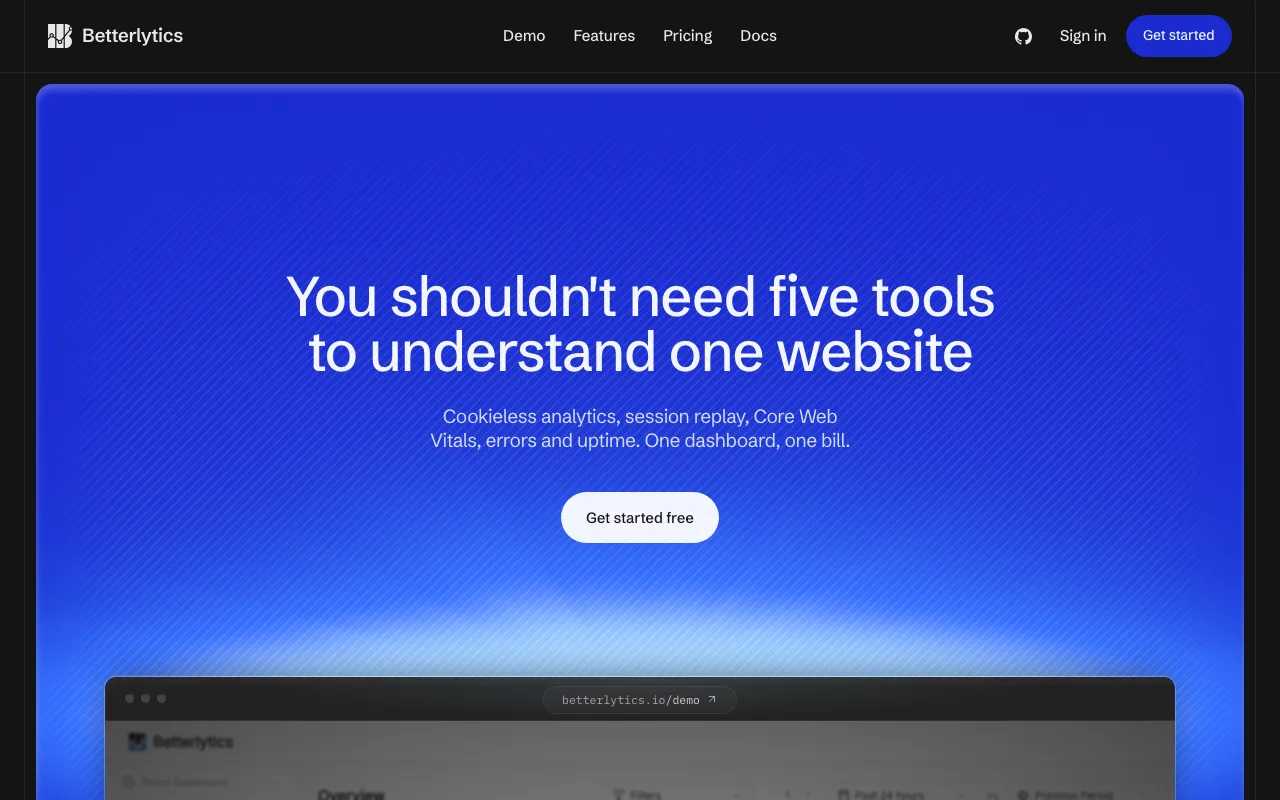
Betterlytics combines web analytics, session replay, error tracking, Core Web Vitals, and uptime monitoring in one dashboard. It offers a managed EU cloud option or self-hosted deployment.
Overview
Betterlytics is an analytics product that aims to replace a patchwork of separate traffic, replay, error, uptime, and performance tools with one dashboard on a shared data model. It tracks page views, visitors, traffic sources, devices, custom events, funnels, and real-time activity, and it is designed to operate without cookies.
Advanced capabilities described in the materials include session replay, user journeys, client-side error grouping with stack traces linked to replays, Core Web Vitals measurement in visitors' browsers, and uptime monitoring with SSL checks and public status pages. Privacy-oriented positioning covers GDPR, CCPA, and PECR readiness, data anonymization, and EU hosting for the managed service.
Teams can adopt it as a hosted cloud service or run it on their own infrastructure. Self-hosted setup is outlined as manual installation via Docker, while the cloud path is positioned for quick onboarding with automatic updates. Access controls include role-based permissions, two-factor authentication, and OAuth sign-in with providers such as Google and GitHub.
Developers integrate a lightweight tracker through a script tag or framework SDKs for stacks such as React and Next.js. The product also exposes a built-in MCP server so compatible AI clients can query traffic, funnels, errors, and uptime in natural language.
Key features
- Unified analytics dashboard
- Cookieless visitor measurement
- Session replay and journeys
- Client-side error tracking
- Core Web Vitals monitoring
- Uptime and SSL status pages
- Docker self-hosting option
- Built-in MCP query server
Use cases
- Site traffic and funnel analysis
- Debugging UX with session replay
- Correlating JS errors with sessions
- Public uptime and incident pages
- Privacy-focused analytics hosting
Does the same job as
Betterlytics doesn't name these products itself, but its own description shows it does the same job.

 Google Analytics