
Kubernetes
Open-source container scheduling and management system
Kubernetes (K8s) manages containerized applications across many hosts. It automates deployment, scaling, and ongoing operations for grouped containers.

Linux application containers for shared and HPC systems
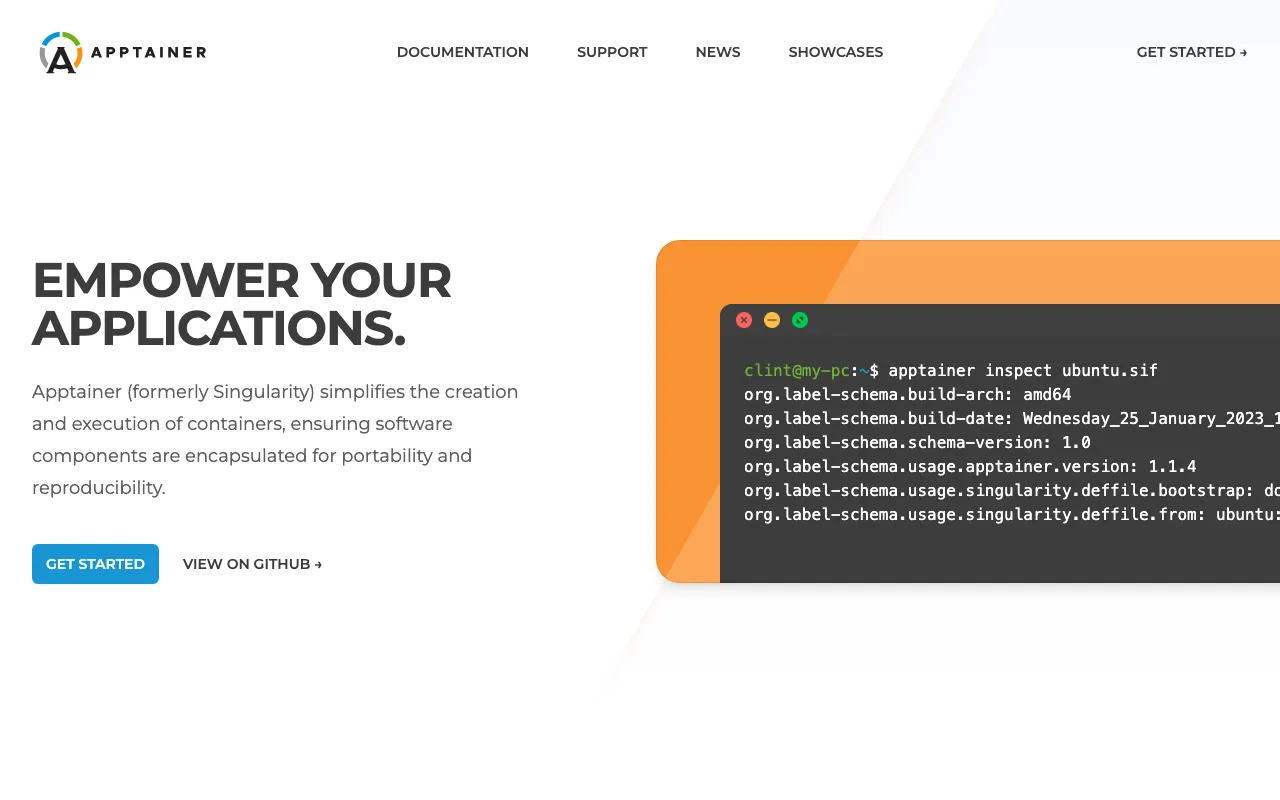
Apptainer is an open source Linux container platform aimed at simple, fast, secure workloads on shared systems and high-performance computing clusters.
Apptainer runs complex applications in containers on Linux, with emphasis on shared multi-user systems and high-performance computing environments. It was formerly known as Singularity and is developed under the Linux Foundation.
Containers use an immutable single-file SIF image format that supports cryptographic signatures and encryption. The default model favors integration over isolation: GPUs, high-speed networks, and parallel filesystems on a cluster or server remain accessible without extra wiring. The same SIF file is easy to move between workstations, HPC sites, and edge hosts.
Security is built around matching identity inside and outside the container, with unprivileged use and no extra host privilege by default. Apptainer can pull and run images from OCI registries and aims for broad compatibility with Docker Hub content so existing container images can be reused on Apptainer-oriented infrastructure.
Administrators configure the runtime for their environment; users run and build containers through documented guides. Encryption integrates with Vault and other secret-management approaches when workloads need protected models, data, or application artifacts.
Open-source container scheduling and management system
Kubernetes (K8s) manages containerized applications across many hosts. It automates deployment, scaling, and ongoing operations for grouped containers.

Compact certified Kubernetes distribution for constrained environments
K3s packages production-ready Kubernetes in a single small binary with lighter memory use, aimed at edge, IoT, CI, development, and ARM deployments.

Local Kubernetes cluster for development and learning
Minikube runs a Kubernetes cluster on macOS, Linux, and Windows. It focuses on local app development and supports common Kubernetes features via CLI controls.

Serverless functions platform for Kubernetes
OpenFaaS deploys event-driven functions and microservices on Kubernetes using OCI images, with scaling, metrics, and a UI portal.

Multi-cluster Kubernetes and container management platform
Rancher is a container management stack for running and operating Kubernetes across environments. It targets production teams that need centralized cluster control, security, and DevOps tooling.

Ansible automation for production-ready Kubernetes clusters
Kubespray deploys highly available Kubernetes clusters on public clouds, OpenStack, vSphere, or bare metal. Ansible playbooks drive installation and upgrades across many Linux distributions.