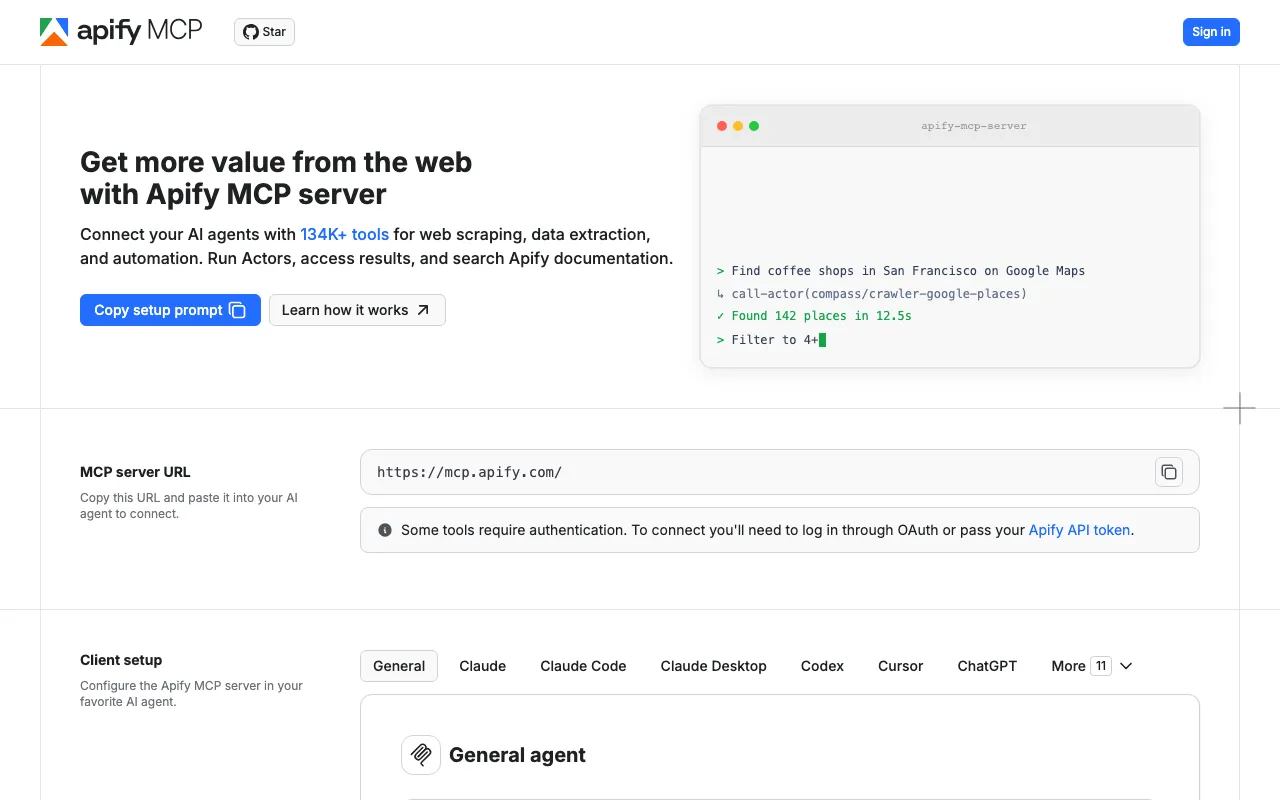
The Apify MCP server exposes Apify Store scrapers, crawlers, and automations as tools for MCP-capable AI clients. Agents can search Actors, inspect inputs and pricing, run jobs, and read dataset results through one connection.
Overview
Apify MCP turns the Apify Store catalog into callable tools so agents are not limited to a fixed set of site-specific MCP installs. A typical workflow searches the store, loads an Actor's schema and pricing, executes the run, then paginates structured output from the resulting dataset.
The hosted endpoint uses Streamable HTTP with OAuth sign-in, or clients can send a bearer API token when OAuth is unavailable. The same server can run locally over stdio via the npm package, while Actor compute and storage still execute on the Apify platform in either mode.
Default tooling covers Actor discovery, documentation search, web search and fetch helpers, and platform helpers for runs, datasets, key-value stores, tasks, and schedules. Individual Actors may register as dedicated tools built from their input schemas, and some Actors expose nested MCP tool lists.
Setup snippets are generated for clients such as Claude Code, ChatGPT, Cursor, VS Code, Copilot, and Claude Desktop. Optional configuration limits which tool categories load per session.
Key features
- Apify Store Actor search
- Actor input and pricing lookup
- Run Actors and read datasets
- Hosted OAuth MCP endpoint
- Local stdio npm server
- Web Search and Web Fetch tools
- Apify and Crawlee doc search
- Per-client tool category filtering
Use cases
- Agent-driven web scraping workflows
- SERP and e-commerce data pulls
- Lead generation through store Actors