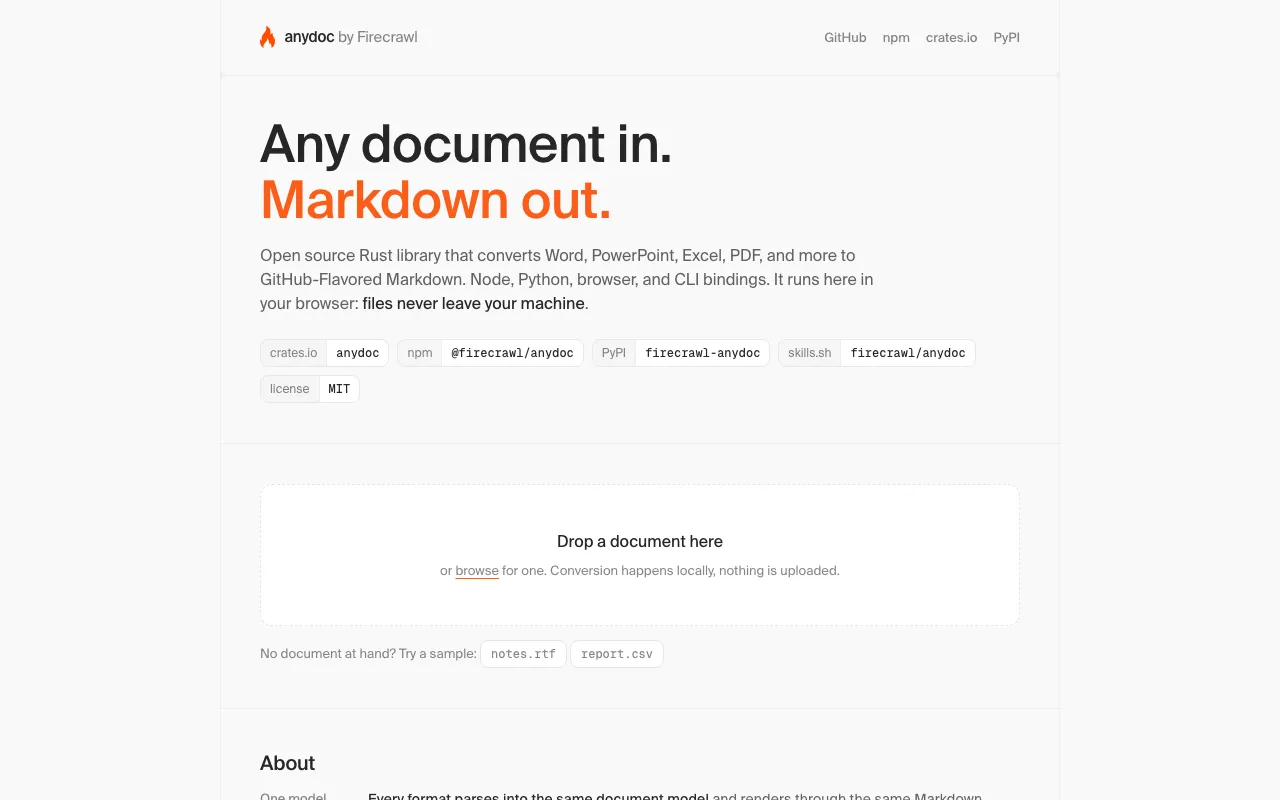
anydoc turns Word, PowerPoint, Excel, OpenDocument, RTF, EPUB, CSV, and text-based PDF files into consistent GitHub-Flavored Markdown. A Rust core ships with Node, Python, CLI, and browser WebAssembly bindings.
Overview
anydoc ingests common office and tabular formats, parses each into a shared document model, and serializes the result through one Markdown pipeline. Headings, lists, tables, footnotes, math, and embedded media therefore follow the same rules regardless of which input format produced them.
Format detection inspects file bytes—PDF headers, RTF structure, OLE streams, ZIP package metadata—so misnamed extensions still convert when the content matches. The tool preserves structural elements such as merged table cells, task lists, speaker notes, internal links, and equations exported as LaTeX-style math.
Bindings expose the same convert-from-path or convert-from-bytes API in Rust, Node, Python, a command-line tool distributed via npm, and a WebAssembly build that can run entirely in the browser. Optional hosted OCR sends only PDFs that need it to Firecrawl Parse when you enable that mode and supply an API key.
An agent skill package teaches compatible coding agents to invoke the CLI for document conversion. Errors distinguish unsupported types, encrypted files, malformed inputs, resource limits, and PDFs that require OCR.
Key features
- Unified Markdown output
- Fourteen supported formats
- Content-based format detection
- Rust core with language bindings
- CLI and browser WebAssembly
- Optional hosted PDF OCR
- OMML and MathML to LaTeX
- Agent skill integration
Use cases
- LLM ingestion pipelines
- Batch document normalization
- In-browser local conversion
- Agent-readable office files
- Mixed-format archive processing



 Claude Code